
STEADI: Intervene
Emergency Flood Preparedness Checklist for Seniors
Generic flood checklists miss the deadliest senior hazard in a flood: falling. This plan-ahead checklist for seniors and caregivers covers flood-risk awareness, a senior-specific go-kit, an alert and support network, and a six-month refresh cadence — with fall prevention built into every stage.
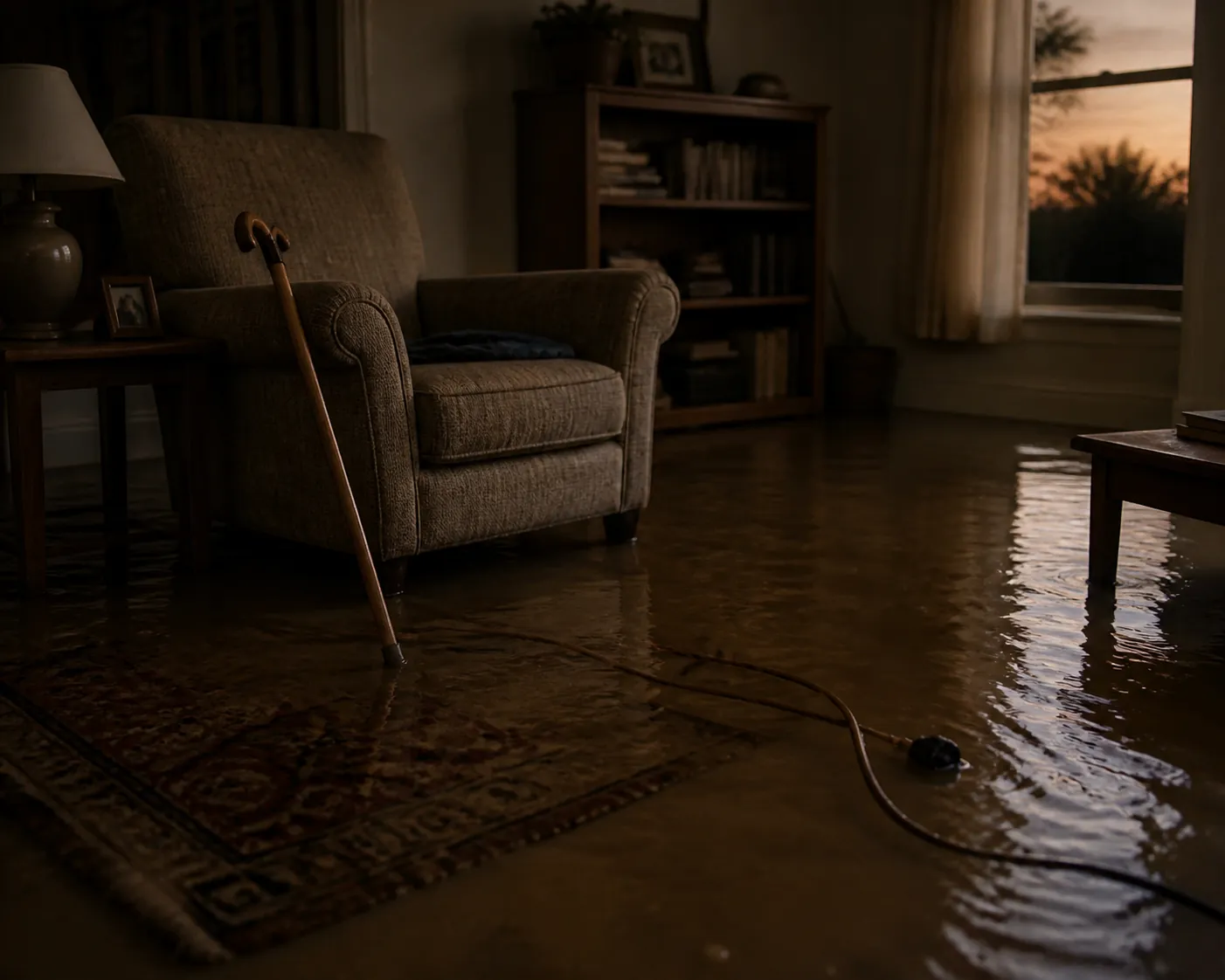
The first flood rule for an older adult is a fall-prevention rule: do not step into moving water. Six inches of fast-moving water can knock over an adult; 12 inches can carry away many cars. That changes the meaning of “just get across the driveway” or “just reach the mailbox.” In a flood, a short walk can become a fall, and a fall can become the reason someone cannot get out at all.[3][4]
That is why an emergency flood preparedness checklist for seniors cannot be a generic storm list with “medications” added near the end. It has to assume wet floors, low light, displaced furniture, dead phones, blocked exits, missing glasses, a walker that does not roll through water, and a caregiver who may not be able to drive across town once roads close.
The age pattern is not a small footnote. AARP reported that adults 50 and older accounted for 59% of U.S. flash and river flood deaths in 2024, using National Weather Service fatality data.[1][2] That statistic should not scare an older adult out of living independently. It should make the plan more honest about what actually fails: footing, lighting, transportation, communication, and timing.
The checklist at a glance
Print this part if you are planning with a parent, spouse, neighbor, or client. The details underneath matter, but the order matters too. The safest time to solve transportation, medication, lighting, and support problems is before anyone is standing in water.
| Planning step | What to decide before flood season | Fall-prevention reason |
|---|---|---|
| Check the home’s flood risk | Look up the address, know the evacuation routes, and avoid waiting until a named storm is close. | A person with slower walking speed or limited balance needs more lead time. |
| Build a senior-specific go-kit | Pack medications, assistive items, water, lighting, documents, and comfort items where they can actually be reached. | A kit that requires bending, climbing, searching, or stepping over clutter is not ready. |
| Create an alert and support network | Name who calls, who drives, who has the key, and what happens if cell service fails. | An older adult should not have to improvise transportation or help after roads begin flooding. |
| Make a short home hazard pass | Clear the path from bed to bathroom, chair to exit, and exit to vehicle; move cords and loose rugs. | Floodwater, darkness, and hurried movement turn ordinary clutter into trip hazards. |
| Set during-flood movement rules | Do not walk or drive through floodwater; obey evacuation orders; move to higher ground early when told. | Six inches of moving water is enough to knock an adult down. |
| Plan for after the water recedes | Keep the older adult out of muddy, dark, debris-filled rooms until the space is checked. | Cleanup injuries often start with a slip, a hidden object, or a rushed first inspection. |
| Refresh every six months | Check medications, batteries, documents, helpers, transportation, and practice the communication plan. | A plan that worked last year may not fit this year’s walking, vision, hearing, or driving situation. |
Start with the address, not the closet bin
Before buying another flashlight, look up the home’s flood risk. FEMA’s Flood Map Service Center lets you search an address and view flood map information for that location.[6] This is not a substitute for local emergency alerts, and it does not tell you whether a specific storm will flood a specific street. It does give a caregiver and an older adult a better starting point than memory or neighborhood rumor.
Write down three things after checking the address: the nearest higher-ground destination, the main evacuation route, and the backup route if the usual road floods. If the older adult does not drive, write the driver’s name beside each route. “Someone will come” is not a transportation plan.
This is also the time to check insurance, not when water is in the forecast. The National Flood Insurance Program says most flood insurance policies have a 30-day waiting period before coverage takes effect, with limited exceptions.[7] Keep this check modest: the point here is not to become a floodplain expert. It is to avoid discovering too late that a homeowner’s or renter’s assumption was wrong.
If the home has a history of water intrusion, ask a qualified professional about electrical risk before the season starts. CDC flood guidance includes raising electrical components at least 12 inches above the projected flood elevation.[5] For an older adult, that recommendation is not only about property protection. It is also about avoiding a dark, wet house where someone is tempted to step around cords, outlets, and appliances in unsafe conditions.
Pack the go-kit for the person who will use it
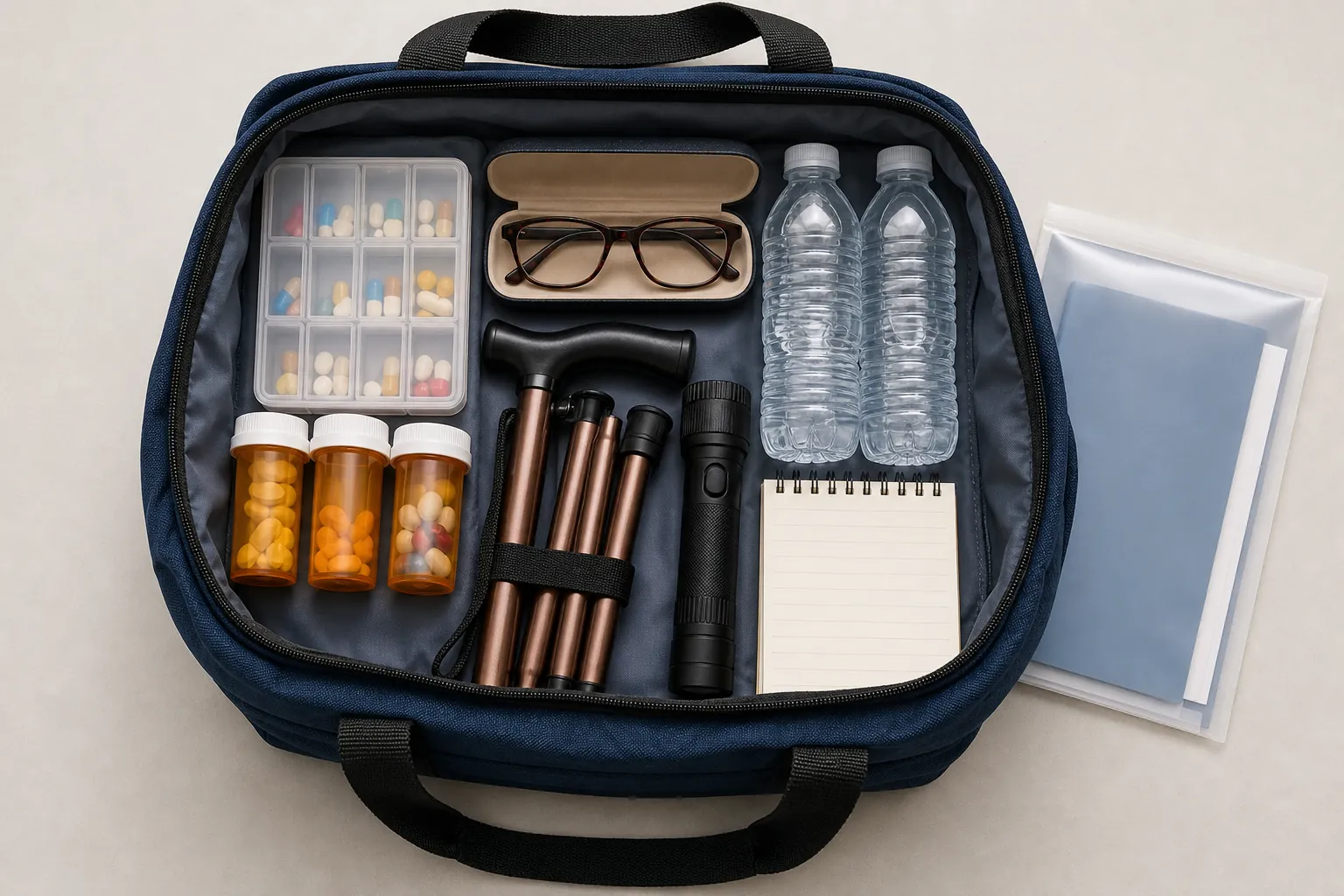
A senior go-kit should be easy to lift, easy to open, and stored where the older adult or helper will naturally look. A heavy plastic tub on a high garage shelf may satisfy a checklist and still be useless at 2 a.m. A soft zippered tote near the usual exit, with a smaller medication pouch inside, is often more realistic.
Medication guidance varies by source, so it should be written clearly rather than turned into one fake universal rule. The Red Cross recommends that older adults have at least a 30-day supply of medications and medical supplies, and it specifically includes extra assistive items such as glasses, hearing aids, and mobility devices in preparedness planning.[8] California Department of Aging disaster tip sheets use a 10-day medication supply frame for power outages.[9] If insurance refill limits make this hard, the practical step is to ask the prescriber or pharmacist what can legally and safely be staged ahead of flood season.
Water guidance should be just as specific. CDC recommends at least 1 gallon of water per person per day and a 3-day supply.[5] For a person who uses thickened liquids, has swallowing issues, or needs water for medical equipment, that estimate may need a clinician’s review. Do not store the only water in a place that requires stairs, a step stool, or walking through the garage in the dark.
The assistive items are not “extras.” Spare eyeglasses can be the difference between seeing the edge of a rug and catching a toe under it. A backup cane, walker tips, hearing aid batteries, a magnifier, dentures, incontinence supplies, and a written medication list all protect movement. If the usual cane is beside the recliner but the evacuation bag is by the door, put a spare cane by the bag or make the cane part of the exit routine.
- Medication list with dosage, prescriber, pharmacy, allergies, and emergency contacts.
- Medication and medical-supply reserve, using the source-specific guidance above and the person’s refill rules.
- Spare eyeglasses, hearing aid batteries, denture supplies, cane or walker accessories, and any daily-use assistive item that would be hard to replace quickly.
- Water stored at reachable height, not behind boxes or up a flight of stairs.
- Flashlight, extra batteries, and a plug-in night-light with battery backup if the home uses them safely.
- Copies of identification, insurance cards, advance directives if used, key medical documents, and a waterproof pouch for originals that must travel.
- A written contact sheet because a dead phone should not erase every phone number.
- A small notepad and pen for shelter instructions, medication changes, or a caregiver’s arrival time.
Lighting belongs in the go-kit discussion because floods often bring power problems, and poor lighting is a fall hazard before it is an inconvenience. Keep one flashlight where the older adult wakes up, one near the main exit, and one in the kit. For more detail on safe battery lighting and cleared nighttime paths, use the power-outage fall-proofing checklist.
Build the alert and support network before anyone is rushed
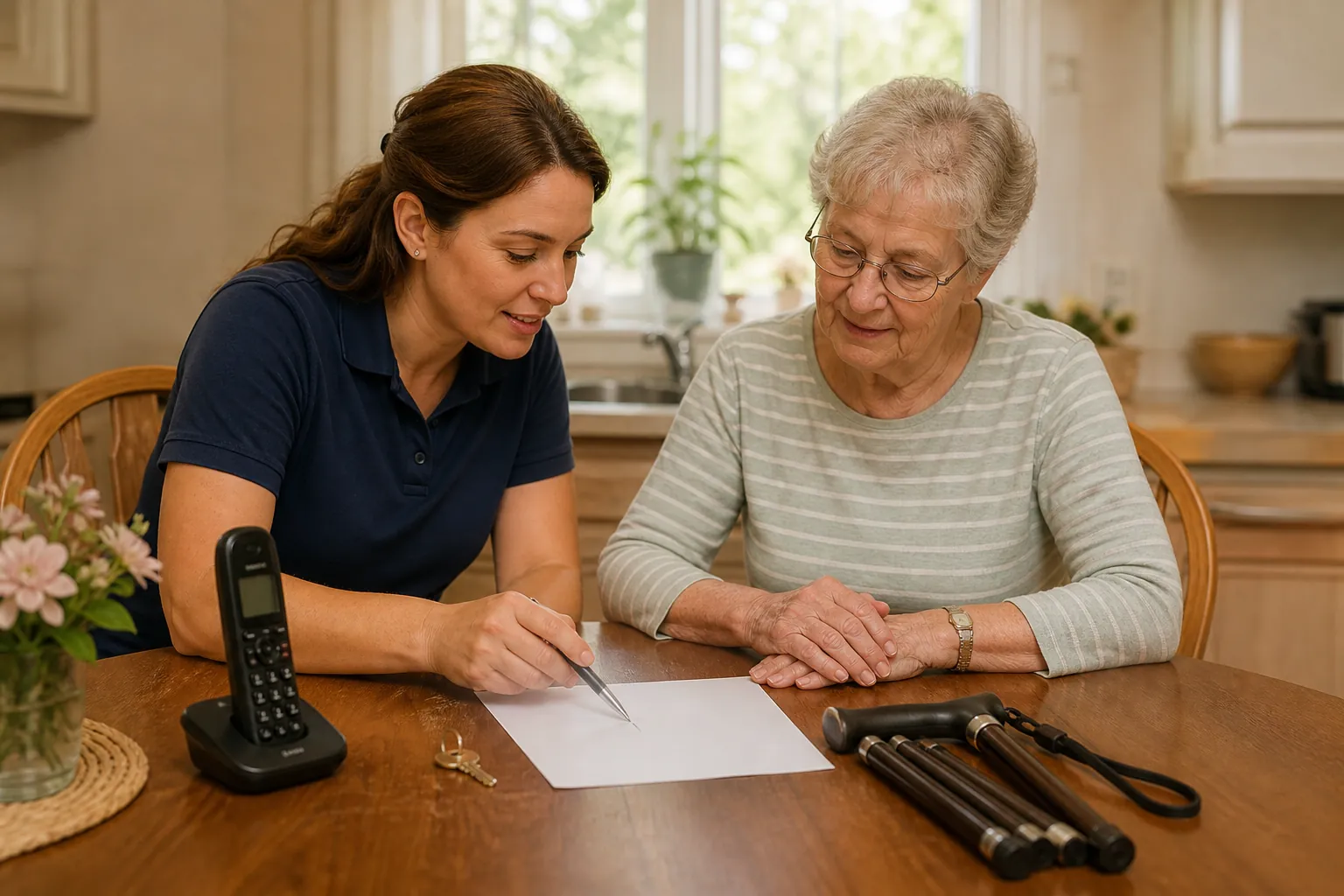
The support network is where many neat checklists fail older adults. A flood alert is only useful if the person hears it, understands what action it requires, and has a way to act without walking through unsafe conditions. Ready.gov’s older-adult guidance tells people to make a plan that includes transportation, evacuation help, and a support network.[10]
Make the network visible on paper. Put one copy on the refrigerator, one in the go-kit, and one with the primary caregiver. If the older adult dislikes feeling managed, frame it as a household directory rather than a control document. The question is not who is in charge of the parent. The question is who has already agreed to do which task.
- Alert person: who checks weather alerts and calls the older adult first.
- Backup alert person: who calls if the first person is unreachable.
- Driver: who can transport the older adult, walker, wheelchair, oxygen equipment, pet, and go-kit.
- Key holder: who has a spare key or knows the lockbox code.
- Medication helper: who can read labels, bring the medication pouch, and communicate the medication list if the older adult is stressed.
- Out-of-area contact: who can receive updates if local lines are jammed.
- Neighbor check-in: who can knock on the door if roads are still safe and the phone is not answered.
Do not leave transportation as a friendly promise. If a walker folds, practice putting it in the actual car. If a wheelchair needs a ramp, confirm the driver has access to a suitable vehicle. If the older adult uses oxygen or other powered equipment, decide what travels, what stays, and who knows how to handle it. These are awkward details at the kitchen table and much worse in a driveway under rain.
Also decide what happens if cell service fails. Printed numbers, a landline if the home still has one, a neighbor’s doorbell, an out-of-area contact, and a prearranged “if I cannot reach you by this time” rule all reduce improvisation. For a deeper communication plan, use the cell-service-down caregiver checklist.
Evacuation orders deserve plain language. CDC flood guidance says not to ignore evacuation orders.[5] For an older adult with balance or mobility limits, leaving early is not overreacting; it is what keeps evacuation from becoming a wet, dark, hurried transfer. If the household needs more detail on timing, mobility-aid limits, and when not to attempt a route, use the flash-flood evacuation steps for seniors.
Do one short home hazard pass
The home does not need to look staged for a safety brochure. It needs a clear route from the places the older adult actually uses: bed to bathroom, favorite chair to exit, kitchen to phone, exit to vehicle. Flood planning has to assume low light and stress, not careful daytime walking.
- Move charging cords, extension cords, and oxygen tubing out of walking paths.
- Remove loose rugs or tape down edges before storm season.
- Keep shoes with firm soles by the bed and near the main exit.
- Store the go-kit where it does not block the exit route.
- Move the flashlight to the first place the person will reach, not the place a visitor thinks is tidy.
- Keep a chair near the exit if the older adult may need to sit while putting on shoes or waiting for help.
Keep this pass short. For the detailed pass through bedroom, bathroom, kitchen, living room, entryway, and garage, use the room-by-room flood safety checklist for elderly parents.
If water is already rising
At this point the checklist gets shorter, because the choices should already be made. Follow official alerts. Leave when told. Do not drive around barricades. Do not walk through floodwater to retrieve a car, trash bin, package, pet bowl, or keepsake. The six-inch rule is not a metaphor; it is a balance rule.[3][4]
If the older adult is still at home and has not been told to evacuate, move the go-kit, phone, shoes, flashlight, assistive device, and written contact sheet together. Keep the walking path dry and lit as long as possible. If water is entering the home or the person cannot move safely, call emergency services rather than asking a neighbor or family member to enter floodwater.
A caregiver who is far away should resist giving instructions that require the older adult to test the depth of water, cross a yard, or go into a garage. The safer job is to keep the person connected, confirm location, relay official instructions, and activate the local support person named in the plan.
After the water recedes, do not make the older adult the first inspector
The house may look familiar from the doorway and still be unsafe underfoot. Mud, buckled flooring, swollen rugs, loose cords, broken glass, shifted furniture, and poor lighting can turn the first walk-through into the next emergency. If there is any question about electrical safety, structural safety, contaminated water, or gas, wait for appropriate local guidance and qualified help.
Cleanup has its own fall risks: carrying wet items, stepping over debris, bending repeatedly, and working while tired. Older adults who want to help should be given safer seated tasks when possible, such as sorting dry documents, making calls, or reviewing medication needs. For a broader post-disaster cleanup safety pass, see the cleanup fall-safety guide for seniors.
Refresh the plan every six months
The Red Cross recommends that older adults review, practice, and refresh emergency plans every six months.[8] That cadence is useful because aging-in-place plans change quietly. A person may still live in the same home but walk more slowly, hear alerts less reliably, use a different pharmacy, stop driving at night, or need a different mobility aid.
- Check medication dates, refill rules, and the written medication list.
- Replace expired food, water, batteries, and medical supplies.
- Test flashlights and battery-backed lights.
- Confirm that spare eyeglasses, hearing aid supplies, cane tips, walker accessories, and other assistive items still match current needs.
- Call each helper and confirm the role, phone number, address, key access, and transportation plan.
- Practice the communication plan, including what happens if cell service is down.
- Walk the exit route in daylight and again with low light, removing anything that catches a foot or blocks a mobility aid.
- Recheck the FEMA flood map information and local emergency-management instructions before storm season.
A senior flood checklist is not simply a longer supply list. It is a different way of organizing the plan. If it does not reduce the chance that an older adult will be knocked down, stranded without support, or forced to improvise in a dark, wet home, it is not yet senior-specific.
References
- Older Adults Among Texas Flood Victims, AARP
- 2024 Flood Fatalities, National Weather Service
- Turn Around Don't Drown, National Weather Service
- Flood Safety, American Red Cross
- Flood Safety, Centers for Disease Control and Prevention
- FEMA Flood Map Service Center, Federal Emergency Management Agency
- Flood Insurance Waiting Periods, National Flood Insurance Program
- Older Adults, American Red Cross
- Disaster Tip Sheets, California Department of Aging
- Older Adults, Ready.gov
Related reading
Noticed something outdated or inaccurate on this page? Flag a correction. We review every report against CDC, NIA, and AARP HomeFit guidance before updating a page.
Part of the Fall Prevention section.