
Room checklist
The Family Caregiver's Guide to Planning an Aging-in-Place Remodel: From Assessment to Contractor to Completion
A structured five-step process for adult children planning home modifications for a parent — covering professional assessments, prioritizing by fall risk, realistic budgeting, hiring CAPS-certified contractors, and phasing work over time to reduce costs and stress.
Why Most Families Start After a Crisis — and How to Do It Differently
If you are reading this, there is a good chance the conversation started the hard way — after a fall, a new diagnosis, or a hospital discharge that made it clear your parent's home is no longer safe. You are not alone in that starting point. According to U.S. Census Bureau data cited by RubyHome, only 1 in 10 U.S. homes currently has the accessibility features needed to support aging in place. The other 90 percent are what the industry calls "aging ready" — meaning they have steps at every entrance, standard-height toilets, narrow doorways, and bathtubs with high walls to step over.
The default response to this gap is reactive: a rushed call to a general contractor, a quick grab-bar installation that may or may not be anchored to a wall stud, and a bill that feels too high for what was done. That approach costs more in the long run — both in money and in missed opportunities to make the home genuinely functional for the years ahead.
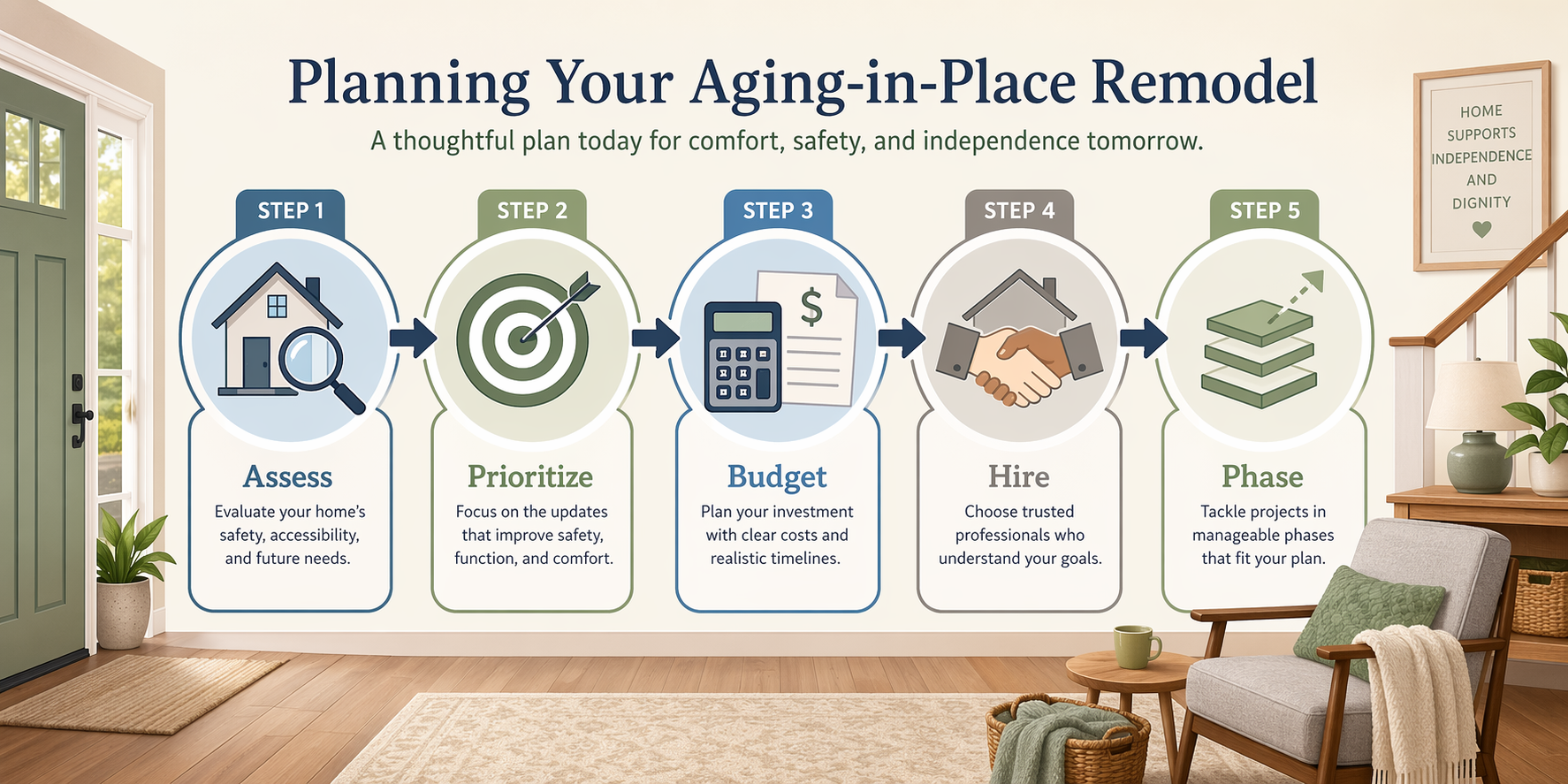
A better path exists. It follows five sequential steps that move from understanding what your parent actually needs, to prioritizing the most dangerous risks, to budgeting realistically, to hiring the right professional, and finally to executing the work in a logical order. This guide walks you through that process, drawing on evidence from occupational therapy practice, NAHB construction standards, and the experience of families who have done it before you.
Step 1: Start With a Professional Home Safety Assessment
The single most common mistake families make is calling a contractor before they have a clear picture of what needs to change. A contractor can give you a price for a walk-in shower, but a contractor is not trained to evaluate how your parent moves through the bathroom, whether their balance is sufficient for a transfer, or which specific combination of grab bar height and location will actually prevent a fall.
That kind of assessment is the domain of an occupational therapist (OT) or a Certified Aging-in-Place Specialist (CAPS). An OT evaluation typically covers:
- How your parent transfers in and out of the shower, tub, and bed
- Whether existing furniture and layout create obstacles or support stability
- Which specific grab bar heights, toilet heights, and shower configurations match their body mechanics
- Lighting adequacy, trip hazards, and flooring transitions that may not be obvious to an untrained eye
- Cognitive factors — can they remember to use a grab bar? Will a complex shower control confuse them?
Many health insurance plans cover occupational therapy evaluations, including the home safety assessment component. ElderLife Financial notes that an OT assessment is often covered before any contractor work begins, making it one of the lowest-cost and highest-value steps you can take.
For a deeper look at what an OT assessment covers and how to request one, see our Occupational Therapist's Guide to Aging-in-Place Home Modifications.
Step 2: Prioritize Modifications by Fall Risk — Bathroom First
Once you have a professional assessment in hand, the next step is deciding what to do first. The data is unambiguous about where to start. According to the National Center for Injury Prevention and Control, 35.7 percent of fall injuries in older adults occur in the bathroom. That is more than any other single room in the house. The combination of wet, hard surfaces, the need to step over a tub wall, and the absence of something to grab onto makes the bathroom the most dangerous room by a wide margin.
The NAHB CAPS checklist provides specific construction benchmarks for each room. For the bathroom, the critical specifications include:
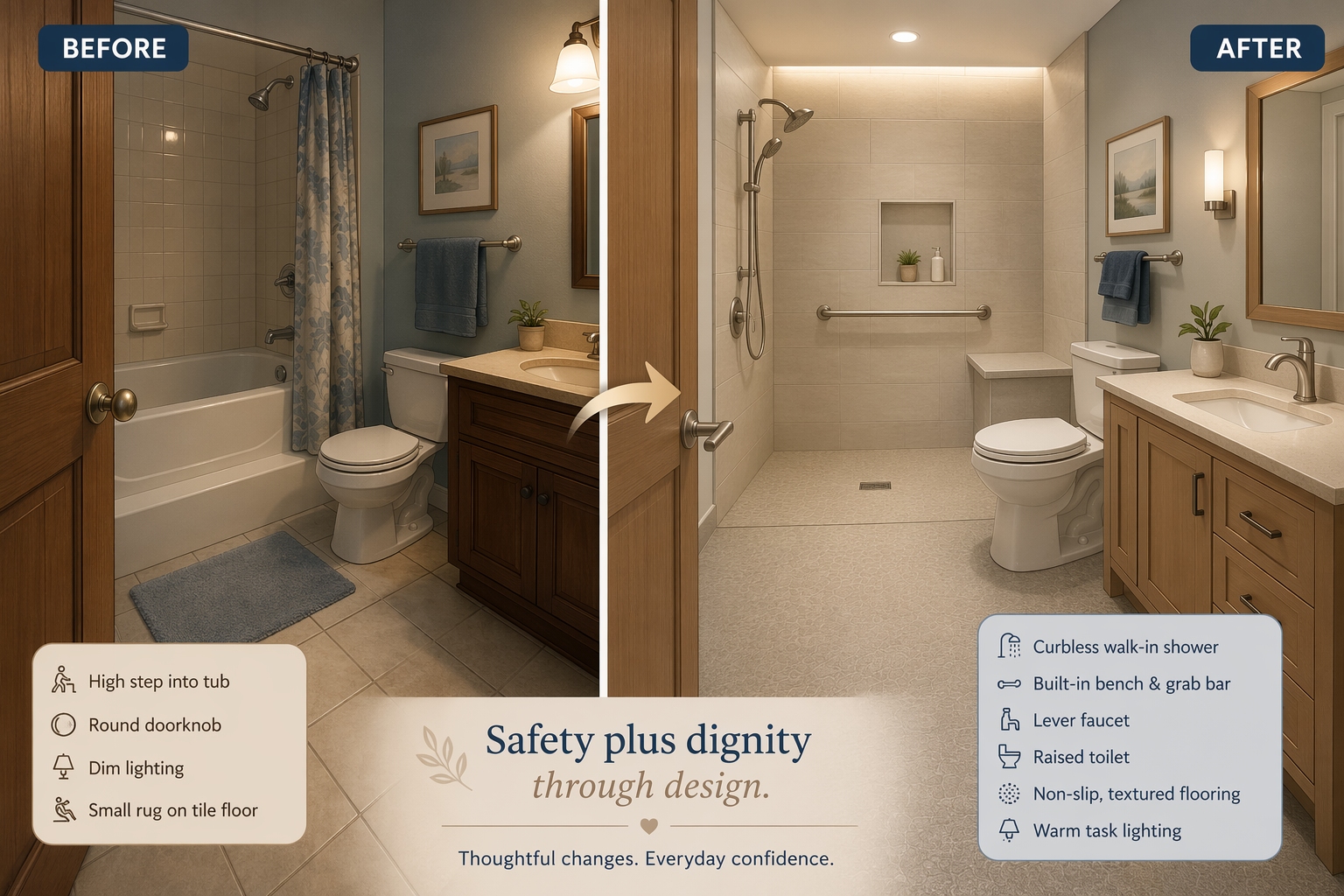
- A 60-inch turning radius or acceptable T-turn space for wheelchair or walker access
- Wall blocking around the tub, shower, toilet, and shower seat that can support 250–300 pounds for grab bar installation
- A curbless shower with a minimum width of 36 inches
- A toilet height of 17–19 inches (roughly 2.5 inches higher than a standard toilet)
- Non-slip flooring throughout
After the bathroom, the next priorities are the entryway (zero-step entry or ramp), the kitchen (accessible counters and pull-out shelving), and the bedroom (clear path to the bathroom, adequate lighting). The table below summarizes the priority order and the primary risk each area addresses.
| Priority | Area | Primary Risk | Key Modification |
|---|---|---|---|
| 1 | Bathroom | 35.7% of fall injuries | Curbless shower, grab bars, raised toilet |
| 2 | Entryways | Trip hazard at threshold | Zero-step entry or ramp |
| 3 | Kitchen | Reaching and carrying hazards | Pull-out shelves, lever faucets |
| 4 | Bedroom | Nighttime bathroom trips | Clear path, motion-activated lighting |
| 5 | Stairs | Loss of balance on steps | Handrails both sides, contrast strips |
For a detailed breakdown of bathroom-specific modifications, see our Contractor's Guide to a Bathroom Remodel That Actually Prevents Falls.
Step 3: Budget Realistically — From Low-Cost Fixes to Full Remodels
Cost is the number one barrier families cite when delaying home modifications. The good news is that not everything needs to happen at once, and many of the highest-impact safety improvements are surprisingly affordable. The table below breaks down the cost ranges for common modifications using data from Forbes, NerdWallet, ElderLife Financial, and 3 Birds Accessibility (2024–2026).
| Modification | Low-End Cost | High-End Cost | Notes |
|---|---|---|---|
| Grab bars (standard) | $15 | $80 | Per bar; professional installation adds $100–$400 |
| Grab bars (floor-to-ceiling tension) | $140 | $300 | No wall blocking needed; good for rentals |
| Lever-style door handles | $25 | $75 | Per handle; easy DIY swap |
| Handheld showerhead | $30 | $100 | Includes hose and bracket |
| Raised toilet seat | $40 | $150 | Adds 2–4 inches to seat height |
| Motion-activated nightlights | $15 | $50 | Per unit; plug-in or hardwired |
| Walk-in shower conversion | $6,000 | $12,000 | Custom design; prefab under $1,000 |
| Stair lift (straight staircase) | $2,500 | $8,000 | Installed; curved starts at ~$10,000 |
| Door widening (per doorway) | $600 | $2,000 | Requires 36-inch door for 32-inch clear width |
| Wheelchair ramp (modular aluminum) | $1,100 | $3,600 | Average $2,300; portable ramps $175–$500+ |
| Full home aging-in-place remodel | $15,000 | $60,000+ | National average ~$9,500 for partial remodels |
The national average for an aging-in-place remodel is approximately $9,500, according to RubyHome, with most homeowners spending between $3,000 and $15,000. A full home-wide remodel can reach $50,000 or more. The key insight from the data is that proactive planning saves money. A grab bar installed during a bathroom renovation costs a fraction of what it costs to add blocking and install one after the tile is already in place. The Custom Home blog notes that retrofitting grab bar blocking after walls are finished costs $500–$1,500 per location, compared to essentially nothing if planned during construction.
Step 4: Hire a CAPS-Certified Contractor — What to Look For and Ask
Not all contractors are equipped to do aging-in-place work correctly. A general contractor may be excellent at kitchen remodels but unfamiliar with the specific requirements for grab bar blocking (250–300 pound load capacity), curbless shower slopes, or the turning radius needed for a wheelchair. That is where a Certified Aging-in-Place Specialist (CAPS) credential matters.
CAPS certification is offered by the National Association of Home Builders (NAHB) in partnership with the AARP. It requires training in universal design, building codes for accessibility, and the specific needs of aging adults. A CAPS-certified contractor understands that a 36-inch door is not just a width — it is the minimum clear opening for a wheelchair, which requires a 36-inch door slab and proper hinge placement.
To find a CAPS contractor near you, use the NAHB CAPS directory. When interviewing candidates, ask these questions:
- "How many aging-in-place projects have you completed in the past year?" (76% of remodelers report increased demand, per NAHB — you want someone with recent, relevant experience.)
- "Can you show me examples of curbless shower installations with proper slope and waterproofing?"
- "How do you handle wall blocking for grab bars? Do you use plywood blocking or metal reinforcement?"
- "Will you provide an itemized quote that separates materials, labor, and permits?"
- "Do you coordinate with occupational therapists or other healthcare providers on your projects?"
For a comprehensive guide to vetting and hiring a CAPS specialist, see our Complete Guide to Hiring a CAPS-Certified Aging-in-Place Specialist. If you are still deciding between a CAPS contractor, a general contractor, or an occupational therapist, our CAPS vs. General Contractor vs. Occupational Therapist comparison can help you understand the differences.
Step 5: Phase the Work Over Time — Do Highest-Safety Items First
Few families can afford to write a single check for a $50,000 full-home remodel. The good news is that you do not need to. Phasing the work over months or even years is not only financially practical — it also gives your parent time to adjust to each change before the next one arrives.
A sensible phasing plan follows the same priority order established in Step 2:
| Phase | Timeline | Modifications | Estimated Cost |
|---|---|---|---|
| Phase 1: Immediate safety | Week 1–2 | Grab bars, motion-activated nightlights, lever handles, non-slip bath mats, raised toilet seat | $200–$1,000 |
| Phase 2: High-risk rooms | Month 1–3 | Walk-in shower conversion, comfort-height toilet, non-slip flooring in bathroom and kitchen | $6,000–$15,000 |
| Phase 3: Access and mobility | Month 3–6 | Stair lift or ramp, doorway widening, handrails on both sides of stairs | $3,000–$12,000 |
| Phase 4: Long-term structural | Month 6–12 | First-floor bedroom/bathroom addition, full kitchen remodel, home elevator | $15,000–$60,000+ |
This phased approach has a second benefit: it lets you observe how your parent actually uses the new features before committing to the next round of changes. A grab bar in the shower may reveal that a fold-down shower seat is also needed. A raised toilet may make it clear that a bidet attachment would further improve independence.
For a broader framework on creating a comprehensive aging-in-place plan that integrates modifications with monitoring technology and care services, see our Staged Decision Framework for Aging in Place.
How to Talk to a Reluctant Parent About Home Modifications
The technical side of remodeling is straightforward compared to the emotional side. Many older adults resist home modifications because they see them as symbols of decline — proof that they can no longer manage on their own. That resistance is not stubbornness; it is a reasonable emotional response to a loss of autonomy.
Eve Hill, a CAPS specialist and co-founder of Customized Aging, recommends starting the conversation with empathy. As she told Forbes Health: "Let them know that they're not alone and you're going to do everything you can to make sure they can stay where they want to stay." The key is to frame modifications as tools for preserving independence, not as evidence that independence is already lost.
Common objections and how to address them:
- "I don't need that yet." — Point out that the best time to install a grab bar is before you need it. Rushed jobs after a fall are more expensive and offer fewer choices.
- "It will make the house look like a hospital." — Modern aging-in-place design uses residential materials and finishes. A curbless shower with a linear drain looks like a spa, not an institution.
- "We can't afford it." — Start with Phase 1 items (under $1,000) and explore funding options (see next section). Many modifications qualify as tax-deductible medical expenses.
- "I don't want to be a burden." — Reframe: modifications reduce the burden on everyone. A grab bar means they do not need to call you every time they shower.
Funding Pathways: Tax Deductions, Grants, VA Benefits, and More
The cost of modifications is often the biggest source of anxiety for families. The good news is that multiple funding pathways exist, and many families qualify for at least one of them. The table below summarizes the major options.
| Funding Source | What It Covers | Key Eligibility | Maximum Amount |
|---|---|---|---|
| IRS Medical Expense Deduction | Modifications prescribed for medical necessity (ramps, grab bars, widened doorways, etc.) | Costs exceeding 7.5% of adjusted gross income | Full cost if property value not increased (IRS Pub 502) |
| VA HISA Grant | Ramps, doorway widening, walk-in tubs, grab bars | Veteran enrolled in VA healthcare | $6,800 (service-connected); $2,000 (non-service-connected) |
| VA SAH Grant | Construct, buy, or modify adapted home | Severe service-connected disabilities (loss of use of both hands, severe respiratory injuries, etc.) | Varies by eligibility tier |
| USDA Section 504 | Health/safety hazard removal, home repairs | Homeowner 62+, very low income, rural area | $10,000 grant; $40,000 loan |
| Medicaid Money Follows the Person | Ramps, bathroom mods, stairlifts, doorway widening | Transitioning from nursing home back to home | Varies by state |
| Rebuilding Together | Free home repairs for eligible seniors | Income-qualified, typically 60+ | Varies by local affiliate |
| Area Agency on Aging (AAA) | Referrals, sometimes direct funding for minor repairs | 60+ (varies by local office) | Varies by location |
| HUD Title 1 Property Improvement Loan | Home repairs and improvements | Homeowner with equity | $25,000 (unsecured); $60,000 (secured) |
For a deeper dive into each funding option, including step-by-step application guidance, see our Guide to Grants, Loans, and Assistance Programs and our updated 2026 funding resource.
Related reading
Need a professional assessment?
Find a CAPS-credentialed professional or local aging services through our outbound resource list — we never name or rank individual contractors.
Find Local HelpNoticed something outdated or inaccurate on this page? Flag a correction. We review every report against CDC, NIA, and AARP HomeFit guidance before updating a page.