
STEADI: Intervene
Severe Weather Prep Checklist to Prevent Senior Falls
Work through the room-by-room steps that make an older adult's home fall-safe before severe weather arrives, since dark rooms, wet floors, ice, and storm-supply clutter cause most preventable injuries. Includes a senior-specific supply kit, hazard-by-hazard tables, and the 72-hour post-storm fall watch.
A severe weather preparedness checklist for seniors should start with the floor, not the forecast. For many older adults, the injury that sends everyone scrambling is not caused by wind, rain, snow, or heat itself. It happens when the power fails, the hallway goes dark, the bathroom floor is damp, the front steps ice over, or storm supplies end up stacked where a walker needs to turn.
That is why this checklist treats fall prevention as the main job. The CDC reports that one in four older adults falls each year, more than 14 million people, and that falls are the leading cause of injury-related death for adults 65 and older. The CDC also reports a 21% increase in the age-adjusted older-adult fall death rate from 2018 to 2024, with the 2024 figure marked provisional as of its publication date.[1] NCOA puts the annual burden in plainer household terms: older-adult falls lead to 3 million emergency room visits and 1 million hospitalizations each year.[2]
The useful question before storm season is not “Do we have supplies?” It is: can this home still be walked through safely when routines break, lighting disappears, floors get wet, and the person living there is tired, worried, or rushing to the bathroom?
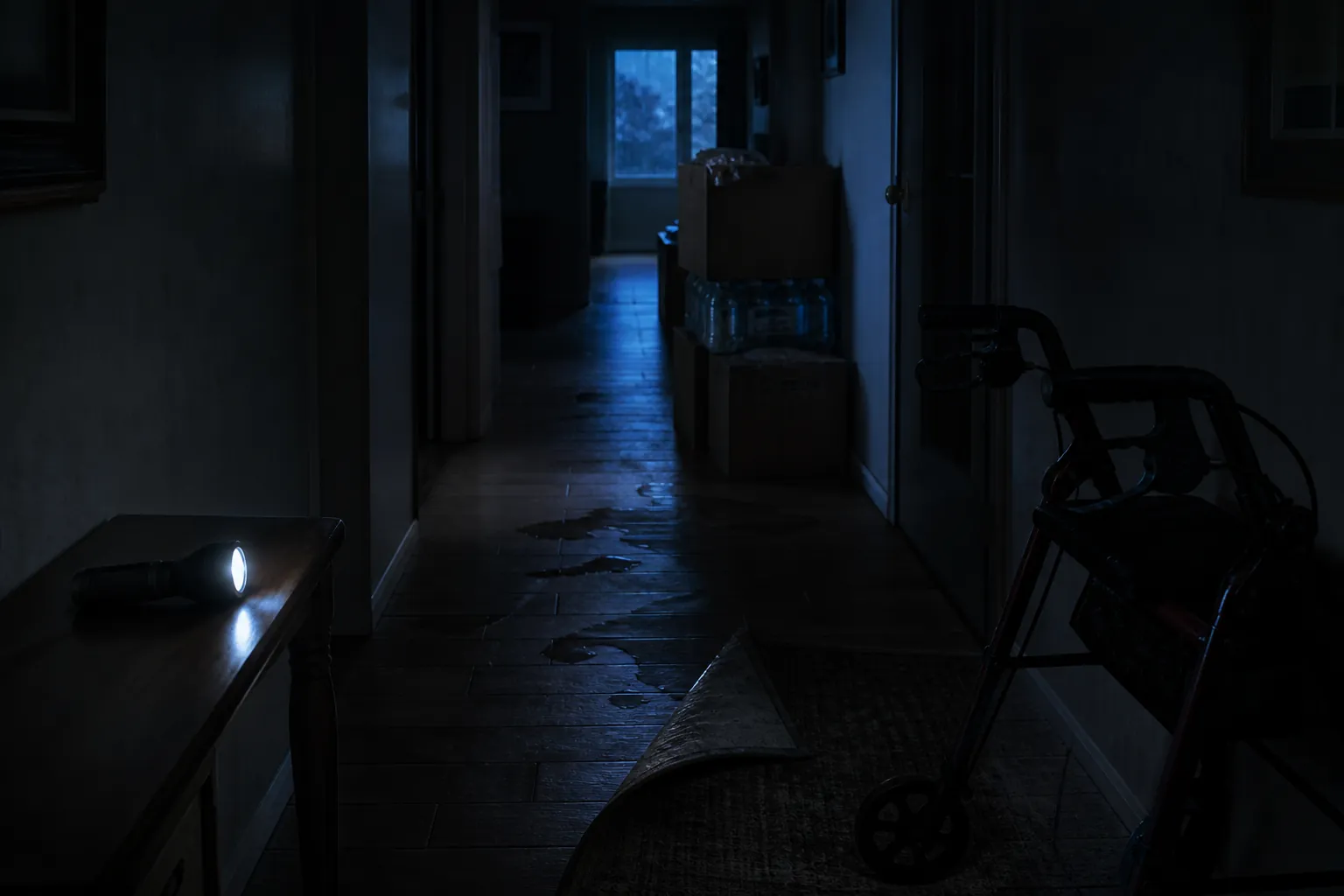
The two-hour room-by-room fall sweep
Do this before the warning phase, while there is still time to move things without hurry. Set a timer for two hours if that helps keep the work practical. You are not remodeling the home. You are removing the hazards that become worse when the house is dark, wet, cold, hot, or crowded with supplies.
Walk the house in the same direction the older adult actually moves through it: from the entrance, through halls and stairs, into the bathroom, bedroom, kitchen, and living areas, then to medication storage, device charging, and exterior paths. If the person uses a cane, walker, wheelchair, oxygen tubing, or a bedside commode, bring that equipment through the route with you. A path that looks clear to a visitor can still be too narrow for the device used at 2 a.m.
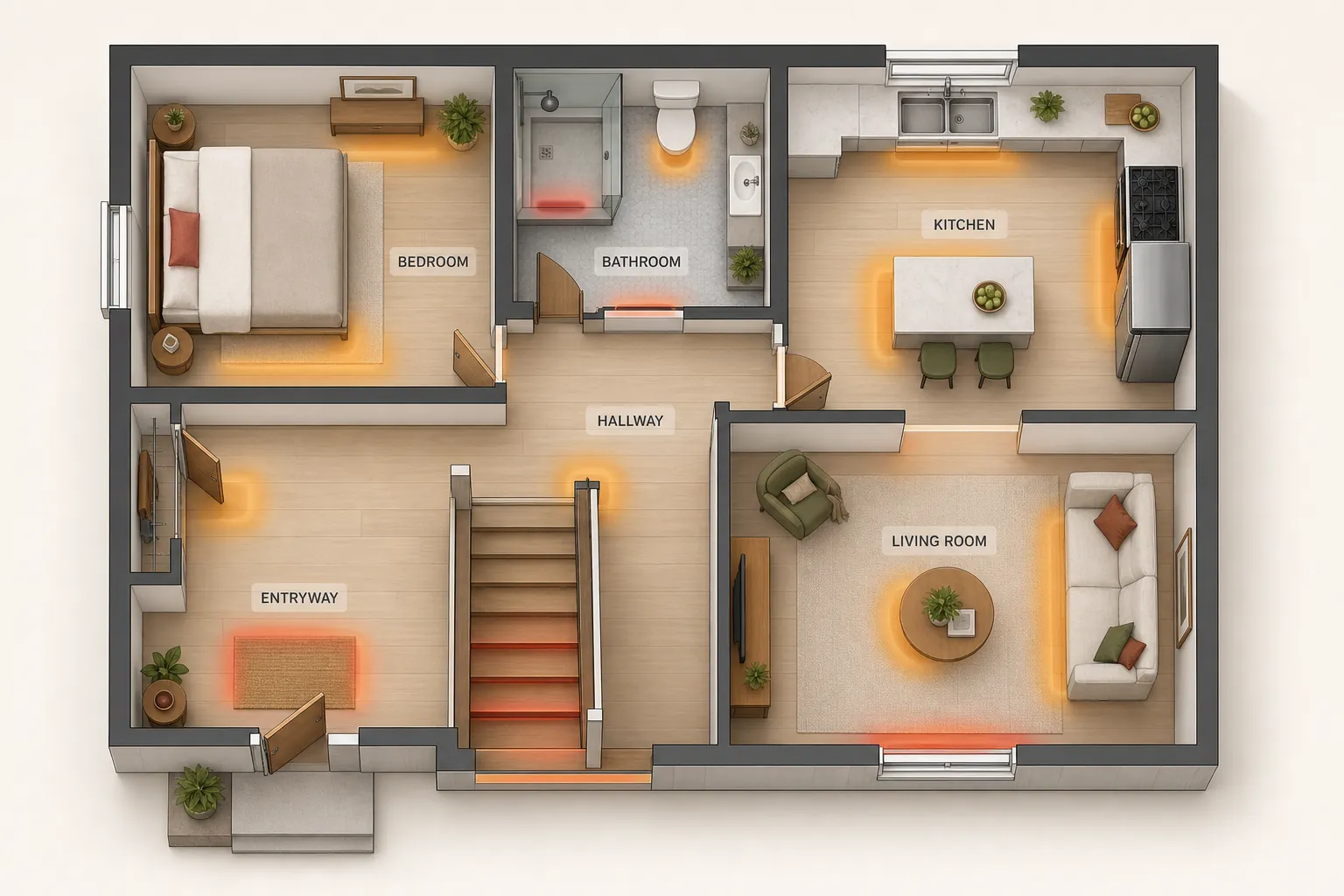
Entryway, porch, and the first ten feet inside
The entry is where outdoor weather gets dragged indoors. Rainwater collects under shoes. Snow melts into a slick patch. Delivery boxes and storm supplies get dropped “just for now.” If an evacuation order comes, this is also where people move fast while carrying bags.
- Remove loose mats that slide, curl, or bunch under a cane or walker. If a mat must stay, use a low-profile, non-slip mat that lies flat.
- Place absorbent towels or a stable boot tray where wet shoes can be handled without creating a puddle in the walking line.
- Move bottled water, sandbags, coolers, and supply boxes out of the direct route from the door to the main chair, bathroom, and bedroom.
- Put a flashlight at reachable height near the door, not in a drawer behind other objects.
- Before winter weather, put ice melt, sand, or cat litter near the door where someone else can reach it before the first step becomes slick.
NCOA specifically names winter surfaces as a predictable fall risk and recommends traction supports such as ice-gripper cane tips, rubber-soled boots, and cat litter on slick spots.[2] The point is to stage those items before the surface changes. A bag of ice melt in the garage is not very useful if the garage path is already icy.
Stairs and hallways
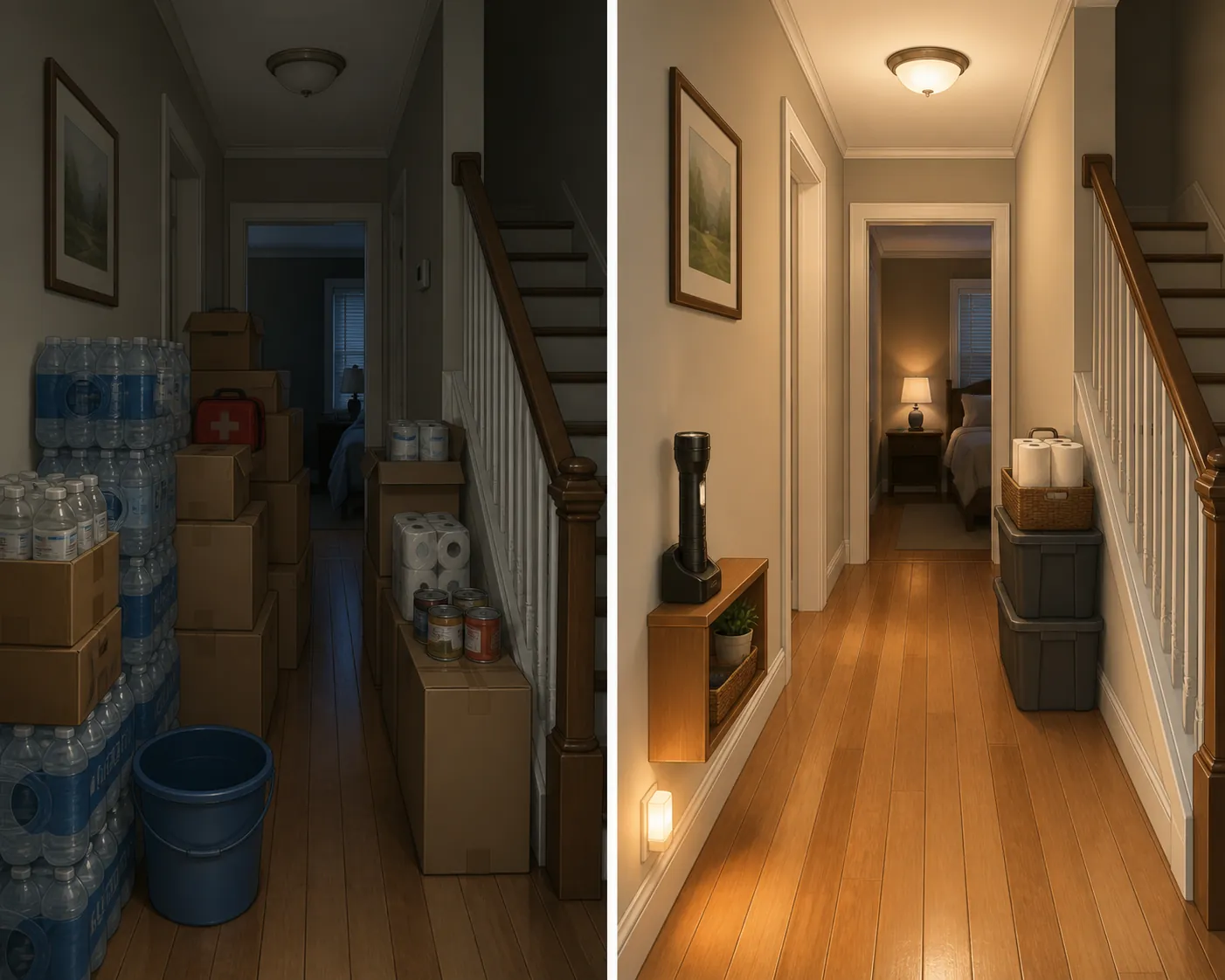
Hallways become storage lanes during storm prep. That is exactly the wrong place for water cases, battery bins, pet food, buckets, extension cords, or laundry baskets. During an outage, the older adult may be touching the wall for balance while also trying to locate a walker, cane, or railing.
- Clear a continuous walking lane from the main chair to the bathroom, bedroom, kitchen, and exit.
- Check that handrails are secure and that nothing hangs from them.
- Remove cords from the path, including temporary charging cords and extension cords for fans, radios, medical devices, or lamps.
- Place battery lanterns or motion-sensor lights at turns, stair landings, and the hallway bathroom route.
- Mark stair edges with high-contrast tape if depth perception is a problem in low light.
If you do only one test, turn off the lights and walk the usual nighttime route with the older adult’s actual mobility aid. Do not do this as a balance challenge; stand close, use safe lighting, and stop if the route feels unsafe. The test often reveals the practical problem immediately: the walker clips a storage bin, the cane tip catches a rug edge, or the person reaches for furniture that will not be visible in a power outage.
Bathroom
The bathroom is high stakes because storms disrupt the exact things that normally make it manageable: light, water pressure, heat, timing, and confidence. People also tend to hurry there. A rushed bathroom trip during an outage is one of the situations this checklist is trying to prevent.
- Remove loose bath mats or replace them with non-slip mats that do not curl.
- Set a battery nightlight, motion-sensor light, or flashlight where it can be reached before entering the bathroom.
- Check grab bars, shower chairs, raised toilet seats, and toilet safety rails for wobble.
- Keep towels within reach so water can be wiped before it spreads into the hall.
- If a bedside commode is used during storms or outages, place it before the storm, with a clear transfer path and lighting.
Do not wait until the power is out to decide whether nighttime bathroom trips are too risky. If the older adult has dizziness, urgent toileting, new weakness, or recent falls, discuss a storm plan with their clinician or home health team before weather season. This article is educational and does not replace medical advice.
Bedroom
Most homes look prepared in the kitchen and chaotic beside the bed. That is backward. The first unsafe movement after the lights fail may be standing up from bed and reaching for a walker in the dark.
- Place a flashlight, phone, glasses, hearing aids, and mobility aid on the side the person actually uses to get up.
- Keep the flashlight at bed height, not across the room.
- Clear slippers, oxygen tubing, throw blankets, pet beds, and cords from the path between bed and bathroom.
- Check that footwear has backs and non-slip soles; loose slippers are not storm footwear.
- Put a small water supply and essential overnight items within reach if getting to the kitchen in the dark would be unsafe.
If the home has an adjustable bed, lift chair, CPAP, oxygen concentrator, stair lift, or powered recliner, decide what happens if electricity is unavailable. Ready.gov tells older adults to plan for individual needs, including medicines and assistive devices.[4] For powered equipment, that means the plan has to be specific: backup battery, manual release, alternate sleep location, generator safety handled outdoors only, or relocation before the outage becomes dangerous.
Kitchen
The kitchen often becomes the supply depot, which makes sense until the floor disappears under cases of water and bags of shelf-stable food. Ready.gov lists one gallon of water per person per day, food, a NOAA weather radio, flashlight, batteries, and first aid supplies among basic emergency kit items.[3] Those items help only if they do not create the next fall hazard.
- Store water and food along a wall, in a low cabinet, or in a stable bin outside the walking lane.
- Do not stack heavy water cases where they can slide, tip, or require bending and twisting to lift.
- Move frequently used food, cups, medications that are normally taken with food, and pet supplies to waist-to-shoulder height.
- Place a battery lantern where it lights the route to food and water without needing to carry an open flame.
- Remove scatter rugs near the sink, refrigerator, and stove before severe weather arrives.
The Red Cross advises using flashlights instead of candles during winter storms.[5] That advice belongs in every season. A candle asks an older adult to manage flame, wax, matches, smoke, pets, oxygen equipment, and trip hazards while the house is already harder to navigate.
Living room and main sitting area
The main chair is command central during a storm. That area should let the person stand, reach the mobility aid, turn, and sit again without stepping over supplies. It should not look like a camping aisle.
- Move coffee tables, magazine baskets, ottomans, and decorative stands if they narrow the route from chair to bathroom or exit.
- Tape down or remove area rugs, especially where the person pivots to sit or stand.
- Place a flashlight, phone charger or backup battery, hearing aid supplies, glasses, and medication list within reach of the main chair.
- Keep a stable side table available so water, radio, and medications are not kept on the floor.
- If pets live in the home, move food bowls, beds, and leashes away from the walking path before the weather changes their routine.
A lift chair or recliner needs special attention. If it requires power to return to a standing position, the older adult may be trapped low in the chair or may try an unsafe transfer when the battery dies. Test the backup plan before storm season.
Medication, medical devices, and assistive equipment
Medication disruption can become a fall issue when it causes dizziness, weakness, confusion, urgency, or missed doses. Device disruption can do the same when a person tries to move without the aid they normally depend on.
- Keep an up-to-date medication list, allergy list, pharmacy information, and prescriber contacts in the go kit and near the main medication area.
- Ask the pharmacist or clinician how much medication reserve is realistic and safe; published preparedness recommendations vary by source and situation, often ranging from a shorter go-kit supply to a longer stay-home reserve.
- Check cane tips, walker glides, wheelchair brakes, rollator brakes, grabber tools, hearing aid batteries, glasses, and shoe traction before storm season.
- Charge battery-powered devices early, including phones, medical alert devices, backup batteries, hearing aids, and mobility equipment where applicable.
- Store device supplies where they can be reached without bending into a dark closet.
Ready.gov’s older-adult guidance is useful because it does not treat everyone’s kit as identical. It specifically tells older adults to consider medical and assistive needs when preparing.[4] A walker basket, spare cane tip, hearing aid batteries, extra glasses, incontinence supplies, and written medication list may matter more in this home than another case of food.
Exterior paths, trash area, car, and mailbox
A home can be tidy inside and still unsafe because the older adult steps outside too soon. The exterior sweep is not about proving independence after the storm. It is about deciding which routes are safe, which tasks can wait, and when local conditions override the home checklist.
- Clear leaves, hoses, planters, tools, and uneven items from the path to the car, trash bins, and mailbox.
- Check that exterior lights work and that battery or solar backup lighting is positioned where steps or thresholds are hard to see.
- Move ice melt, sand, or cat litter to a reachable location before freezing weather.
- Place sturdy, rubber-soled footwear by the exit before rain, flooding, or ice.
- Decide in advance who handles shoveling, debris removal, generator setup, and heavy lifting.
The Red Cross warns against overexertion from shoveling because of heart attack risk.[5] That warning has a fall-prevention side, too: fatigue, cold, uneven footing, and urgency make outdoor cleanup a bad time to test balance.
Senior-specific supply kit: what changes when fall risk is part of the plan
A generic emergency kit assumes the supplies are the finish line. In an older adult’s home, supplies are only helpful if they are reachable, lighted, labeled, and kept out of walking routes.
| Kit area | Include | Fall-prevention placement rule |
|---|---|---|
| Water and food | Water, shelf-stable food, manual can opener, pet food if needed | Store low enough to reach but not in the hallway, doorway, or turning space for a walker |
| Lighting | Flashlights, battery lanterns, motion lights, spare batteries | Place one at bed height, one near the main chair, one near the bathroom route, and one near the exit |
| Communication and alerts | NOAA weather radio, phone charger, backup battery, written contacts | Keep on a stable surface, not on the floor or behind stacked supplies |
| Medications and health documents | Medication list, allergies, pharmacy and prescriber contacts, copies of key documents | Keep copies in both the stay-home kit and go kit; ask clinicians about safe medication reserve |
| Mobility and assistive devices | Cane tips, walker accessories, wheelchair supplies, glasses, hearing aid batteries, incontinence supplies | Store where they can be reached without entering a dark closet or bending into a crowded cabinet |
| First aid and hygiene | First aid kit, wipes, hand sanitizer, gloves, trash bags, towels | Keep towels near likely wet zones so small puddles do not become hallway hazards |
| Evacuation support | Go bag, footwear, device chargers, medication list, mobility aid plan | Keep the bag near the exit but outside the walking lane |
Ready.gov’s basic kit guidance includes one gallon of water per person per day, food, a NOAA weather radio, flashlight, batteries, and first aid supplies.[3] Its older-adult guidance adds the missing layer: plan for medicines, medical equipment, assistive devices, and support needs.[4] Use those lists, but do not let the kit turn the home into an obstacle course.
Medication and kit-duration advice is not identical across organizations or situations. Some guidance distinguishes a 3-day go kit from a 2-week stay-home supply; medication reserve advice also depends on insurance, prescribing rules, refrigeration, controlled substances, and clinical safety. Treat the range as a planning conversation with the pharmacist or clinician, not as permission to stockpile or skip doses.
Hazard adjustments for heat, hurricanes, flooding, outages, and ice
Severe weather is local. In late summer, many U.S. households are watching heat, hurricanes, flash flooding, and power outages more closely than ice, while winter preparation still belongs on the calendar before the first freeze. Use the room sweep as the base layer, then branch for the hazard that is actually coming. If local officials issue evacuation orders, flood warnings, wildfire instructions, or cooling-center guidance, that local direction overrides any home checklist.
| Hazard | How it raises fall risk | Pre-storm action | Place or move | Stop managing at home when... |
|---|---|---|---|---|
| Extreme heat | Weakness, dizziness, dehydration, poor sleep, rushed movement to fans or water | Stage water, cooling supplies, charged devices, and a safe route to the coolest room | Water, phone, medications, fan cords, backup batteries, light clothing, mobility aid | Indoor heat becomes unsafe, the person has concerning symptoms, cooling equipment fails, or local officials direct use of cooling centers |
| Hurricane or heavy rain | Wet entries, leaks, clutter from sandbags and supplies, evacuation haste | Clear entry paths, lift trip hazards, stage go bag outside walking lane, and identify the safest exit route | Towels, footwear, go bag, flashlight, medication list, water stored away from routes | Evacuation orders, flooding, structural damage, blocked exits, or emergency officials say to leave |
| Flash flood | Standing water hides steps, curbs, debris, and floor damage; rushing increases transfer risk | Move the older adult out of flood-prone areas early when advised and keep mobility devices ready | Go bag, mobility aid, waterproof document pouch, sturdy shoes, phone charger | Flood warnings affect the home, water approaches the structure, roads are unsafe, or officials advise evacuation |
| Power outage | Dark rooms, dead lift chairs, silent devices, cords, unsafe candles, bathroom trips without visual cues | Place reachable lighting along actual routes and charge devices before the storm | Flashlights, lanterns, batteries, phone power bank, medical device backup, bedside supplies | Medical equipment cannot be powered safely, indoor temperature is unsafe, or the person cannot move safely without powered support |
| Winter storm or ice | Slippery steps, icy walks, wet floors, heavy clothing, shoveling fatigue | Stage traction supplies before freezing starts and arrange help for snow and ice removal | Ice melt, sand or cat litter, rubber-soled boots, cane ice tip, towels, exterior lighting | Ice blocks safe exit, heat fails, emergency services advise staying off roads, or outdoor clearing would require unsafe exertion |
For deeper single-hazard planning, use a dedicated heat wave checklist for seniors, a power outage fall-prevention plan, or a flash flood safety guide for older adults. This checklist stays focused on the physical home environment: the floor, the light, the walking route, and the supplies that can either support movement or block it.
When a watch becomes a warning
Once a watch becomes a warning, stop improving the whole house and protect the routes that matter most. This is the wrong time to reorganize closets or carry heavy boxes across the hallway. Work only on what affects safe movement, essential supplies, and local instructions.
- Clear the path from bed to bathroom, main chair to bathroom, main chair to kitchen, and main chair to exit.
- Move water, food, batteries, and go bags out of walking lanes and away from stair edges.
- Place flashlights or lanterns at bed height, chair height, bathroom entry, kitchen entry, and the main exit.
- Charge phones, medical alert devices, hearing aids, backup batteries, and powered mobility or medical equipment.
- Remove or tape down rugs that could catch a cane, walker, or shoe.
- Put safe footwear by the bed and exit; for winter, add traction supplies before the porch or steps freeze.
- Use flashlights instead of candles, consistent with Red Cross guidance.[5]
- Avoid risky overexertion, including shoveling or heavy debris work, and assign those tasks before conditions worsen.
- Follow evacuation, shelter, flood, heat, wildfire, and road instructions from local emergency officials.
If the older adult lives alone, keep communication planning brief here and use a dedicated severe weather safety checklist for seniors living alone for check-ins, contacts, and escalation. In this home sweep, the priority is still the same: can the person stand up, turn, walk, toilet, eat, and exit without tripping over the preparedness plan?
The 72-hour fall watch after the storm
Falls often happen after the obvious danger appears to be over. People are tired. Furniture has shifted. Towels are soaked. Flashlights are dead. A rug that was flat yesterday has curled after being kicked by a boot. The caregiver relaxes because the storm has passed, and the older adult tries to resume normal routines in a house that is not normal yet.
| Post-storm check | What to look for | What to do before normal routines resume |
|---|---|---|
| Floors and thresholds | Wet spots, grit, mud, warped flooring, curled mats, loose thresholds | Dry, remove, mark off, or repair the area before it becomes part of the walking route |
| Lighting | Dead batteries, dim lanterns, missing flashlights, dark bathroom route | Replace batteries and put lights back at bed, chair, bathroom, kitchen, and exit |
| Furniture and supplies | Moved chairs, water cases in halls, buckets, fans, cords, coolers, cleanup tools | Return walking lanes to their pre-storm width before sitting down to rest |
| Medication and meals | Missed doses, changed timing, poor hydration, spoiled food concerns | Review the medication list, call the pharmacist or clinician with concerns, and restore safe meal and fluid routines |
| Body signals | Dizziness, weakness, confusion, new pain, shortness of breath, unusual sleepiness | Pause independent walking and seek medical guidance or urgent help based on severity |
| Bathroom trips | Rushing, urgency, wet towels, poor nighttime lighting, unstable commode placement | Reset lighting, clear the route, and add supervision or assistive setup if needed |
| Outdoor routes | Ice, branches, uneven debris, standing water, damaged steps, loose railings | Delay mail, trash, and cleanup trips until the route is inspected or cleared |
Use the first three days to keep asking small, concrete questions. Did the walker get moved to charge something else? Did the flashlight migrate back to a drawer? Is the cane tip worn? Is the person more fatigued than usual? Did a medication schedule change during the outage? Is there a new wet spot by the back door? Those are the details that decide whether the home is safe again.
If there was flooding, structural damage, evacuation, suspected electrical damage, sewage exposure, gas odor, or debris around the home, use a dedicated after-storm home safety guide for seniors and follow local emergency instructions before re-entry or cleanup. A tidy hallway does not make a damaged home safe.
Severe-weather preparedness for seniors is not complete when supplies are bought. It is complete when the home remains walkable, lit, uncluttered, and usable through the outage and the first 72 hours afterward.
References
- Older Adult Fall Data, CDC, https://www.cdc.gov/falls/data-research/index.html
- Winterize to Prevent Falls, NCOA, https://www.ncoa.org/article/winterize-to-prevent-falls/
- Build A Kit, Ready.gov, https://www.ready.gov/kit
- Older Adults, Ready.gov, https://www.ready.gov/older-adults
- Winter Storm Safety, American Red Cross, https://www.redcross.org/get-help/how-to-prepare-for-emergencies/types-of-emergencies/winter-storm.html
Related reading
Noticed something outdated or inaccurate on this page? Flag a correction. We review every report against CDC, NIA, and AARP HomeFit guidance before updating a page.
Part of the Fall Prevention section.