
STEADI: Intervene
Longevity for Seniors Starts With Strength and Balance
Strength and balance are the highest-leverage longevity habits for older adults because they target the leading cause of injury and lost independence: falls. This guide lays out weekly strength, balance, and protein targets, a progressive plan, and the clear signs that a physical therapist should be involved.
Most healthy-aging advice for seniors eventually says the same thing: move more, eat well, sleep, stay connected, see your doctor. Fine. But if the question is which habit most directly protects independent years, strength and balance deserve to move to the front.
Falls are not a side issue in aging. One in four older adults falls each year, and falls are the leading cause of fatal and nonfatal injuries among adults age 65 and older. The age-adjusted fall death rate also rose from 55.3 per 100,000 in 2012 to 78.0 in 2021, according to CDC data cited by the National Council on Aging.[1] Those numbers are not abstract if the real concern is whether an older adult can keep using the stairs, getting out of a chair, showering safely, walking to the mailbox, or living at home without a sudden loss of confidence.
That is why strength and balance are not just fitness goals. They are fall-prevention habits. They help decide whether added years remain usable.
The body needs more than walking
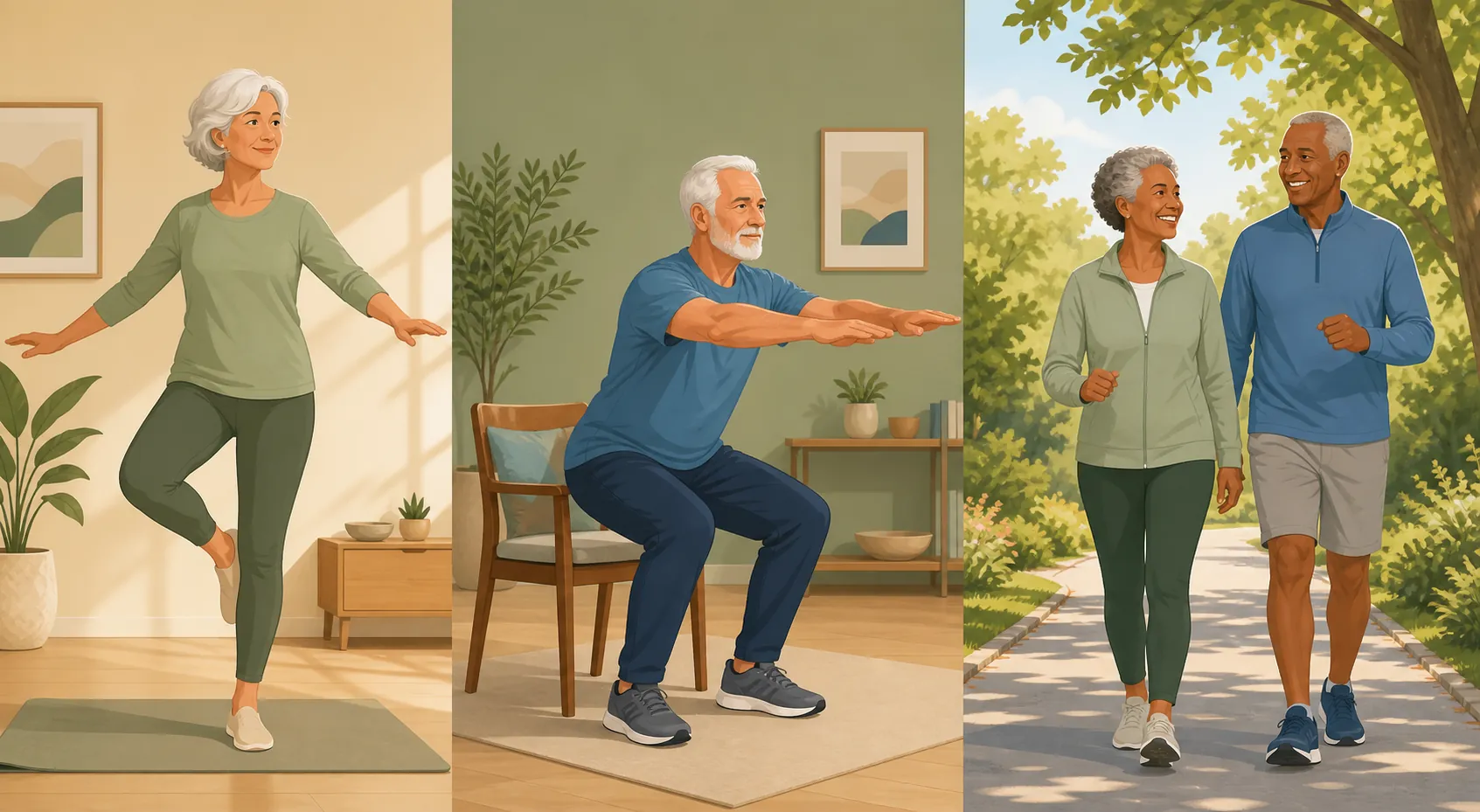
Walking is useful. It supports endurance, circulation, mood, and daily stamina. But walking alone does not fully train the two abilities that often matter during a near-fall: producing force quickly enough to recover, and controlling the body when weight shifts unexpectedly.
The CDC’s activity guidance for older adults is explicitly multicomponent: at least 150 minutes of moderate-intensity aerobic activity each week, or 75 minutes of vigorous activity, plus muscle-strengthening activity on 2 or more days a week, plus balance activities. The CDC also notes that some physical activity is better than none.[2]
That combination matters because each part solves a different problem. Walking builds the engine. Strength work builds the legs, hips, trunk, and upper body needed for transfers and recovery. Balance practice teaches the nervous system to stay organized when the base of support changes.
| Habit | What it protects | What it can look like |
|---|---|---|
| Strength | Rising from a chair, climbing stairs, carrying groceries, recovering from a stumble | Chair squats, sit-to-stands, wall pushups, heel raises, step-ups, resistance-band rows |
| Balance | Standing still, turning, reaching, stepping around obstacles, reacting to a loss of balance | Tandem stance, single-leg practice near a counter, slow weight shifts, heel-to-toe walking |
| Walking | Endurance for daily life and confidence moving through the neighborhood or home | Comfortable-to-moderate walks, gradually working toward a regular walking routine |
The National Council on Aging makes the same practical point from the fall-prevention side: combine a strength-and-balance program with a walking program, working up to a 30-minute walk 3 times a week, for better fall protection than treating walking as the whole plan.[3]
A useful weekly target
A realistic week does not need to look like a gym schedule. It does need to include all three pieces: strength, balance, and walking. If an older adult is currently doing very little, the first job is not to hit every target immediately. It is to start in a way that is repeatable and safe enough to build on.
| This week | Action | How to keep it practical |
|---|---|---|
| Strength on 2 days | Choose a few supported movements for the legs, hips, trunk, and upper body. | Use a sturdy chair, counter, or wall. Stop before form breaks down. |
| Balance practice on several days | Practice standing control near a stable surface. | Stay close enough to touch the counter. Balance training should be challenging, not reckless. |
| Walking on 3 days if tolerated | Walk at a comfortable or moderate pace. | If 30 minutes is too much, use shorter walks and build gradually toward the NCOA walking target. |
| One check-in | Notice what felt easier, what felt unsafe, and what caused pain. | This is the moment to adjust the plan or ask for professional help instead of pushing through. |
For someone who already walks often, the missing piece is usually not more walking. It is the work that makes walking safer: stronger legs, better control during turns, and more confidence when standing from a low chair or stepping off a curb.
Strength work should look like daily life
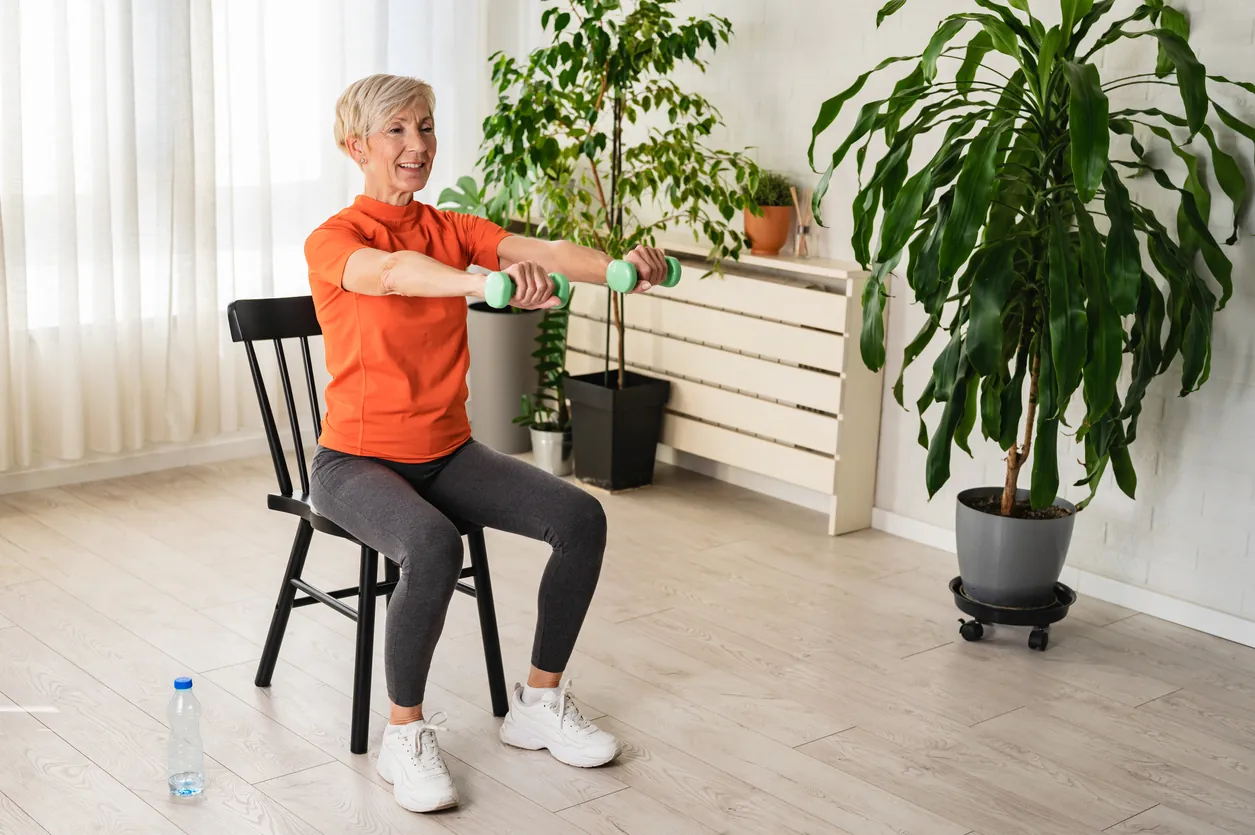
The best starting exercises are often ordinary movements made more deliberate. Sit down and stand up from a chair. Rise onto the toes while holding a counter. Step up onto a low step if that is already safe. Push against a wall. Pull a resistance band toward the ribs. These are not glamorous movements, but they map directly onto the tasks that keep a person independent.
The important question is not whether the exercise looks impressive. It is whether the body is being asked to produce force with control. A person who can stand from a chair more reliably has gained something that shows up at breakfast, in the bathroom, and during every car transfer.
Balance work belongs near support
Balance training should not be performed in the middle of a room by someone who already feels unsteady. A kitchen counter, heavy table, or stable rail changes the risk. The goal is to make the balance system practice, not to test how far a person can go before grabbing for something.
A simple self-check can be useful, as long as it is not treated like a diagnosis. Stanford Medicine cites a study of adults ages 51 to 75 in which being able to stand on one leg for 10 seconds was associated with better mortality outcomes.[4] That does not mean standing on one leg for 10 seconds proves someone is safe, and it does not mean practicing the test is a complete program. It is a quick signal: if standing control is poor, balance deserves attention.
Protein is the support system for the strength plan
Muscle does not improve from exercise alone. Older adults also need enough protein to repair and maintain muscle tissue. Stanford Medicine cites geriatrics guidance of roughly 1.0 to 1.3 grams of protein per kilogram of body weight per day for healthy older adults; for a 150-pound person, that is about 68 to 88 grams daily, which can often be spread as roughly 20 to 30 grams at each of three meals.[4]
That meal-by-meal distribution is the useful part. A protein target that sits on paper does not help much if breakfast is toast, lunch is light, and dinner carries the whole burden. Eggs, Greek yogurt, fish, poultry, beans, lentils, tofu, cottage cheese, and protein-fortified options can all be part of the answer depending on appetite, chewing ability, budget, culture, and medical needs.
People with kidney disease or other conditions that affect protein recommendations should ask their clinician before increasing intake. For a deeper nutrition-focused breakdown, see how much protein seniors need to prevent falls.
Genes matter less than the next safe repetition
Family history matters. So does luck. But it is easy to over-credit genes and under-credit the habits that decide whether someone can get through the day safely. Harvard Health Publishing summarizes longevity research with the estimate that genetics account for about 25% of life expectancy, leaving a large role for lifestyle and environment.[5]
That does not mean habits can control everything. They cannot. It does mean an older adult does not need an anti-aging project to do something meaningful this week. Stronger legs and steadier balance are modest in the best sense: they have a direct route into daily function.
For the broader checklist of habits that support independent aging, use Longevity Tips That Keep Seniors Independent Longer. This article is the narrower piece: the strength-and-balance lever, because falls are where independence can change suddenly.
A simple progression for the next several weeks
Progression does not have to mean harder exercises every session. It can mean better control, less rushing, more consistency, or needing less hand support. The safest progression is usually boring enough to repeat.
| Phase | What to do | Move ahead when |
|---|---|---|
| Start | Use supported chair-based or counter-supported strength moves, easy balance practice, and comfortable walking. | The routine feels safe and does not increase pain. |
| Build | Keep the 2 weekly strength days, add balance practice more consistently, and lengthen walks as tolerated. | Standing, transfers, or short walks feel more controlled. |
| Challenge carefully | Make one variable slightly harder: slower chair stands, a little more walking time, lighter fingertip support during balance, or a resistance band. | The change does not create wobbling that feels unsafe. |
| Maintain | Keep strength, balance, and walking in the week instead of letting walking crowd out the other two. | The routine fits normal life well enough to continue. |
Home safety still matters. Better balance does not cancel out loose rugs, poor lighting, icy steps, cluttered walkways, or unsafe footwear. If an adult child is worried about a parent’s home setup, start with a red flag safety checklist for elderly parents. In colder climates, seasonal hazards deserve their own plan, including winter weather fall prevention and ways to prevent falls on ice outdoors.
When a physical therapist should be involved
A self-start plan is reasonable for many people who feel stable, have no recent falls, and can move without limiting pain. It is the wrong place to prove toughness.
The National Council on Aging advises involving a physical therapist when someone feels unsteady, has fallen before, or has pain that limits movement.[3] Those are not minor details. They change the risk of a home exercise plan and the kind of assessment a person may need.
- If standing from a chair feels uncertain, ask for help before adding harder leg exercises.
- If turning, stepping backward, or showering feels unsafe, balance work should be guided.
- If a fall has already happened, treat it as information, not embarrassment.
- If pain changes walking, stair use, or transfers, the plan needs to account for that pain rather than work around it blindly.
The useful message is not that it is too late once someone feels unsteady. It is that the starting point should match the risk. Johns Hopkins Medicine’s healthy-aging guidance emphasizes that healthier steps can still matter at older ages.[6] For fall prevention, the safest version of that idea is specific: start where the body is now, and bring in professional help when steadiness, pain, or a previous fall says the situation is no longer simple.
Longevity is not much of a victory if the extra years are spent afraid to stand, walk, bathe, or leave the house. Strength and balance are not flashy, but they go straight at the problem that most often makes older adults lose ground. They help keep the added years livable.
References
- Get the Facts on Healthy Aging — National Council on Aging
- Older Adult Activity: An Overview | Physical Activity Basics — CDC
- What Exercises Can Help Seniors Prevent Falls? — National Council on Aging
- Five healthy habits for successfully aging in our 60s and 70s — and beyond — Stanford Medicine
- Longevity: Lifestyle strategies for living a healthy, long life — Harvard Health Publishing
- It's Never Too Late: Five Healthy Steps at Any Age — Johns Hopkins Medicine
Related reading
Noticed something outdated or inaccurate on this page? Flag a correction. We review every report against CDC, NIA, and AARP HomeFit guidance before updating a page.
Part of the Fall Prevention section.