
STEADI: Intervene
Flood Preparedness Checklist for Elderly Living Alone
Fall-first flood readiness for an older adult living alone: when to leave before water rises, how to avoid moving-water falls, and how to protect mobility aids and remove fall hazards before flood season. Includes the warning signs that mean ask for help or call 911 now.
For an older adult living alone, a flood preparedness checklist has to start with the part that becomes dangerous fastest: getting out before water reaches the doorway, driveway, sidewalk, or road. Six inches of fast-moving water can knock an adult down, and one foot of moving water can sweep a vehicle away; the important words are “fast-moving,” because the danger is not just depth, but force against feet, wheels, canes, and walkers. [1][2]
That is why this belongs in fall prevention, not just storm preparation. Falls caused more than 38,000 deaths among adults 65 and older in 2021 and are the leading cause of injury death for that age group. [3] When an older adult lives alone, there may be no one in the house to move the walker to the door, notice that water is crossing the threshold, carry a go-bag, or say, “No, do not step into that.” Nearly 3 in 10 adults 65 and older lived alone in 2022, and 43% of women 75 and older lived alone. [4]
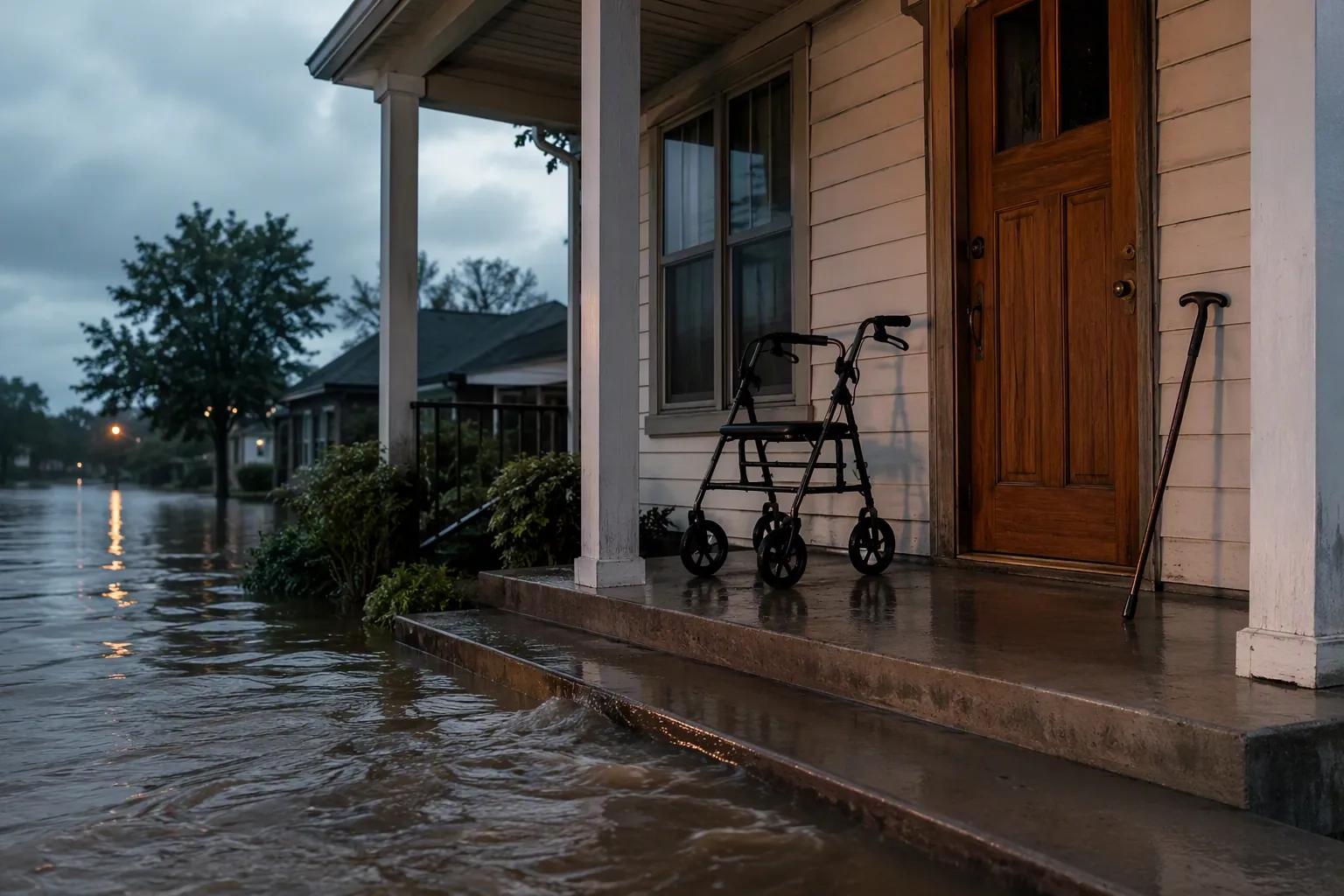
The safest plan is not a clever plan for walking through floodwater. It is a plain plan for leaving early, while the walking surface is still dry, the mobility aid is still reachable, the shoes are still on, and the person can make decisions without rushing.
Why older adults living alone need a different flood checklist
A generic flood list usually starts with water, food, batteries, and documents. Those matter, but for an older adult living alone, the more urgent questions are closer to the floor: Are sturdy shoes by the bed or the door? Is the walker parked where it can be reached if the power goes out? Is there a throw rug in the exit path? Can the person carry what they packed while also using a cane? Is the rollator safe on a wet ramp? Does anyone know they have not left yet?
Large population studies do not tell you what will happen in one house on one street, but they do support taking flood-related injury risk seriously. A Columbia Mailman School press release summarizing a study of 35.6 million U.S. death records from 2001 through 2018 reported that injury death rates among people 65 and older rose 24.9% during the month of tropical storm and hurricane-related flooding. [5] Another Columbia Mailman summary, reporting a Lancet Planetary Health study, found that within four weeks after major floods, hospitalizations among adults 65 and older rose for injuries and poisoning by 1.1% and for musculoskeletal diseases by 1.3%. [6]
Those findings should not be stretched into a prediction about any one storm or any one person. They do, however, match what a home walkthrough already shows: a flood can turn a normal transfer, hallway walk, porch step, or driveway crossing into an injury emergency.
For the broader hazard picture around water, slippery surfaces, and delayed help, see why a water crisis is a fall emergency for older adults. This checklist stays with the flood-specific decisions: when to leave, how to keep mobility equipment usable, and when to stop trying to manage alone.
The flood checklist, timed by decision point
Flood preparation should not wait for a warning siren or a wet doorstep. The useful checklist has three different speeds: before flood season, during a flood watch, and during a flood warning.
| When | What changes | Fall-first action |
|---|---|---|
| Before flood season | There is time to rearrange the home, make calls, and test the plan. | Clear the exit path, plan transportation to higher ground, prepare mobility aids, and decide who will check in. |
| Flood watch | Flooding is possible. | Put shoes on or beside the feet, move the walker or cane to the exit, charge devices, call the support person, and be ready to leave before flooding begins. |
| Flood warning | Flooding is happening or expected soon. | Move to higher ground if the route is still safe and dry; do not walk or drive through moving water. [2] |
| Water is already moving across the route | Self-evacuation may create the injury. | Do not step into it. Call for help, local emergency services, or 911 if trapped or in immediate danger. |
Before flood season: make the exit path dull and predictable
The best flood work happens on an ordinary day. Walk the route from the bed, favorite chair, bathroom, and kitchen to the safest exit. Then remove anything that could catch a toe, wheel, cane tip, or walker leg.
- Remove throw rugs from the bedroom, hallway, kitchen, and door area. If a rug must stay, it should not sit in the evacuation path.
- Tape charging cords flat along the baseboard or move them completely out of the path.
- Move baskets, shoes, plant stands, pet bowls, and delivery boxes away from the hall and door.
- Check thresholds. A walker or rollator that catches slightly on a dry day may stop hard when the person is rushing or the floor is damp.
- Place sturdy, closed-heel, non-slip shoes where the person can put them on without walking across the room in socks.
- Keep eyeglasses, hearing aids, a phone, and a flashlight or lamp within reach of the bed and the main chair.
- Add nightlights or battery lighting along the route if power loss is likely.
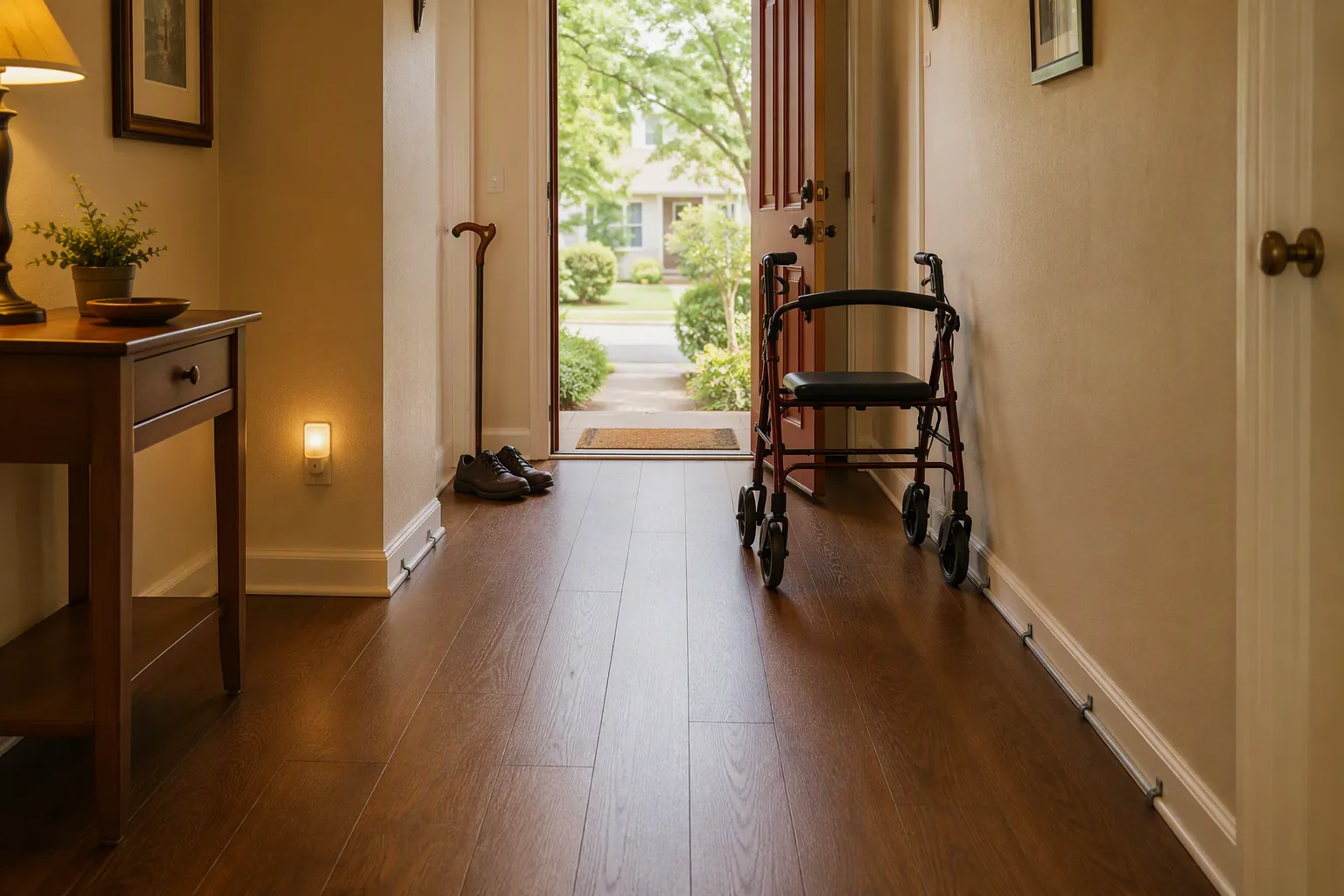
If storm season also brings outage risk, use a room-by-room pass from how to fall-proof a senior's home before a power outage. The flood-specific point is that the route has to work when the person is moving alone, possibly in the dark, possibly wearing a raincoat, carrying medication, and trying not to step into water.
Before flood season: plan the mobility equipment, not just the bag
A go-bag is useful only if the person can leave with it. The walker, rollator, cane, wheelchair, powered mobility device, CPAP supplies, glasses, hearing aids, medication organizer, and chargers are not accessories. They are the plan.
- Choose one “leave now” spot for the walker, rollator, cane, or wheelchair. Do not store it in a back room, garage corner, or behind furniture during flood season.
- If the person uses a cane indoors and a walker outdoors, keep both ready. Flood evacuation usually means outdoor surfaces, ramps, curbs, wet pavement, and waiting areas.
- Label mobility equipment with the person’s name and phone number.
- For a powered wheelchair or scooter, keep the charger in the same place every time, charge early when a flood watch is issued, and decide what the backup is if power goes out or the device cannot be transported.
- Do not assume a shelter, ride, or neighbor will have the exact durable medical equipment the person depends on. Bring what is essential whenever it is safe to do so.
- Practice lifting or folding the rollator or walker into the planned vehicle before storm season, not in the rain.
The American Red Cross recommends that older adults build a personal support network and make sure those people know the plan, including where supplies are kept and how to help with evacuation. [7] That matters more for someone living alone because “I have a walker” is not the same as “someone can get the walker into the car before the road floods.”
Before flood season: set the help chain
A support network should not be a vague promise to “check in.” It should answer four questions:
- Who calls when a flood watch is issued?
- Who drives, or who arranges the ride, if leaving is needed?
- Who has a key or knows how to enter if the person cannot reach the door?
- Who is the backup if the first person does not answer?
Ready.gov also advises older adults to sign up for emergency alerts and consider practical issues such as electronic benefit payments so a mail disruption does not interrupt income. [8] For the general evacuation contact sheet, medication list, document copies, and support-network layout, use the emergency evacuation checklist for seniors living alone. Use that broader checklist for those details; in a flood, the more dangerous decision is timing.
When a flood watch is issued
A flood watch means flooding is possible. For an older adult living alone, this is not the time to wait and see from the recliner. It is the time to make the home easier to leave and the decision easier to carry out.
- Put sturdy shoes on, or place them directly beside the chair or bed.
- Move the walker, rollator, cane, or wheelchair to the exit side of the room, not across a hallway.
- Charge the phone, hearing aids, medical devices, power banks, scooter, or powered chair.
- Move medication, eyeglasses, ID, keys, and the phone into the bag or coat that will leave with the person.
- Call the support person and say the actual plan: “If this becomes a warning, I am going to your house,” or “If water reaches the corner, I am calling for a ride.”
- Check the planned route before it is needed. A route that crosses a low bridge, dip, drainage area, or flood-prone driveway may fail early.
- If evacuation is likely, leave during the watch while the path is still dry.
Reluctance is normal. People do not want to leave pets, routines, medical equipment, a familiar bathroom, or a home they have protected for years. But the decision should be made while leaving is still a controlled action, not after the porch step, sidewalk, or road has become a moving-water problem.
When a flood warning is issued
A flood warning means flooding is happening or will happen soon. Ready.gov’s flood guidance is direct: move to higher ground before flooding begins. [2] For someone who uses a cane, walker, rollator, wheelchair, or slow transfer routine, “before” has to mean earlier than it would for a younger person who can jog to a car with a backpack.
- If local officials tell the area to evacuate, leave if the route is still safe and dry. Do not wait to see whether water reaches the door.
- If the planned driver is available, use that help early. Do not save the favor for when the road is worse.
- Take the mobility aid that matches the hardest surface ahead, not just the easiest surface inside the house.
- Keep the phone on the body, not loose in a bag that could be dropped.
- Lock the door only if doing so does not add a fall risk or delay. The person matters more than the lock.
- If water is already covering the route, do not walk through it and do not drive through it. Call for help instead.
This is also where hurricane and severe-storm instructions may take over. If the flood warning is part of a tropical system, use what to do during a hurricane warning to prevent falls. If the threat is a broader storm system, use the severe storm checklist for seniors that puts falls first. The flood rule remains the same: do not turn a late evacuation into a fall in moving water.
The moving-water rule
Do not walk through moving floodwater. Do not test it with a cane. Do not try to push a rollator through it. Do not hold on to a fence and step sideways through it. The six-inch warning is about fast-moving water, and a walker or cane does not cancel the force of water against the body. [1][2]
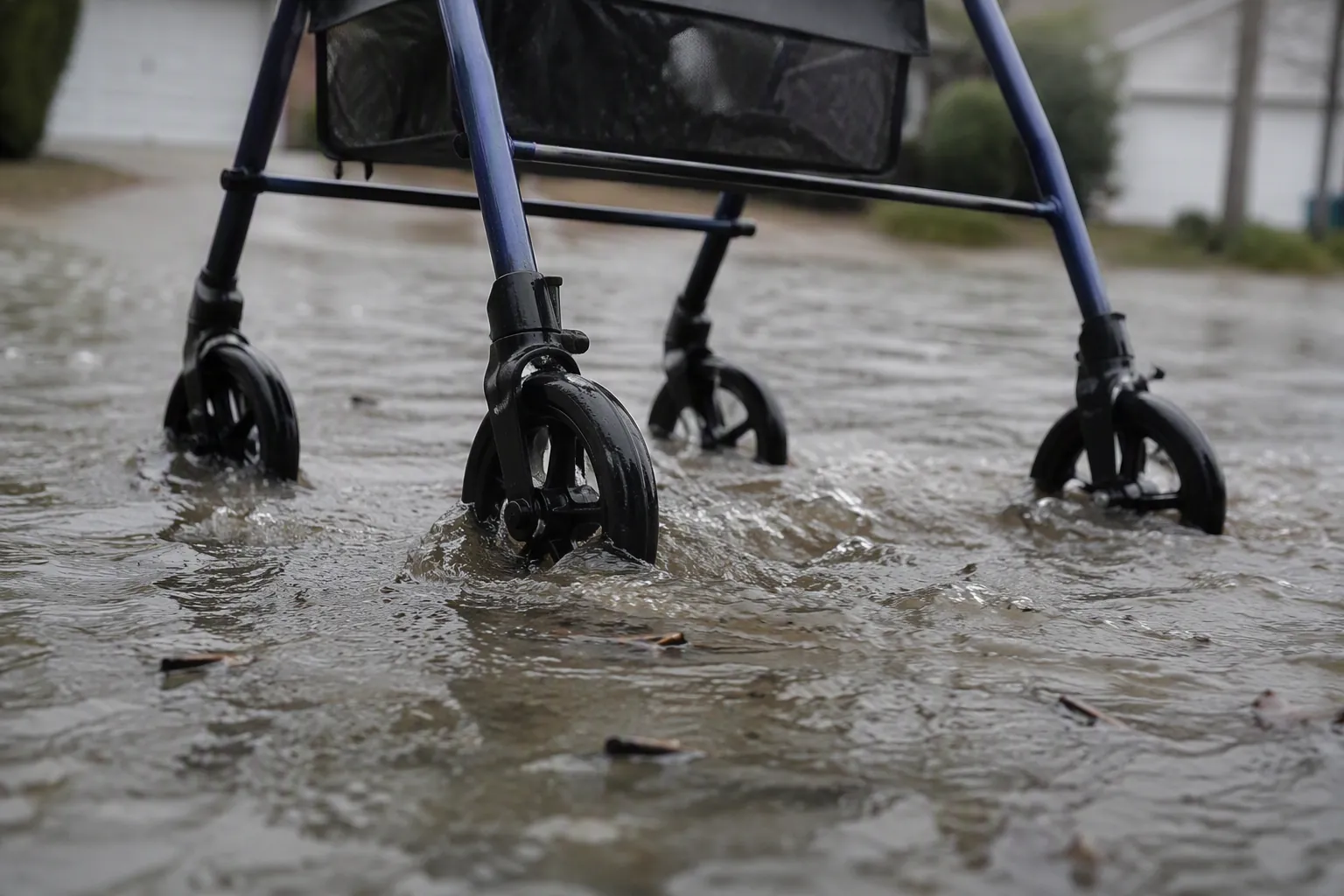
A mobility aid can also become unstable in ways that are hard to correct alone. A cane tip can slide. A walker leg can catch on hidden debris. Rollator wheels can turn or stop unevenly. A person who usually recovers balance by grabbing a counter or wall may have nothing solid within reach outside.
Standing water has its own hazards, especially if it hides a step, curb, hole, or electrical danger, but the six-inch knockdown warning should not be repeated without the moving-water qualifier. If the water is moving across the walking route, the decision is no longer “Can I make it?” The decision is who to call and where to wait.
What to pack without losing the fall-prevention focus
AARP recommends that family caregivers prepare emergency supplies and practice the plan, including revisiting it at least every six months. [9] For flood readiness, keep the bag light enough to carry while using the person’s normal mobility aid. If the bag makes the person lean, twist, or abandon the walker, the bag is too heavy or the carrying method is wrong.
- Use a crossbody bag, small backpack, walker pouch, or rollator basket that does not change balance.
- Pack medication, medication list, pharmacy information, ID, insurance cards, emergency contacts, phone charger, hearing aid batteries or charger, eyeglasses, and basic hygiene items.
- Keep a small flashlight or headlamp where it can be reached without bending into a closet.
- If the person uses CPAP, oxygen, incontinence supplies, wound-care supplies, or other daily equipment, decide how those items leave with them and who can help carry them.
- Do not put the only keys, phone, or medication in a bag across the room during a watch or warning.
General food, water, document, and pet-supply planning belongs in the broader evacuation checklist. In this flood-specific list, the packing test is simpler: can the person stand up, reach the mobility aid, take the bag, and leave without making balance worse?
If you are checking on a parent from another zip code
A long-distance flood call should not stop at “Do you have water and batteries?” Ask questions that put the room in view.
- “Are your shoes on or beside your chair?”
- “Where is your walker right now?”
- “Is the hallway clear from your chair to the door?”
- “Is your phone charged and on your body?”
- “Who is coming if you need a ride, and what time will they call back?”
- “Is there any water on the porch, driveway, sidewalk, or street?”
If the answers are vague, make the next step smaller. Do not argue about the whole evacuation first. Ask them to put on shoes. Ask them to move the walker to the door. Ask them to call the neighbor while you stay on the line. A flood plan fails in small places: the cane in the bedroom, the keys in the kitchen, the bag too heavy, the ride not confirmed.
Warning signs: ask for help or call 911 now
The line between independence and danger can move quickly during a flood. These are not “try harder” moments. They are stop-and-get-help moments.
- Water is moving across the porch, driveway, sidewalk, street, ramp, or steps the person would need to use.
- The person has been told to evacuate, but the planned ride has not arrived or the dry route is no longer clear.
- The walker, cane, wheelchair, scooter, glasses, hearing aids, medication, or phone is wet, missing, unreachable, or unusable.
- The person has fallen, hit their head, cannot get up, has new severe pain, or cannot safely stand and transfer.
- There is new confusion, faintness, chest pain, shortness of breath, severe weakness, or the person sounds unable to follow the plan.
- Water is entering the home and the person cannot leave by a dry, safe route.
- The person is alone, frightened, and considering walking through moving water.
After the flood, do not rush re-entry. Wet flooring, shifted furniture, debris, damaged steps, and poor lighting can make the first walk back through the home dangerous. For the post-disaster walkthrough mindset, use the re-entry guidance in how to protect an older adult from falls after a tornado; the cause may be different, but the first trip back inside still needs cleared paths, light, stable footing, and another person if possible.
The plan worked only if the older adult leaves before water arrives, avoids moving water entirely, has the mobility aid ready to go, and knows exactly when to stop self-managing and call for help.
References
- Flood Safety — American Red Cross
- Floods — Ready.gov
- About Older Adult Fall Prevention — Centers for Disease Control and Prevention
- The Living Arrangements of Older Americans — U.S. Census Bureau — May 2024
- Floods Linked to Rise in U.S. Deaths from Several Major Causes — Columbia University Mailman School of Public Health — January 6, 2025
- Large study uncovers specific impacts of flooding on older adult health — Columbia University Mailman School of Public Health — July 30, 2025
- Older Adults — American Red Cross
- Older Adults — Ready.gov
- Emergency Preparedness for Family Caregivers — AARP
Related reading
Noticed something outdated or inaccurate on this page? Flag a correction. We review every report against CDC, NIA, and AARP HomeFit guidance before updating a page.
Part of the Fall Prevention section.