
Not All Older Adults Face the Same Risk from Smoky Air
Wildfire smoke doesn't affect all older adults equally. This article breaks down the evidence on how race, gender, poverty, and geography create a hierarchy of risk, helping caregivers prioritize protection for those most vulnerable.
If your parent is over 65 and the air is smoky, the starting answer is yes: they are in a sensitive group. But that is not enough to decide who needs the first air purifier, the first check-in call, or the first evacuation plan. The health risks of smoky air for older adults are not distributed evenly inside the 65-plus population.
The clearest evidence comes from a Medicare-based study of older adults exposed to wildfire smoke between 2004 and 2009. On smoke-wave days, Black older adults had a 21.7% increase in respiratory hospital admissions, compared with a 6.9% increase for white older adults. Women had a 10.4% increase, compared with 3.7% for men. Older adults in counties where more than 15% of residents lived in poverty experienced 2.70 smoke-wave days per year, while those in counties with less than 10% poverty experienced 1.28 days per year.[1]
Those numbers change the caregiving question. The issue is not only whether an older adult has COPD, heart disease, or diabetes. It is also whether smoke reaches them more often, whether their housing can keep smoke out, whether they can cool the home without opening windows, whether someone nearby can respond, and whether past inequities have already shaped their baseline health.
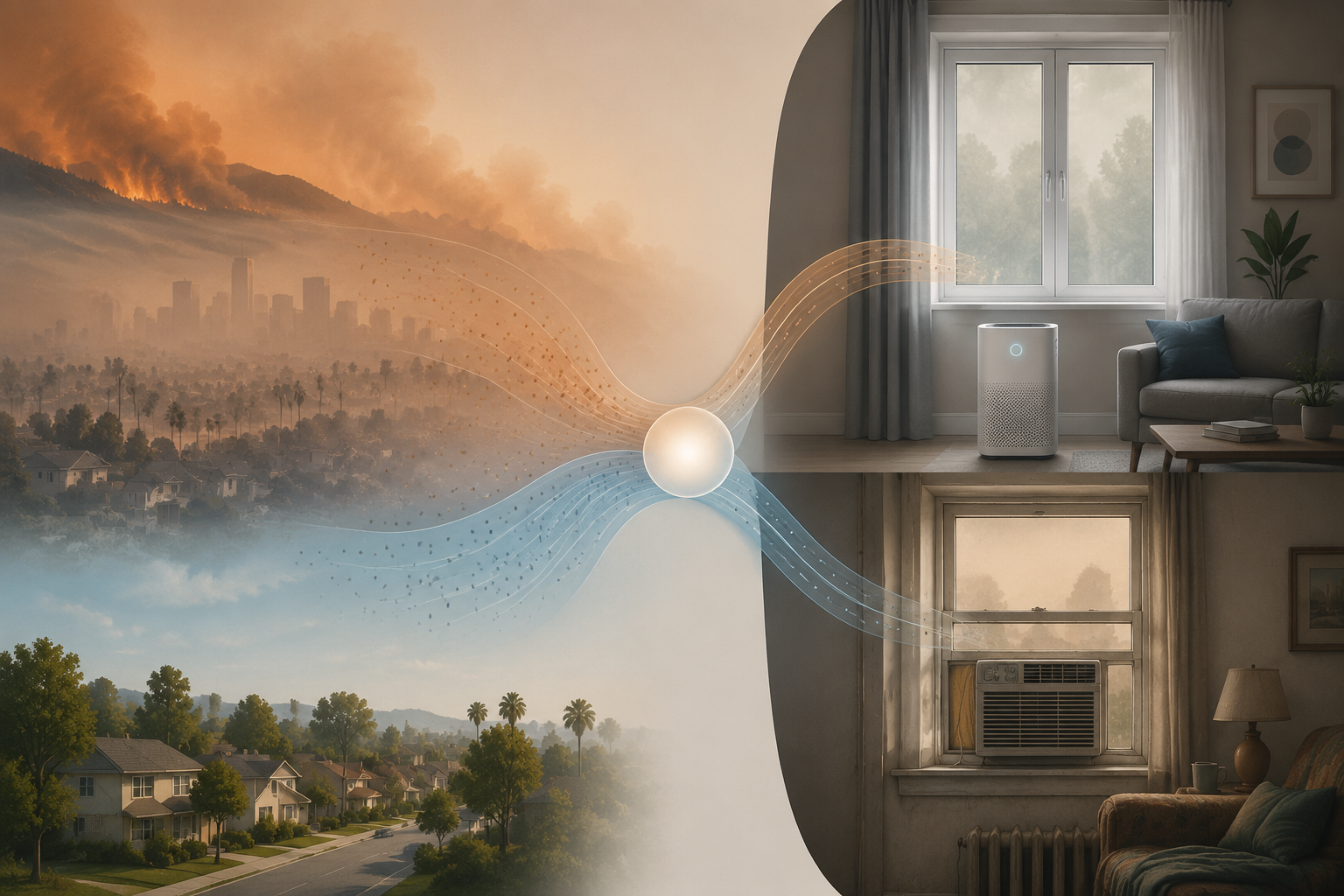
Risk Has Two Sides: Exposure and Vulnerability
A caregiver can sort smoky-air risk more accurately by separating two questions: how much smoke is likely to reach this person, and how well can this person’s body and living situation tolerate it?
| Question | What To Look For | Why It Changes Priority |
|---|---|---|
| How much smoke reaches them? | Wildfire-prone region, repeated smoke drift, poor outdoor air days, county-level smoke exposure | More exposure means more days when protection has to work |
| How vulnerable is their body? | Age 65+, COPD, asthma, heart disease, diabetes, respiratory symptoms, limited mobility | The same smoke level can produce more serious consequences |
| How vulnerable is their living situation? | No air conditioning, no high-efficiency filtration, drafty housing, limited transportation, no nearby caregiver | They may be unable to reduce exposure when smoke arrives |
| Do risk factors stack? | Race, poverty, gender, chronic disease, geography, and isolation occurring together | Stacked risks should move someone toward the front of the protection line |
EPA AirNow identifies adults 65 and older as a group at higher risk from particle pollution, including wildfire smoke, with sensitive-group concern beginning at the Orange AQI level of 101.[2] That baseline matters. But if two older adults are both in the Orange zone, the one living alone in a high-poverty smoke-prone county without reliable filtration is not in the same practical position as the one with central air, sealed windows, transportation, and a caregiver five minutes away.
Why Black Older Adults Belong Near The Top Of The Protection List
The Black-versus-white admission gap in the Liu study is not a decorative disparity statistic. It is the kind of finding that should change triage. A 21.7% rise in respiratory admissions on smoke-wave days among Black older adults, compared with 6.9% among white older adults, means that the same category of smoke event was associated with a much larger hospital burden in one group.[1]
The study also found that 73.4% of Black older adults were exposed to more than one smoke wave, compared with 56.0% of white older adults.[1] That matters because risk is not only about what happens after smoke enters the lungs. It is also about how often the person is put in that position in the first place.
For a family, this does not mean race replaces medical history. It means race may be part of the health profile because it can reflect accumulated differences in exposure, housing, neighborhood conditions, access to care, and baseline disease burden. A caregiver deciding who needs help first should not treat those conditions as separate from health simply because they are not listed on a medication label.
The Liu data comes from Medicare records from 2004 through 2009, so it predates the most extreme wildfire seasons of recent years.[1] That makes the study older than anyone would like for 2026 caregiving decisions. Still, it remains unusually useful because it directly compares exposure and admissions across race, poverty, gender, and region in the older adult population.
Poverty Raises Risk Before Anyone Starts Coughing
High-poverty areas showed a heavier exposure burden in the same study. Older adults in counties with more than 15% poverty had more than double the smoke-wave days of those in counties with less than 10% poverty: 2.70 days per year versus 1.28 days per year.[1]
That number is easy to underestimate because it sounds small on a calendar. For an older adult with fragile lungs or heart disease, an added smoke day is not just an unpleasant day indoors. It can mean another day of closed windows during heat, another night of poor sleep, another delayed pharmacy trip, another skipped walk, or another period when an adult child has to decide whether to leave work and intervene.
Lower income also affects the defenses a person can put between themselves and smoke. An older adult may know the advice—stay inside, filter indoor air, avoid exertion, relocate if needed—and still lack the equipment, cooling, transportation, or spare cash to carry it out. During a smoke event, that becomes a logistics problem, not an awareness problem.
For caregivers, the practical question is blunt: if you have one purifier, one afternoon to seal windows, or one person you can call every morning during a smoke episode, who has the fewest backup protections? The answer may be the parent in the older apartment with no central air, the neighbor who cannot drive, or the aunt whose fixed income makes filter replacement unlikely.
Gender And Respiratory Vulnerability Should Not Be Treated As Afterthoughts
The same Medicare study found a higher respiratory admission risk for women than for men on smoke-wave days: 10.4% versus 3.7%.[1] The finding does not mean every older woman is at higher risk than every older man. It does mean that if an older woman already has respiratory disease, limited home protection, or repeated exposure, her risk profile deserves attention rather than being flattened into “older adult” status.
This is where caregiving can become more precise. A 78-year-old woman with COPD in a smoke-drift region, living alone without a purifier, should move higher on the call list than a healthier older adult with better indoor air control. The point is not to rank people by one trait. It is to notice when several traits point in the same direction.
Geography Includes Both Fire Zones And Smoke-Drift Regions
Some older adults live where wildfire feels like a local event. Others live far from flames but still breathe transported smoke. The Liu study found that nearly all California counties—99.2%—were exposed to at least one smoke wave, compared with 7.5% of counties in the southwestern United States during the study period.[1] That contrast shows why caregivers in California and other wildfire-prone areas often need standing smoke plans rather than occasional improvisation.
But geography should not be reduced to a West Coast map. Smoke drift can make an older adult vulnerable in a place that does not think of itself as a wildfire community. A parent in the Midwest or Northeast may not need an evacuation plan for flames, but they may still need an indoor clean-air plan, medication review, symptom watch, and someone assigned to check AQI before outdoor errands.
If you are still building the basic monitoring habit, start with how to check air quality for an elderly loved one. If the advisory is already active, use how to keep older adults safe during an air quality advisory for room-by-room action.
Chronic Conditions Still Matter, But They Are Not The Whole Ranking
CDC guidance identifies people with chronic conditions—including asthma, COPD, heart disease, and diabetes—as groups who may be at higher risk during wildfire smoke exposure.[3] For older adults, these diagnoses should move planning from general caution to specific preparation.
- For COPD or asthma: confirm rescue medications, maintenance inhalers, oxygen instructions if used, and the threshold for calling a clinician.
- For heart disease: watch for chest discomfort, unusual shortness of breath, swelling, fatigue, or symptoms that do not match the person’s normal pattern.
- For diabetes: plan for disrupted meals, reduced activity, stress, and illness routines during days when smoke keeps the person indoors.
- For limited mobility: decide in advance who can move equipment, replace filters, pick up medications, or relocate the person if indoor air becomes unsafe.
Condition-specific planning deserves its own checklist because the right action differs by diagnosis. Use A Caregiver's Wildfire Smoke Preparedness Checklist for Chronic Conditions when a parent already has lung disease, heart disease, diabetes, or multiple medications that could complicate a smoke event.
The important adjustment is to combine clinical and social risk. A parent with COPD and central air may still need careful protection. A parent with COPD, no filtration, high smoke exposure, and no nearby caregiver needs earlier protection.
Dementia Adds A Different Kind Of Smoke Risk
Respiratory admissions are the strongest evidence for immediate triage in this article. Dementia adds a second concern: smoke planning is harder when memory, judgment, orientation, or routine-following are already impaired.
A 2024 JAMA Neurology study of 1.2 million older adults reported an association between wildfire PM2.5 exposure and incident dementia, with stronger associations among racial and ethnic minority subgroups and people in high-poverty neighborhoods.[4] That finding should be treated as an emerging layer rather than the main proof for urgent smoke response, and it should not be used to predict an individual person’s dementia risk.
Even without using dementia research to predict individual outcomes, memory impairment changes the care plan during smoky air. A person may open windows because the room feels stuffy, forget why the purifier is running, walk outside during a poor-air advisory, miss inhalers, or become agitated if routines change. The caregiver’s job shifts from giving instructions to designing an environment where the safer choice is the easiest choice.
For severe smoke days, that may mean setting up a clean room before the AQI peaks, labeling the purifier controls, removing unnecessary outdoor tasks, and assigning a real person—not just an app notification—to check in. If conditions move into very unhealthy or hazardous territory, how to set up a senior-safe clean room during Code Purple alerts can help translate the alert into a room setup.
How Caregivers Can Triage When Smoke Is Coming
Most families cannot solve housing quality, neighborhood exposure, medical access, and transportation during a smoke event. They can still triage. The goal is to put limited time and equipment where the risk stack is tallest.
- Start with all adults 65 and older, then move people higher if they are Black, live in a high-poverty area, are women with respiratory vulnerability, or have repeated smoke exposure.
- Move people higher again if they have COPD, asthma, heart disease, diabetes, dementia, limited mobility, or recent respiratory symptoms.
- Look at the home: no air conditioning, no high-efficiency filtration, leaky windows, heat that forces windows open, or no safe room should all raise urgency.
- Look at response capacity: living alone, no nearby caregiver, no transportation, limited phone access, or difficulty understanding alerts should raise urgency.
- Assign the first concrete action: deliver a purifier, prepare a clean room, review medications, schedule check-in calls, move outdoor appointments, or arrange temporary relocation.
This is not a perfect scoring system. It is a way to avoid the common mistake of treating “older adult” as one flat category. A healthier 70-year-old with filtered indoor air may need monitoring and sensible precautions. An 82-year-old Black woman with COPD in a high-poverty smoke-drift area, living alone without reliable cooling or filtration, needs earlier action.
If you need AQI-based steps rather than risk ranking, use how to protect your aging parent during an air quality alert. For a broader foundation on smoke-related health effects, see the real health toll of wildfire smoke on older adults.
The Caregiving Judgment
During wildfire smoke events, protection should go first to older adults whose risks stack together: Black older adults, people in high-poverty areas, women with respiratory vulnerability, adults with COPD, asthma, heart disease, diabetes, or dementia, and anyone in a high-exposure region or home without filtration, cooling, transportation, or a reliable person to intervene.
Age tells you who belongs in the sensitive group. Exposure, disease, housing, poverty, race, gender, geography, and caregiver access tell you who should be protected first.
References
- Who Among the Elderly Is Most Vulnerable to Exposure to and Health Risks of Fine Particulate Matter From Wildfire Smoke? American Journal of Epidemiology, 2017.
- Older Adults AirNow.gov.
- Wildfire Smoke and People with Chronic Conditions Centers for Disease Control and Prevention.
- Wildfire Smoke and Dementia Association in Older Adults JAMA Neurology, 2024.
Related reading
Noticed something outdated or inaccurate on this page? Flag a correction. We review every report against CDC, NIA, and AARP HomeFit guidance before updating a page.
Part of the Fall Prevention section.