
Glossary entry
24-Hour Home Care FAQs: Cost, Coverage, Logistics, and When It's Time

What Is 24-Hour Home Care?
24-hour home care means a senior receives continuous supervision and assistance with activities of daily living (ADLs) — bathing, dressing, toileting, transferring, and eating — inside their own home, around the clock. This is not a single caregiver staying overnight. It is a team of caregivers working rotating shifts so that someone is awake, alert, and available at every hour of the day and night.
The most common shift structures are two 12-hour shifts or three 8-hour shifts. The specific arrangement depends on the agency, state regulations, and the senior's needs. The key constant: there is never a gap in coverage.
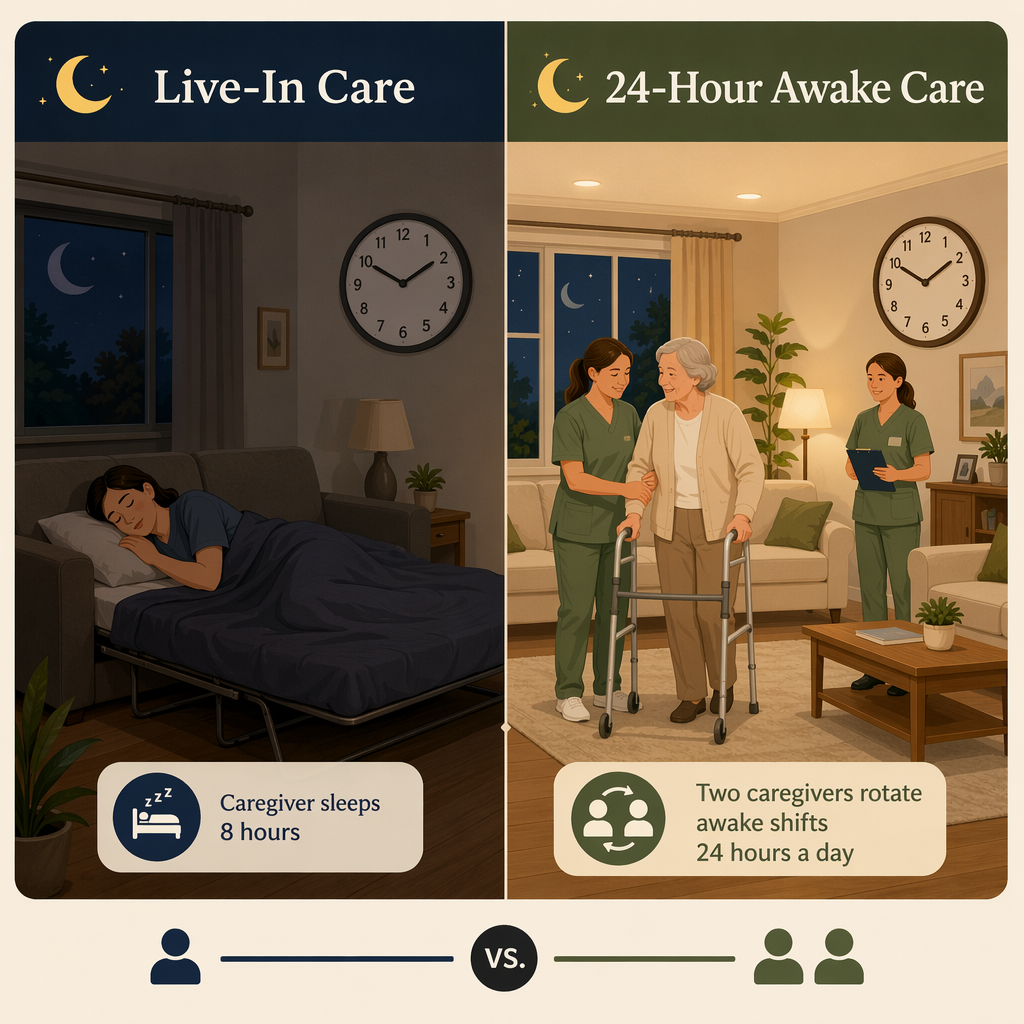
What Is the Difference Between 24-Hour Care and Live-In Care?
These two terms are often used interchangeably, but they describe fundamentally different arrangements with different costs and levels of supervision. Understanding the distinction is critical before you call an agency.
| Feature | 24-Hour Care (Awake Care) | Live-In Care |
|---|---|---|
| Caregiver status | Awake and on duty at all times | Sleeps for 8 hours during the night |
| Shift structure | 2 x 12-hour shifts or 3 x 8-hour shifts | Single caregiver for 24 hours |
| Supervision overnight | Continuous — caregiver is awake and available | Caregiver is asleep; not expected to provide care |
| Best for | Wandering, sundowning, frequent bathroom trips, post-hospital recovery | Seniors who sleep through the night and do not need assistance |
| Typical monthly cost (2026) | $19,656 – $24,733 (national median range) | ~$10,646 (A Place for Mom proprietary data) |
Federal Department of Labor rules require that a live-in caregiver must have a place to sleep and must receive an uninterrupted 8-hour break during each 24-hour period. If your parent cannot safely go 8 hours without assistance — because of dementia-related wandering, incontinence, or fall risk — live-in care is not appropriate. You need 24-hour awake care.
How Much Does 24/7 Home Care Cost in 2026?
The short answer: a lot. The exact number depends on where you live, the agency you choose, and whether you need 24-hour awake care or live-in care. Here is what the 2026 data shows.
| Source | Hourly Rate | Daily Cost (24 hrs) | Monthly Cost (30 days) |
|---|---|---|---|
| A Place for Mom 2026 Report | $34/hour | $816/day | $24,733/month |
| Genworth via AgingCare (2023–2024 survey) | $27/hour | $648/day | $19,656/month |
State-by-state variation is dramatic. The highest-cost states can be nearly double the lowest-cost states:
| State | Estimated Monthly Cost (24/7 Care) |
|---|---|
| Washington | ~$27,000 |
| Minnesota | ~$26,390 |
| Colorado | ~$24,388 |
| California | ~$23,296 |
| Oregon | ~$23,296 |
| Massachusetts | ~$22,568 |
| Alabama | ~$14,705 |
| Mississippi | ~$14,560 |
| Louisiana | ~$14,196 |
| West Virginia | ~$13,650 |
For a deeper breakdown of overnight shift costs and how to model your own budget, see our complete cost guide for overnight care.
What Services Are Included in 24-Hour Home Care?
A 24-hour home care plan typically includes assistance with the following:
- Bathing, dressing, grooming, and toileting
- Transferring (moving from bed to chair, chair to toilet, etc.)
- Feeding assistance and meal preparation
- Medication reminders (not administration of injections or IV medications)
- Light housekeeping and laundry related to the care recipient
- Companionship and supervision for safety
- Mobility assistance and fall prevention
It is important to understand that non-medical home care aides are not licensed nurses. They cannot perform skilled medical tasks like wound care, catheter changes, or administering injections. If your parent needs those services, you will need a separate home health agency. The specific scope of what an aide can do also varies by state regulations.
Does Medicare Cover 24-Hour Home Care?
No. This is one of the most common and costly misconceptions families face. Medicare explicitly does not pay for 24-hour-a-day custodial care at home.
For a complete breakdown of what Medicare does and does not pay for, read our guide: What Medicare Actually Pays For When an Elderly Parent Needs Care at Home. And for the often-misunderstood homebound requirement, see The Medicare Homebound Rule: What It Actually Means.
Does Medicaid Cover 24-Hour Home Care?
Medicaid rarely covers round-the-clock personal care in a private home. While more than 86% of long-term support beneficiaries received care at home through Medicaid waiver programs in 2021, those programs typically cap the number of hours of care per day.
Here is what you need to know about Medicaid Home and Community-Based Services (HCBS) waivers:
- Typical caps range from 8 hours per day (Virginia) to 16 hours per day (Washington D.C.) — well short of 24-hour coverage.
- Asset limits are strict: in 2026, the individual asset cap is typically around $2,000 (some states like California have higher limits, e.g., $130,000 for an individual).
- Income limits in many states allow up to 3 times the federal SSI amount ($994/month in 2026), equaling $2,982/month.
- Most states require the applicant to need help with 3 or more ADLs to qualify for a waiver.
- Some states allow family members to be paid caregivers through self-directed care models.
For a broader look at financial assistance options, including VA Aid & Attendance and long-term care insurance, see our guide to finding money to care for aging parents.
How Do I Know When It's Time for 24-Hour Care?
The decision to move to 24-hour care often follows a specific crisis — a fall, a hospital discharge, a wandering episode. But there are clear warning signs that can help you act before a crisis occurs.
- Frequent falls or near-falls, especially at night when trying to get to the bathroom
- Increased confusion, wandering, or sundowning (agitation in the late afternoon or evening)
- Incontinence or difficulty toileting independently
- Inability to be left alone safely after a hospital or rehab stay
- Caregiver burnout — you or other family members are exhausted, missing work, or experiencing health problems from the strain
- Safety concerns with cooking, using the stove, or navigating stairs
- Wandering or leaving the house at unsafe hours
If you are seeing several of these signs, it is time to have a serious conversation. For a more detailed assessment tool, see our 24-hour care decision framework for families. And if you are wondering whether monitoring technology could be a less intensive first step, read When Is 24/7 Care Actually Necessary? A Decision Framework for Using Monitoring Technology.
How Do I Arrange 24-Hour Home Care?
Arranging 24-hour care is a multi-step process. Here is a high-level overview:
- Assess the level of care needed. Be specific about which ADLs your parent needs help with and whether they need overnight supervision.
- Research licensed and bonded home care agencies in your area. Look for agencies that specialize in 24-hour or live-in care.
- Request in-home assessments from at least two or three agencies. A reputable agency will send a nurse or care manager to evaluate your parent's needs in person.
- Compare costs, caregiver qualifications, and scheduling models. Ask specifically about the shift structure (12-hour vs. 8-hour rotations) and what happens if a caregiver calls out sick.
- Review the care plan and contract carefully. Look for details on overtime rates, holiday pay, cancellation policies, and the process for requesting a different caregiver.
For a complete step-by-step walkthrough, see our 8-step action plan for setting up home assistance.
What Are the Alternatives to 24-Hour Home Care?
24-hour home care is not the only option. Depending on your parent's needs, safety risks, and budget, one of these alternatives may be more appropriate.
| Option | Typical Cost | Best For |
|---|---|---|
| Live-in care | ~$10,646/month | Seniors who sleep through the night and need daytime assistance only |
| Adult day programs | $50–$150/day | Daytime supervision and social engagement; family caregivers need a break during work hours |
| Monitoring technology (PERS, sensors) | $30–$100/month (monitoring fee) | Seniors who are mostly independent but need a safety net for falls or emergencies |
| Assisted living facility | $5,419/month (national median) | Seniors who need 24/7 supervision but do not require skilled nursing |
The right choice depends on your specific situation. For a detailed comparison of home care versus assisted living costs, including the crossover point where one becomes more affordable than the other, read our home care vs. assisted living cost crossover guide.
How Do I Vet a Home Care Agency for 24-Hour Services?
Not all home care agencies are equipped to handle 24-hour care. Here are the key questions to ask before signing a contract:
- Is the agency licensed and bonded in your state? Verify with your state's health department or licensing board.
- What is the caregiver screening and training process? Do they conduct background checks, drug testing, and skills assessments?
- Can you provide references from other families who have used your 24-hour care service?
- What is your backup plan if a caregiver calls out sick? Is there a guaranteed replacement within a certain time frame?
- What is the shift structure? Do you use 12-hour or 8-hour rotations? How many different caregivers will my parent see in a week?
- What are the overtime, holiday, and cancellation policies? Are there any hidden fees?
- Can we request the same caregivers regularly? Consistency is important for building trust and familiarity, especially for seniors with dementia.
Take your time with this step. A good agency will welcome your questions and provide clear, written answers. A bad agency will rush you or avoid specifics.
Browse more in the Glossary.