
Room checklist
How to Talk to a Reluctant Parent About Home Modifications: A Caregiver's Conversation Guide
A practical guide for adult children whose parent resists home safety modifications after a fall or functional decline. Learn the five common resistance patterns, evidence-backed conversation scripts, and a relationship-first framework to move from conflict to collaboration.
The Gap Between Wanting to Age in Place and Preparing for It
You already know the statistics that matter. Over 90% of older adults say they want to remain in their own homes as they age. Yet according to the University of Michigan National Poll on Healthy Aging, only 18% of adults aged 50 and older have actually made any home modifications to prepare for that goal. That is not a small gap. It is a chasm — and it is almost never bridged by information alone.
Your parent likely already knows that grab bars exist, that stair lifts are a thing, and that the bathroom is the highest-risk room in the house. The National Council on Aging reports that over half of all falls among older adults take place at home. The CDC states that one in four older adults falls each year, and falls are the leading cause of fatal and nonfatal injuries for people 65 and older. These are not obscure facts. They are in the news, in the doctor's office, and probably in conversations you have already tried to have.
So if the information is not the problem, what is? The answer is emotional. The gap between knowing and doing is filled with fear, pride, identity, and grief. This guide is not about which modifications to install or how much they cost — the site already covers those topics in depth. This is about the conversation itself: why it keeps failing, what your parent is actually saying when they say "no," and how to move from conflict to collaboration.
Why Logic Fails First: The Psychology of Resistance
When you lead with statistics — "one in four older adults falls each year" — you are speaking a language your parent's brain is actively filtering out. Three psychological mechanisms explain why logical arguments bounce off without landing.
Normalization Bias
Age Safe America describes normalization bias as the tendency for older adults to interpret early warning signs — dizziness when standing up, a near-miss on the stairs, a moment of unsteadiness in the shower — as normal or harmless. "I was just moving too fast." "It was just a slip." "That happens sometimes." Each dismissed event reinforces the belief that nothing is wrong, making the next conversation harder because the evidence keeps getting explained away.
Post-Fall Anxiety Syndrome
When a fall does occur — or even a serious near-fall — the response is often counterintuitive. The person develops a fear of falling, which leads them to walk more slowly and shuffle. Reduced activity causes muscle weakening and balance decline. Weaker muscles and worse balance make another fall more likely, often more severe than the first. This is the post-fall anxiety cycle, and it means that the period immediately after a fall is paradoxically the hardest time to have a productive conversation about prevention, because the parent is already in a defensive, fearful state.
Pride and Identity Preservation
This is the deepest layer. HealthCraft notes that the identity shift from caretaker to care receiver feels intrusive and embarrassing. Your parent has spent decades being the person who takes care of others, who manages the household, who is independent. Accepting a grab bar or a shower chair is not just accepting a piece of hardware — it is accepting a new identity. The British Geriatrics Society systematic review by Hall et al. identified stigma associated with aging and disability as one of the five major barrier themes to home modifications. Pride is not stubbornness. It is a person fighting to preserve the version of themselves they have always been.
Five Resistance Patterns and What to Say
Every objection your parent raises falls into one of five patterns. Each pattern has a different emotional root and requires a different conversational approach. The scripts below are not meant to be memorized word-for-word — they are frameworks you can adapt to your relationship and your parent's personality.
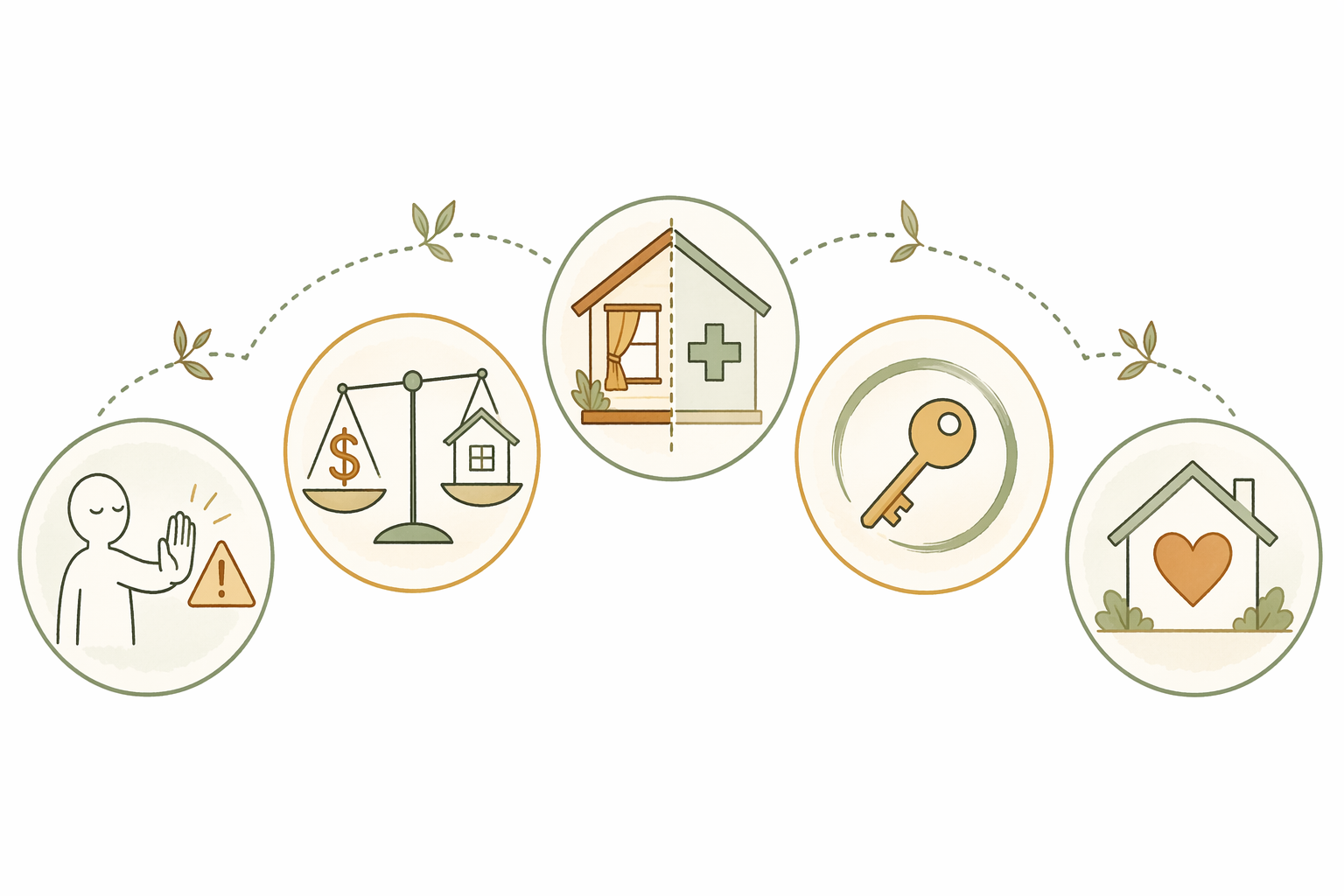
Pattern 1: Denial of Fall Risk ("I'm fine")
This is normalization bias in action. Your parent genuinely believes they are fine because nothing catastrophic has happened yet. The near-falls and moments of unsteadiness have been filed away as normal.
What to say: "I know you feel fine most days. And I'm not saying you can't take care of yourself — you've been doing that my whole life. But I've noticed you're not going upstairs as much as you used to, and that makes me worry. This isn't about age. It's about smart planning. People in their 50s and 60s make these changes so they're prepared for the future."
The key move here is to shift from "you have a problem" to "I have a worry." Home Healthsmith recommends using observation rather than accusation — "I've noticed you're not going upstairs as much lately" — because it invites conversation rather than defensiveness.
Pattern 2: Cost Anxiety ("I can't afford it")
Cost is a legitimate concern, but it is also often a convenient shield for deeper fears. The BGS review confirms cost as a major barrier theme. The key is to acknowledge the financial reality while reframing the investment.
What to say: "I hear you — these things aren't cheap. But let's look at what we're comparing it to. A single grab bar costs between $150 and $400 installed. A stair lift runs $2,500 to $8,000 for a straight staircase. Compare that to the average cost of assisted living, which is around $74,000 per year nationally. Even a full home remodel at $15,000 to $60,000 is a fraction of one year in a facility. And each prevented fall saves an estimated $30,000 in hospital and rehabilitation costs. We don't have to do everything at once. Let's start with one small change and see how it feels."
For a deeper look at financing options, including grants, loans, and assistance programs, see our guide on how to pay for a senior bathroom remodel in 2026.
Pattern 3: Aesthetic Concerns ("It'll look like a hospital")
This objection is about dignity and identity. Your parent does not want their home to look like an institution because they do not want to feel like a patient. The BGS review identifies stigma associated with aging and disability as a core barrier — and visible modifications like grab rails are the most frequently discussed in terms of resistance.
What to say: "I completely understand. Your home should look like your home. But the good news is that modern accessibility solutions look nothing like the institutional equipment you're imagining. Grab bars now come in decorative finishes like brushed nickel and oil-rubbed bronze. Walk-in showers can be beautiful — they're actually a popular design choice in new homes regardless of age. We can find options that match your style. Let's look at some pictures together and see what's possible."
Home Healthsmith emphasizes that today's accessibility products are designed to blend with home decor. The conversation should shift from "what you'll lose" to "what you can keep" — the home's character, the style your parent has cultivated over decades.
Pattern 4: Perceived Loss of Autonomy ("I don't want strangers in my house")
The BGS PPI workshop study identified a novel theme they called "stranger danger" — discomfort with unfamiliar professionals entering the home. This is not about being unfriendly. It is about control. Your parent's home is their last domain of complete authority, and inviting a contractor or occupational therapist in feels like surrendering that control.
What to say: "I know it feels uncomfortable to have people coming into your space and suggesting changes. But remember, they work for you. You are the one who decides what happens in your home. An occupational therapist or a CAPS-certified contractor is there to help you achieve your goal — staying independent in this house. They are not there to take over. We can start with just a consultation, no commitment. You get to say yes or no to every suggestion."
CareLink recommends using terms like "support" or "backup" instead of "care" or "assistance." Reframe the third party as someone who helps your parent maintain their autonomy, not someone who diminishes it.
Pattern 5: Grief Over Home Identity ("This is my home, not a nursing home")
This is the hardest objection to address because it is not really an objection — it is grief. Your parent is mourning the version of their life where they did not need modifications. They are afraid that once they start, they will lose control of what their home means.
What to say: "This is your home. It always will be. Nothing we do changes that. The reason I'm bringing this up is because I want you to stay here — in this house, with all its memories — for as long as possible. These changes aren't about turning your home into something else. They're about making sure you can keep living in the home you love. You are the strong and capable person I've always known you to be. Your body just doesn't have the same strength it used to have. Let's make some changes so you can keep doing as much as possible for yourself."
This script, adapted from HealthCraft's conversation framework, honors the parent's identity while gently acknowledging the physical reality. It does not argue. It aligns.
A Conversation Framework That Works
Beyond individual scripts, a structured approach to the conversation itself increases the chances of a productive outcome. The following framework is synthesized from multiple sources — HealthCraft, Home Healthsmith, Arcadia Home Care, and CareLink — and is designed to work across all five resistance patterns.
- Start with empathy and listening. Before you say anything about modifications, ask your parent how they are feeling about living at home. What do they love about it? What is getting harder? Arcadia Home Care emphasizes that careful listening shows respect and gets at the true root of hesitation. Your goal in the first conversation is not to convince — it is to understand.
- Use "I" statements, not "you" statements. "I worry when I think about you on that ladder" is very different from "You shouldn't be on that ladder." "I would sleep better knowing there's a grab bar in the shower" is different from "You need a grab bar." The first approach invites collaboration. The second triggers resistance.
- Let the doctor take the lead. A written recommendation or a direct conversation from a primary care physician carries weight that you, as a family member, simply cannot match. Arcadia Home Care notes that a doctor's encouragement can make a person believe a modification is a necessity rather than a deprivation of independence. Ask your parent's doctor to write a brief note or make a phone call.
- Take baby steps. Do not lead with a full bathroom remodel or a stair lift. Start with one small change — a grab bar in the shower, a non-slip mat, better lighting in the hallway. Home Healthsmith recommends emphasizing trial options: "Let's try this for a few weeks and see how it feels." Success with a small change builds confidence for larger ones.
- Suggest a trial run. "Just for a few weeks" is a powerful phrase. It lowers the stakes. It makes the modification feel reversible. Arcadia Home Care specifically recommends framing any change as a temporary trial. After a few weeks, the new grab bar or shower chair becomes normal, and the resistance often dissolves on its own.
For a structured approach to prioritizing which modifications to start with after the conversation succeeds, see our aging in place home modifications decision framework.
When to Bring in a Third Party
Sometimes the conversation needs a neutral expert — someone who is not a worried child or a well-meaning spouse. An occupational therapist (OT) or a CAPS-certified contractor can serve as an ally who helps your parent achieve their own goal of staying independent at home.
The evidence for OT-led home modifications is strong. A 2024 study by Riera Arias et al., cited in a systematic review published in Healthcare (Cha, 2025), found that OT-led home modifications improved home adaptation rates from 45.2% to 79.0% and significantly improved autonomy, mobility, and quality of life. When an expert recommends a specific modification, it is no longer a family argument — it is professional advice.
How to frame the third party to your parent: "I'd like to have someone come look at the house who specializes in helping people stay in their homes as they get older. They're not going to tell you what to do — they're going to give us options and you get to decide. Think of it like a home inspector, but for safety and comfort."
For guidance on choosing between an OT, a CAPS-certified contractor, and a general contractor, see our article on who to hire first for aging-in-place home modifications.
What to Do If the Answer Is Still No
Sometimes, despite your best efforts, the answer is still no. This does not mean you have failed. It means the emotional work is not finished. Resistance to home modifications is rarely resolved in a single conversation. Here is what you can do while you wait for the door to open.
- Plant seeds for future conversations. Leave a brochure about grab bars on the kitchen table. Send a link to a video about modern accessible design. Mention a friend whose parent made a similar change and is happy with it. Do not push. Just leave the information where it can be found.
- Start with invisible modifications. Your parent may not notice better lighting, a non-slip bath mat, or a strategically placed chair in the bedroom for dressing. The NCOA recommends these as quick, low-resistance changes that reduce fall risk without triggering the emotional response that visible modifications can cause.
- Enlist trusted allies. Is there a sibling, a close friend, a clergy member, or a neighbor your parent trusts? Sometimes the same message lands differently from a different voice. CareLink recommends enlisting a professional third party like an elder care consultant to provide a neutral perspective.
- Focus on your own planning. You cannot force your parent to accept help, but you can prepare for the moment they do. Use our 30-day timeline for setting up aging in place services to organize your research, gather contractor recommendations, and understand funding options. When your parent is ready, you will be ready.
For a broader overview of how fall prevention services support aging in place, see our family caregiver's roadmap to fall prevention and aging in place.
The conversation about home modifications is rarely easy, but it is almost always worth having. Your parent's resistance is not a rejection of you. It is a person fighting to preserve their sense of self in a body and a home that are changing. Meet them there, with empathy and patience, and the door will open — maybe not today, but eventually.
Related reading
Need a professional assessment?
Find a CAPS-credentialed professional or local aging services through our outbound resource list — we never name or rank individual contractors.
Find Local HelpNoticed something outdated or inaccurate on this page? Flag a correction. We review every report against CDC, NIA, and AARP HomeFit guidance before updating a page.