CAPS vs General Contractor: Which Professional Should You Hire for Aging-in-Place Home Modifications?
Reviewed: 2026-06-23
CAPS vs General Contractor: Which Professional Should You Hire for Aging-in-Place Home Modifications?
Deciding between a CAPS-certified specialist and a general contractor for home modifications? This side-by-side comparison reveals why the specialized training of a CAPS can save you money and prevent costly mistakes on moderate-to-complex aging-in-place projects.
By Editorial Team
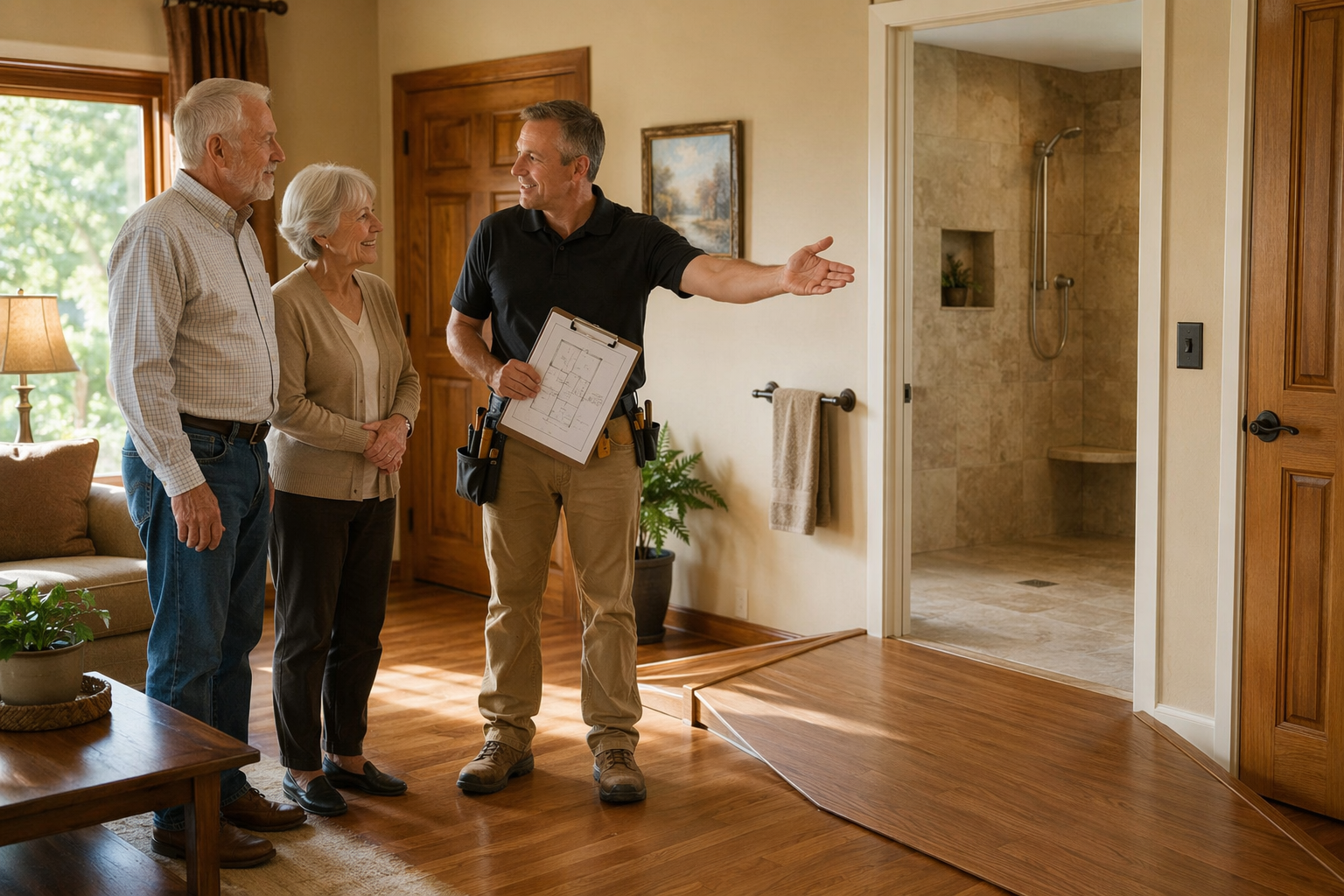
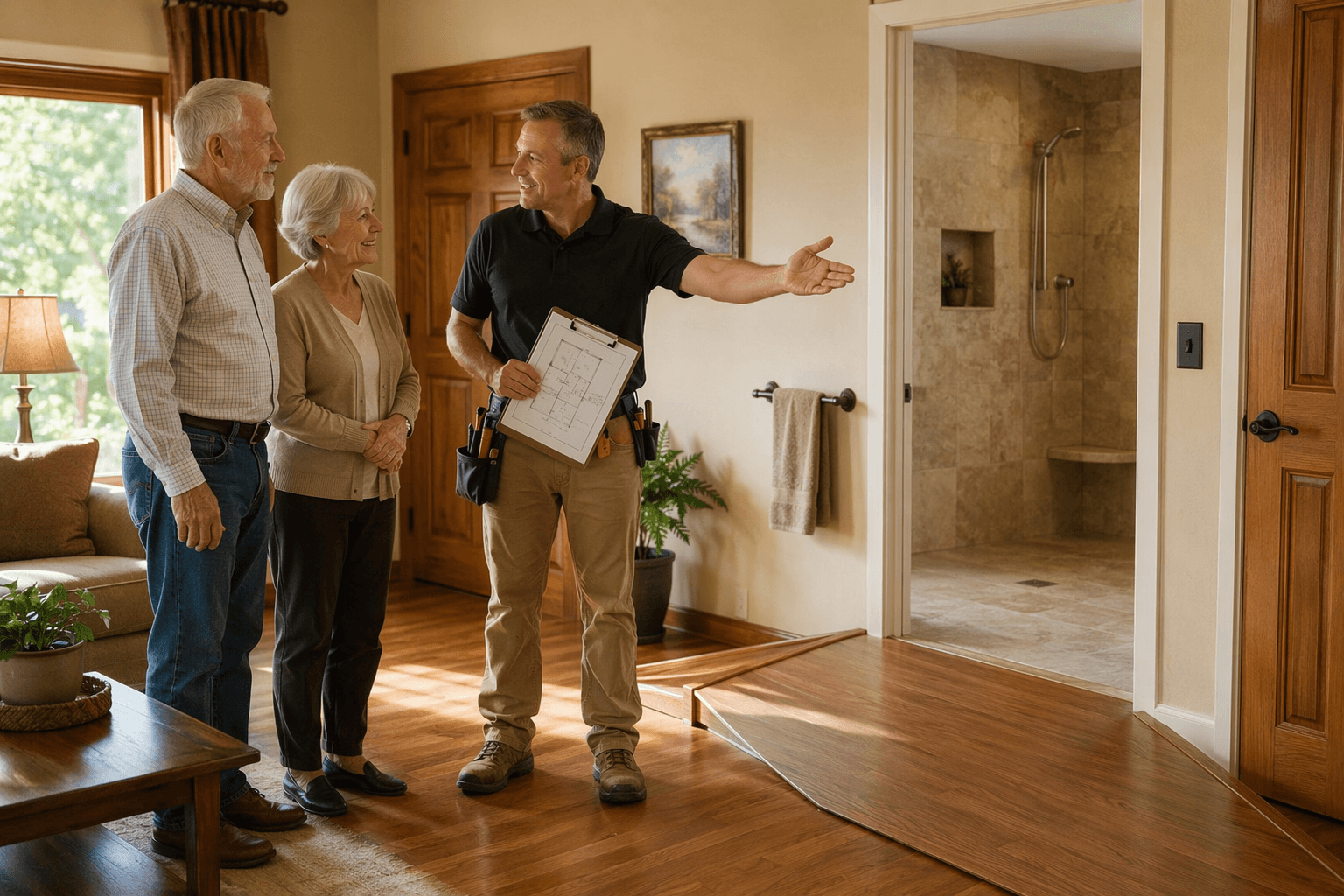
A CAPS assessment catches details a standard contractor walkthrough would miss.
When a parent’s mobility starts to slip — a fall, a hip replacement, a dementia diagnosis — most families do the natural thing: call a general contractor. Makes sense. A GC remodels kitchens, fixes roofs, builds additions. A bathroom grab bar is a simple install, right?
It’s not that simple. A GC’s training covers permits, structure, finishes. It does not cover how an aging body moves through a space, what happens to balance when someone transfers from a walker to a toilet, or why a 1/4-inch threshold can turn a safe step into a fall hazard. A certified aging in place specialist (CAPS) trains on exactly those functional details — the physical needs of an older adult, universal design principles, and how to work with occupational therapists. The typical GC never studies any of that.
The gap is not academic. Amy Roberts, a senior real estate specialist and CAPS, puts the number of U.S. homes that are aging-in-place ready at less than 4%. The Census Bureau says around 10%. Either way, nearly every home needs an evaluation that goes beyond a standard construction walkthrough. And I can show you exactly where the difference shows up.
Three Places the GC’s Training Runs Out
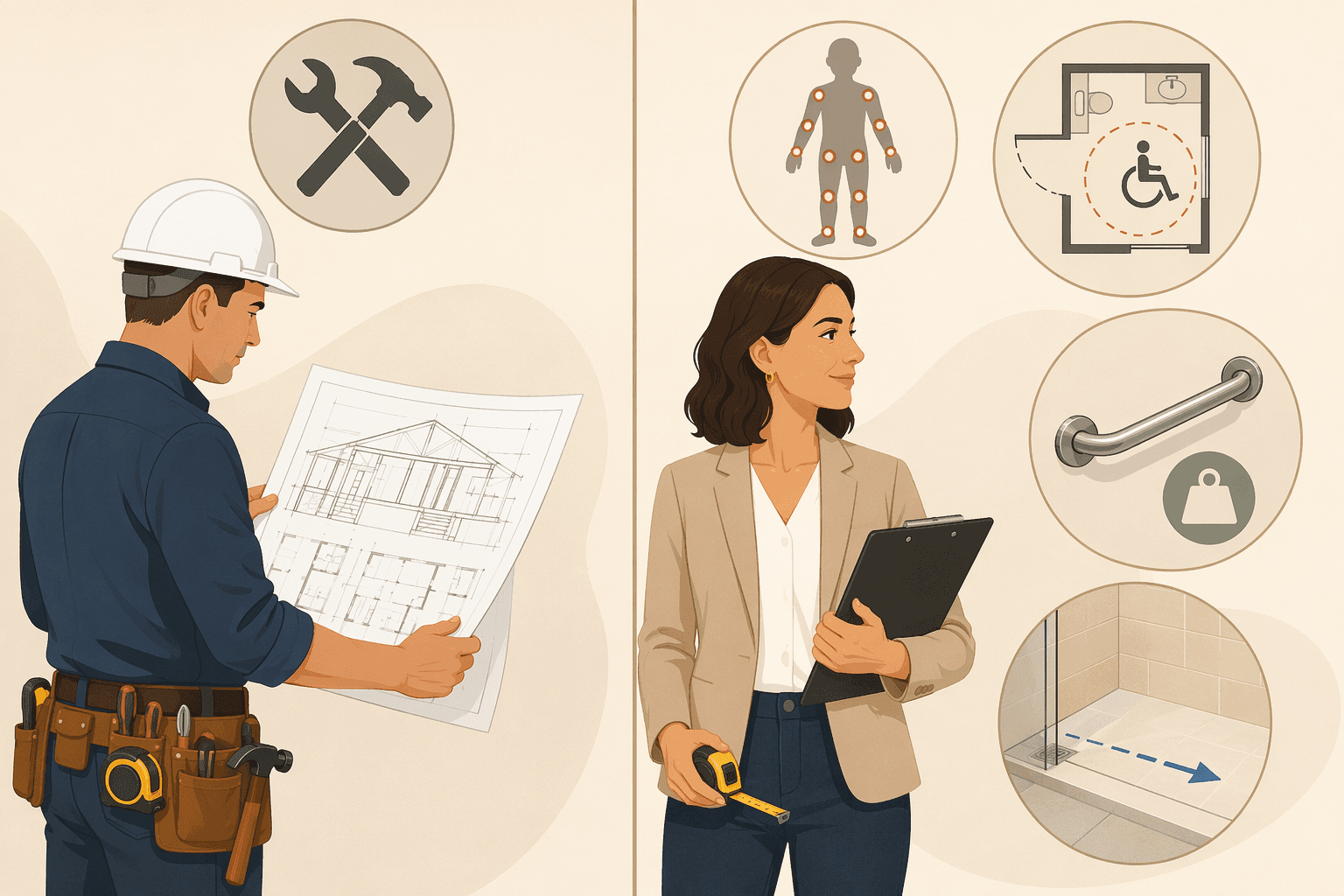
The build-focused approach versus the functional-assessment approach.
I’ve looked at enough rework bills to know: these are the mistakes that families discover after the modification is done — and then either live with a dangerous situation or pay to fix it.
Grab bar backing. A standard contractor installs a grab bar into drywall with toggle bolts. Looks fine, but it won’t hold the 250–300 pounds of a person pulling themselves up. A CAPS knows to install reinforced blocking between studs. The cost of a single grab bar installed is $150–$400. If it fails and has to be redone, you’re out that amount plus drywall repair. A CAPS assessment ($300–$1,000) catches this before the first hole is drilled.
Turning radius. Doorways and hallways need to be at least 32 inches wide for a walker or wheelchair, and a full 60-inch turning radius for a wheelchair to pivot. Most GCs build to standard residential dimensions, not to universal design guidelines. Fixing a too-narrow doorway after the fact costs $700–$2,000. The CAPS measures during the assessment and flags the dimension before construction starts.
Threshold heights and lighting contrast. A 1/4-inch lip at a doorway is a trip hazard for anyone with reduced foot clearance. A CAPS specifies a flush transition. Similarly, low-contrast color changes between floor and wall can disorient someone with macular degeneration. A CAPS specifies high-contrast edges and indirect lighting. Neither detail appears in a typical GC’s scope of work.
The $300 Question
I was skeptical of the extra cost myself. A CAPS home assessment runs $300–$1,000 for a full evaluation with a written report. The specialist may also charge $75–$200 per hour for consultation. That looks like a pure extra compared with a GC who gives a free bid.
But do the math. If the CAPS catches even one mistake a GC would have built wrong, the fee is covered. A single grab bar redo: $150–$400. A doorway widening after the walls are finished: $700–$2,000. A curbless shower that needs a slope correction? Thousands. For a mid-range project — bathroom and entryway modification — the savings from avoiding rework routinely exceed the assessment fee.
The smartest workflow I’ve seen: pay a CAPS first to develop a detailed specification, then a GC bids on that spec with no ambiguity. The GC’s price may be higher than if you went straight to construction, but the risk of change orders and rework drops sharply. That’s why the hybrid model — CAPS assessment plus GC execution — is the most cost-effective path for complex renovations in the $10,000–$50,000 range.
One Structural Difference No One Talks About
General contractors learn on the job and keep up with building codes. But there is no requirement for continuing education in aging-in-place design. A CAPS must complete four hours of continuing education every year to renew the credential. That’s a small requirement, but it forces awareness of new products — lower-threshold shower pans, anti-scald valves with memory stops, smart lighting that adjusts to circadian needs. It doesn’t guarantee every CAPS is current, and it doesn’t mean a GC with a dozen aging-in-place projects is automatically worse. But it is a structural difference that favors the CAPS when the project depends on knowing the latest safety standards.
How to Actually Do It
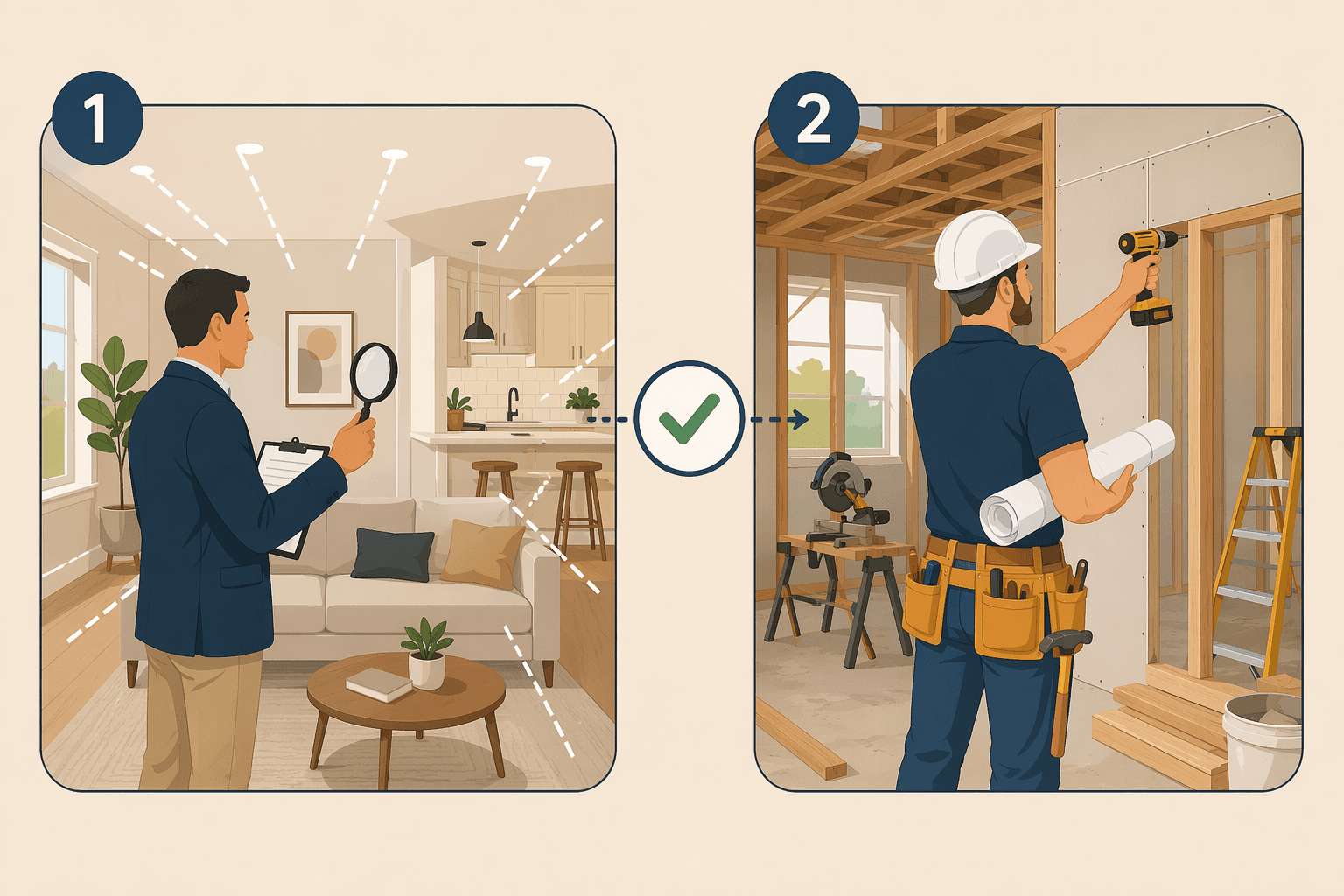
The assessment-first, then execution model avoids rework and keeps costs predictable.
The most practical recommendation I’ve found: hire a CAPS for the assessment and design, then bring in a trusted general contractor to execute the plan. The CAPS doesn’t need to swing a hammer. Many come from design, healthcare, or real estate backgrounds — about a third aren’t contractors at all. They provide a detailed specification (exact grab bar placement with blocking diagrams, threshold heights, lighting contrast ratios) that a GC can build from with confidence.
If you go this route, verify the CAPS and GC are aligned. Share the written assessment report with the GC before construction, and if possible, have the CAPS do a mid-project walkthrough. This is common in the industry and prevents the most expensive error: a detail that was in the plan but got lost in execution.
Choosing the right mix for your project.
Professional
Best for
Typical cost
General contractor only
Simple, non-accessible renovations (e.g., new flooring, paint)
Full-service remodel with integrated design and execution
Higher hourly ($75–$200/hr) but single point of accountability
My Rule of Thumb
Not every project needs a CAPS. A simple handrail or a shower chair — no. But for anything that changes how a person moves through their home — bathroom modifications, entrance ramps, stair lifts, a full kitchen reconfiguration — start with a CAPS assessment. Use the resulting plan to get competitive bids from general contractors. That sequence reduces surprises, keeps safety in the foreground, and usually costs less in the long run.
For a deeper look at room-by-room modifications a CAPS typically recommends, see our evidence-based aging-in-place guide. And if you are weighing this against the broader readiness gap, the aging-in-place gap analysis explains why so few homes are ready.

Comments
Join the discussion with an anonymous comment.