
Room checklist
A Stay-or-Go Flood Evacuation Guide for Elderly Homeowners
Know when evacuation is non-negotiable and when you can safely shelter in place with this five-criterion flood decision framework for elderly homeowners.
- Room
- general
- Reviewed by
- Editorial Team
Flood emergency preparedness for elderly homeowners fails when it stops at “evacuate if ordered.” By the time an order arrives, the household may already have lost the things that make leaving possible: daylight, an available driver, working elevators, dry roads, charged medical equipment, or the older adult’s stamina.
The age disparity in recent U.S. hurricane deaths is hard to dismiss. AARP’s Disaster Resilience Tool Kit reports that adults 75 and older were about 6% of New Orleans’ population but about 50% of Hurricane Katrina deaths, citing Louisiana Department of Health data; that original state dataset could not be independently re-verified here, so AARP is the proximate source. The same AARP resource reports that adults 60 and older made up 70% of Hurricane Ian fatalities, 61 of 87 deaths.[1]
Those numbers do not mean every older homeowner must leave for every flood watch. They do mean the decision cannot wait for a broad public warning if the person needs oxygen, cannot manage stairs, has no reliable ride, or lives where floodwater could block the only exit.

The Stay-or-Go Rule
Use five criteria: flood risk, home resilience, medical dependency, mobility and support, and supply autonomy. Mark each one green, yellow, or red. Any single red criterion changes evacuation from a preference to an imperative. When possible, leave 24–48 hours before an official order, not after the order forces the whole region onto the same roads.
This is guidance, not medical, legal, insurance, or local emergency advice. Medication storage, oxygen use, dialysis, wound care, cognitive impairment, and shelter eligibility need confirmation from clinicians, local emergency management, and county shelter rules before storm season.
| Criterion | Green | Yellow | Red |
|---|---|---|---|
| Flood risk | Home is outside mapped flood-risk areas and local officials are not warning of neighborhood inundation. | Flood risk is uncertain, nearby roads flood first, or the homeowner cannot verify current local risk. | Home is in a mapped flood-risk area, has flooded before, or evacuation routes are expected to close. |
| Home resilience | Living area, exits, utilities, lighting, bathroom access, and safe sleeping space can function through the expected event. | One system is questionable, such as sump pump reliability, stair access, or building generator coverage. | The home may trap the person, lose critical systems, or become unsafe if power, elevators, plumbing, or ground-floor access fails. |
| Medical dependency | No life-sustaining powered equipment is needed, and medications and care supplies can be managed without outside help. | Powered equipment or refrigerated medication is used, but backup plans are incomplete or untested. | No reliable backup power, no safe medication plan, no caregiver coverage, or no confirmed medical shelter option. |
| Mobility and support | The person can leave without stairs or standing water, and a driver is confirmed inside the evacuation window. | The person can leave only with help, timing is tight, or the driver may be unavailable. | No driver, no accessible vehicle, stair dependence, elevator dependence, transfer difficulty, or likely evacuation through water or darkness. |
| Supply autonomy | The home has enough water, food, medications, hygiene, lighting, communication, and fall-safe space for the expected isolation period. | Supplies cover basic food and water but not medication, hygiene, batteries, incontinence care, or safe nighttime movement. | Supplies cannot support at least several days of isolation, or the person needs outside help that may not arrive. |
A yellow result is not permission to wait indefinitely. It means the missing detail must be resolved before conditions deteriorate. A green result means sheltering may be viable only while local alerts, caregiver communication, and exit routes remain intact.
Flood Risk: Do Not Make the Road the First Test
The flood-risk criterion is red if the home is in a mapped flood-risk area, has a history of flooding, sits behind roads that flood before the house does, or depends on a single low-lying route out. The homeowner does not need to predict water depth. The practical question is simpler: will leaving still be physically possible when the family finally agrees it is time?
- Is the home in a flood zone, storm-surge area, riverine floodplain, or repeatedly flooded neighborhood?
- Do nearby roads, underpasses, bridges, or driveway entrances flood before the house itself?
- Would the older adult need to walk, transfer, or use a mobility device through wet pavement or standing water?
- Is the only realistic evacuation route likely to close before an official order reaches the household?
If any answer is yes, treat flood risk as red unless local emergency management gives a clearer, safer instruction. For heavy-rain conditions that do not yet require evacuation, the fall hazard still rises quickly; the site’s guide to protecting seniors during heavy rain warnings covers the wet-floor and doorway risks that often appear before floodwater enters a home.
Home Resilience: A Safe House Has to Keep Working
A home that feels sturdy in normal weather can fail the shelter-in-place test for ordinary reasons: no bathroom on the safe level, no usable bedroom without stairs, no lighting after dark, a sump pump that needs power, outlets or utilities too low to avoid water, or an elevator that cannot be relied on after building damage.
For a single-family home, ask whether the person can sleep, toilet, wash hands, charge devices, store medication, and move safely without going through a garage, basement, exterior steps, or a dark hallway. If the answer depends on a powered pump, powered lift, or powered lighting system with no backup, the criterion is at least yellow and may be red.
For a condo or apartment building, the elevator deserves its own yes/no answer. If the older adult cannot manage stairs and the building cannot confirm generator-backed elevator access, safe stair assistance, or a realistic evacuation plan, the home-resilience criterion is red. Elevator repair timelines after flood damage are location-specific, so the useful action is not guessing a duration; it is asking building management what systems are protected, who tests them, and what happens if they fail.
Some resilience work belongs well before a forecast: raising outlets, protecting mechanical systems, adding battery-backed sump capacity, improving threshold drainage, and creating a no-stairs sleeping and bathroom plan. A CAPS-trained remodeler may help identify aging-in-place changes that also matter in floods; see what a CAPS certified aging-in-place contractor does for the home-modification side of that planning.
Flood insurance is not an emergency switch. The National Flood Insurance Program notes that there is typically a 30-day waiting period before a new flood insurance policy takes effect, so insurance belongs in pre-season planning, not the week a storm appears.[2]
Medical Dependency: Backup Power Is Not a Comfort Item
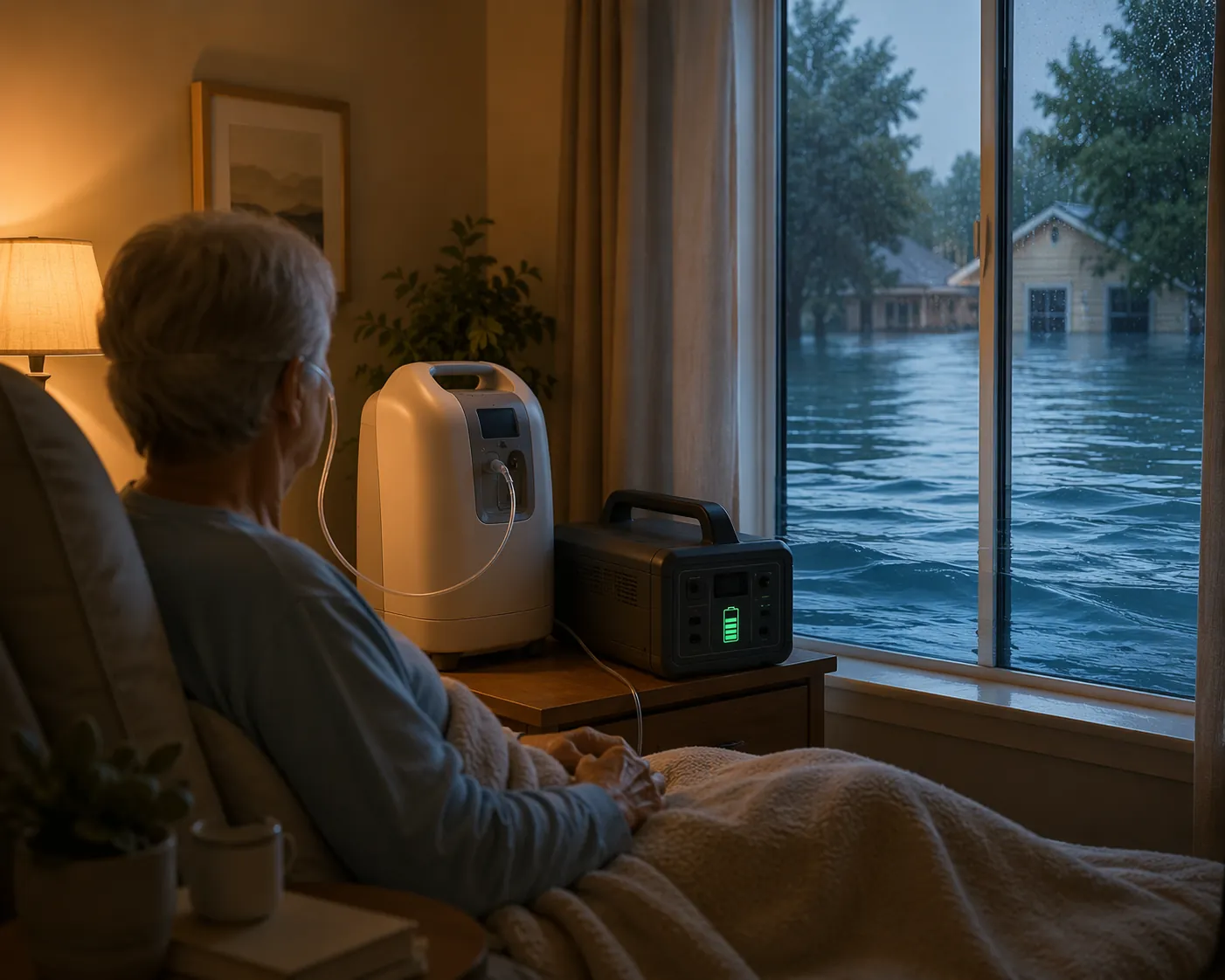
Medical dependency is the criterion households most often soften with hopeful language. “We have batteries somewhere” is not a plan. “The neighbor has a generator” is not a plan if the neighbor evacuates, the generator cannot be safely operated in flood conditions, or the older adult cannot reach that house.
Mark this criterion red if the older adult uses oxygen equipment, a concentrator, CPAP or BiPAP, a powered hospital bed, a lift, a refrigerated medication, wound-care supplies, dialysis-related support, or any other medically important system and there is no tested backup for the full likely outage and isolation period. Red also applies if no one has confirmed whether a special needs shelter, medical shelter, or hospital-based plan is appropriate.
CDC flood safety guidance tells people with disabilities and older adults to notify local authorities if they may need evacuation assistance, and Ready.gov advises older adults to build a support network and plan around medical, mobility, communication, and transportation needs.[3][4] Many communities use special needs registries or medical shelter processes, but availability, eligibility, transportation, caregiver rules, and power support vary by county. Registration is a before-season task, not a same-day guarantee.
- What equipment must keep running, and for how many hours if roads close?
- Has the backup power source been tested with the actual device, not just purchased?
- Can the older adult operate the backup safely without bending, lifting fuel, using extension cords through wet areas, or reading small displays in low light?
- Are medication lists, prescriber contacts, pharmacy information, device settings, and spare supplies packed in a go-bag?
- Has the county confirmed whether the person belongs in a general shelter, special needs shelter, medical shelter, or another setting?
If these answers are unknown during a flood watch, the safest correction is not a shopping trip after roads are wet. It is early relocation to a place where power, medication access, toilets, lighting, and help are already reliable. The site’s power outage fall prevention checklist is useful here because power loss also changes how an older adult transfers, toilets, finds glasses, avoids cords, and walks after dark.
Mobility and Support: The Evacuation Window Closes Before the Water Arrives
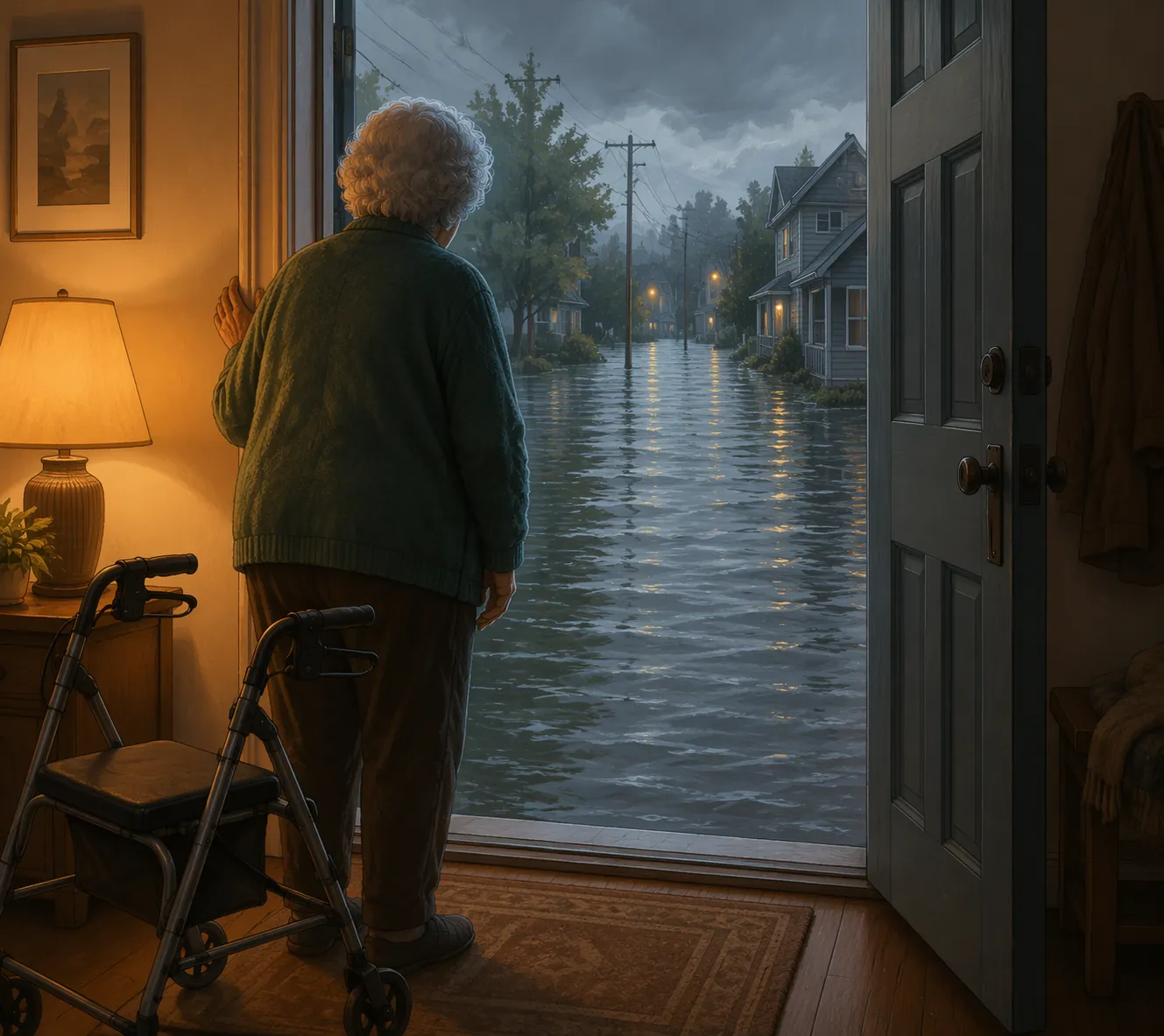
A person can be “able to walk” and still be unable to evacuate safely. The real test is narrower: can this person leave this home, with this device, using this route, at the time the route is still dry, with a confirmed driver and destination?
The First Contact disaster-preparedness model from 211 Tampa Bay Cares is useful because it treats disaster planning as a decision tree rather than a vague intention. It pushes caregivers toward concrete questions about support networks, evacuation plans, supplies, documents, pets, medical needs, and local alerts.[5] The model is Florida-based, so it should be adapted through the homeowner’s county emergency management office, not copied as if every shelter system works the same way.
Mark mobility and support red if any required link is missing: no driver, no accessible vehicle, no one strong enough to assist transfers, no dry route to the vehicle, no destination that can handle the person’s needs, no way to move a wheelchair or walker, or no plan for stairs if elevators fail. Also mark it red if the older adult is likely to resist leaving until the only remaining evacuation would happen in darkness, rain, standing water, or a crowded late-stage shelter process.
A yellow mobility result can sometimes be made green with one phone call: the adult child confirms pickup by a specific time, the neighbor confirms they are staying long enough to help load the car, or the county confirms transportation through a registry. Without that confirmation, yellow ages into red as the storm gets closer.
For a fast packing structure, borrow from senior-specific evacuation planning rather than generic camping lists. The wildfire evacuation checklist built for seniors is written for a different hazard, but the medication, document, mobility-device, and caregiver-contact logic transfers well. For shelter access when stairs and interior rooms are the issue, the tornado safety guide for elderly loved ones gives a useful way to think about mobility-limited movement under time pressure.
Supply Autonomy: A Full Pantry Is Not the Same as Being Able to Shelter
Supplies should be judged by functions, not by how crowded the pantry looks. A shelter-in-place supply plan must cover hydration, food that can be prepared without full utilities, medications, hygiene, incontinence care if needed, safe lighting, charging, communication, pet needs, and a way to keep floors clear and dry enough for transfers.
The American Red Cross recommends that older adults prepare around personal support networks, medical needs, mobility, medications, supplies, and emergency communication. Ready.gov likewise emphasizes planning for older adults’ medications, assistive devices, transportation, and support networks.[4][6] A 72-hour minimum is a common emergency-preparedness baseline, but for flood scenarios where roads may close and services may be delayed, a seven-day go-bag supply is the more practical planning target for older adults with medical or mobility needs.
- Green: supplies are already gathered, usable in a power outage, and matched to the older adult’s actual medication, hydration, toileting, lighting, and mobility needs.
- Yellow: food and water exist, but medication refills, batteries, device charging, hygiene, incontinence supplies, or caregiver access are incomplete.
- Red: the person cannot safely remain without outside delivery, pharmacy access, daily caregiver visits, powered equipment, or help that may be blocked by flood conditions.
Sheltering also has a health tail. A Harvard T.H. Chan School of Public Health news release summarizing a study of older adults from 2000–2016 reported that flooding was associated with up to a 4.5% increase in hospitalization rates for skin diseases during the event and up to a 5.6% increase for musculoskeletal diseases in the fourth week afterward.[7] The data period does not tell us exactly what every 2026 flood will do, but it does undercut the idea that the danger ends when water stops rising.
If the household is staying because all five criteria are green, reduce the avoidable injuries: keep pathways dry and lit, move chargers and cords out of walking paths, set medications where they can be reached without bending, and decide who calls at set times. The broader severe weather safety guide for older adults and the fall-safe tropical storm checklist for seniors are better places for those room-by-room details.
How Early to Leave
The timeline follows the worst criterion, not the family’s average comfort level.
| Result | Decision | Timing |
|---|---|---|
| Any red criterion | Evacuate early unless local officials or a clinician give a more specific safer instruction. | Aim for 24–48 hours before an official order when possible. |
| One or more yellow criteria, no red | Resolve the uncertainty immediately: confirm transportation, shelter eligibility, backup power, supplies, or local flood risk. | Set a same-day deadline; if the answer remains uncertain as conditions worsen, treat it as red. |
| All five criteria green | Sheltering may be viable with local alerts, a communication schedule, charged devices, safe lighting, and a ready exit plan. | Recheck whenever the forecast, road status, power reliability, or health status changes. |
This rule may feel strict because it removes the usual bargaining room. That is the point. If all five criteria are green, sheltering in place can be a reasonable choice while local alerts remain stable and someone outside the home is checking in. If even one criterion is red, the safer decision is to leave early enough that evacuation is still a controlled move rather than an improvised escape through water, darkness, closed roads, or failed power.
References
- Disaster Resilience Tool Kit, AARP,
- Minimize Flood Damage, FloodSmart,
- Flood Safety, CDC,
- Older Adults, Ready.gov,
- Disaster Preparedness for Older Adults and Caregivers, First Contact,
- Older Adults, American Red Cross,
- Flooding increases hospitalization risks in older adults, Harvard T.H. Chan School of Public Health, July 2025,
Related reading
Need a professional assessment?
Find a CAPS-credentialed professional or local aging services through our outbound resource list — we never name or rank individual contractors.
Find Local HelpNoticed something outdated or inaccurate on this page? Flag a correction. We review every report against CDC, NIA, and AARP HomeFit guidance before updating a page.