Assisted Living vs. Memory Care vs. Nursing Home: How to Choose the Right Level of Care
stage guideReviewed: 2026-06-20
Assisted Living vs. Memory Care vs. Nursing Home: How to Choose the Right Level of Care
A head-to-head comparison of assisted living, memory care, and nursing homes for adult children deciding where a parent with dementia or functional decline should live. Includes a decision tree, cost reality check, and tour checklist.
By Editorial Team
assisted living
memory care
nursing home
dementia care
senior housing comparison
Why Families Confuse Assisted Living, Memory Care, and Nursing Homes
When a parent can no longer live safely at home, the search for a residential facility often begins with a Google search that returns three terms — assisted living, memory care, and nursing home — used almost interchangeably. The confusion is understandable. All three provide meals, housekeeping, 24-hour supervision, and help with daily activities. All three are residential settings where someone else handles the cooking and the laundry. But the similarity ends there.
The deciding factor is not age, not diagnosis, and not income. It is the type and intensity of help your parent actually needs. Assisted living is designed for people who need help with bathing, dressing, and medication management but can still make decisions and navigate their environment safely. Memory care is for people with dementia who wander, become agitated, or cannot be left alone without risk. Nursing homes — also called skilled nursing facilities — are for people who need round-the-clock medical care, whether for post-hospital rehabilitation, wound care, feeding tubes, or late-stage dementia that requires full assistance with every activity.
Choosing the wrong level leads to real consequences. A cognitively intact older adult placed in a secured memory care unit loses independence they could have maintained in assisted living. A person with advanced dementia placed in standard assisted living may wander out an unsecured door or receive no structured programming for their cognitive needs. A family that moves a parent to a nursing home for custodial care — when what they really need is dementia-specific supervision — may pay twice as much for a level of medical oversight that is unnecessary.
This guide focuses exclusively on these three facility-based options. If you are also considering home care or a full continuum that includes staying at home, see our separate guide on Home Care vs. Assisted Living vs. Memory Care: A Continuum Decision Guide for Dementia Caregivers. Here, we compare only the three residential settings that families most often confuse, with a head-to-head comparison table, a decision tree, and a tour checklist so you can walk into any facility knowing exactly what to look for.
Assisted Living vs. Memory Care vs. Nursing Home: At a Glance
The table below summarizes the key differences across the dimensions that matter most for safety, quality of life, and cost. The data comes from multiple sources — the National Institute on Aging, the Alzheimer's Association, A Place for Mom, and the National Investment Center for Seniors Housing & Care (NIC) — and each figure is attributed so you can evaluate its recency and methodology.
Head-to-head comparison of assisted living, memory care, and nursing homes across key dimensions. Cost data sourced from A Place for Mom (2026), SeniorLiving.org (2026), and NIC (2023).
Dimension
Assisted Living
Memory Care
Nursing Home (Skilled Nursing)
Primary population
Needs help with ADLs (bathing, dressing, medication) but is cognitively intact or early-stage dementia
Dementia with wandering, behavioral changes, safety concerns, or need for secured environment
Complex medical needs, post-hospital rehab, late-stage dementia requiring 24/7 skilled nursing care
Secured: locked doors, alarmed exits, enclosed outdoor spaces, tracking bracelets; 88% of partner communities are secured (A Place for Mom, 2026)
Medical-grade: bed alarms, lift systems, infection control; federally regulated
Staff training
General personal care training; may include medication management
Specialized dementia care training; 79% of partner communities provide it (A Place for Mom, 2026)
Licensed nurses (RNs, LPNs); certified nursing assistants (CNAs); state and federal training requirements
Daily oversight
24-hour staff; residents manage their own schedules and meals
Staff ensure residents get to meals, activities, and transitions — a level of oversight not provided in standard AL (per memory care consultant Megan Carnarius, RN)
24/7 skilled nursing care; all activities of daily living are assisted or performed by staff
Medical care
Medication management; no skilled nursing
Medication management; dementia-specific programming; no skilled nursing
Skilled nursing: wound care, IV therapy, feeding tubes, post-surgical rehab, hospice
National median monthly cost (2026)
$5,419 (A Place for Mom) to $6,313 (SeniorLiving.org)
$6,690 (A Place for Mom); about 25% more than AL
$9,581 (semiprivate) to $10,798 (private) (SeniorLiving.org)
Medicare coverage
Not covered for room and board or ADL assistance
Not covered for room and board or personal care
May cover short-term rehab stays (up to 100 days with qualifying hospital stay); does not cover long-term custodial care
Assisted Living: Best for Those Who Need ADL Help but Are Cognitively Intact
Assisted living is the most common entry point for older adults who can no longer manage entirely on their own but do not need medical care. The National Institute on Aging describes it as a setting for people who need help with daily care — bathing, dressing, medication management — but not as much as a nursing home provides. Residents typically live in their own apartments or rooms, receive up to three meals a day, and have access to social and recreational activities.
Who is a good fit for assisted living? Someone who:
Needs help with bathing, dressing, or medication management but can still make decisions about their daily life
Can navigate their environment safely — finding their apartment, using the bathroom, recognizing familiar faces
Does not wander, attempt to leave, or exhibit behaviors that require a secured environment
Does not need skilled nursing care (wound care, IV therapy, feeding tubes)
Can benefit from social engagement and structured activities but does not require dementia-specific programming
What assisted living does not provide is equally important. Standard assisted living communities are not secured against wandering. Staff are trained in personal care, not necessarily in dementia-specific behavior management. There is no requirement for cognitive therapies or structured daily routines for people with memory loss. If your parent has moderate-to-advanced dementia, standard assisted living may not be safe.
Memory Care: Best for Dementia with Wandering, Behavioral Changes, or Safety Concerns
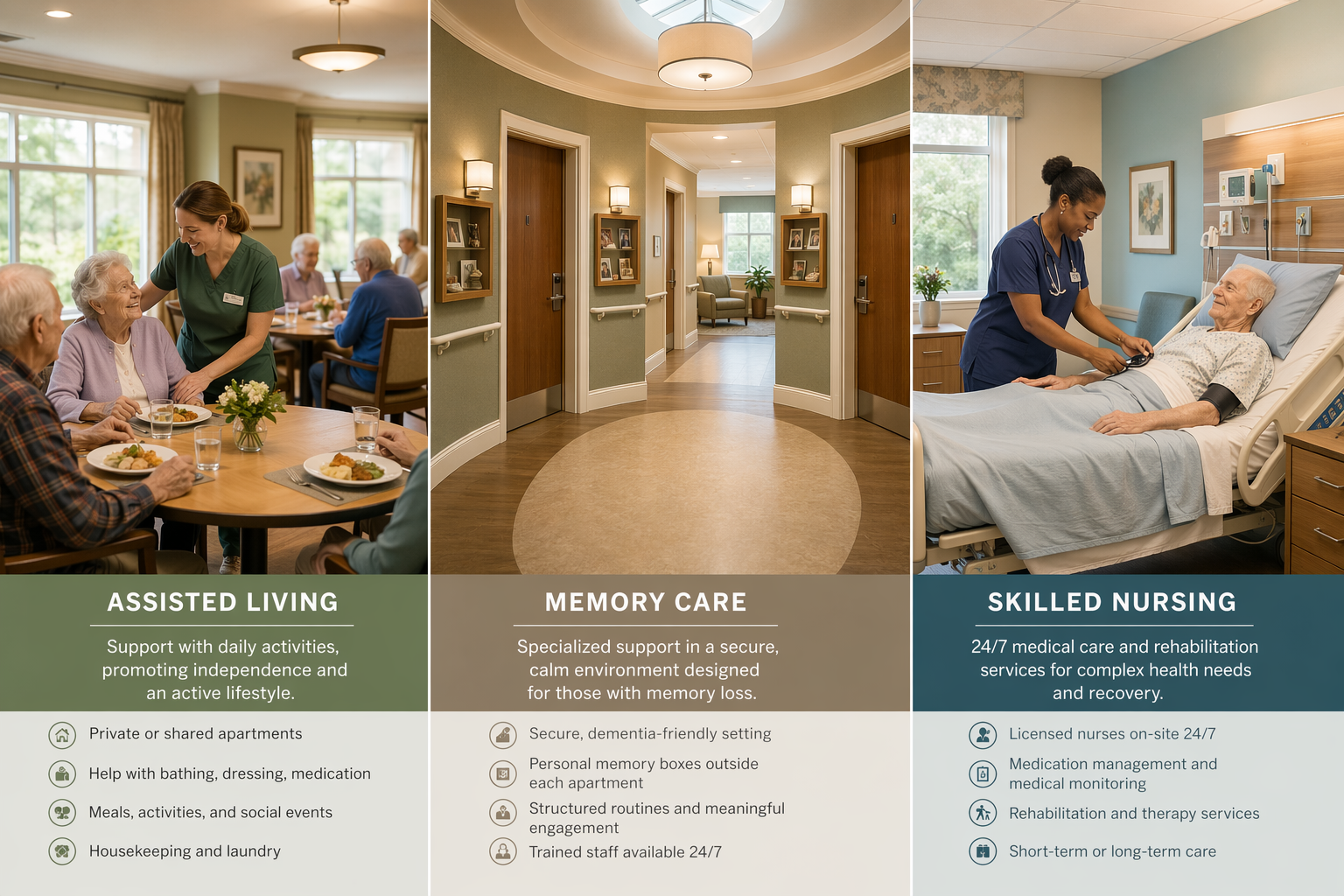
The three settings serve distinctly different populations. Memory care (center) is distinguished by secured environments, specialized staff training, and structured daily routines designed for people with dementia.
Memory care is the fastest-growing sector of the senior housing market, and for good reason. According to NIC data cited by AARP, memory care units increased by nearly 84% from 2013 to 2023, reaching 162,100 units nationwide. After a sharp decline in occupancy during the COVID-19 pandemic, occupancy rebounded by 17% and returned to pre-pandemic levels by 2023. This growth reflects a clear market reality: the number of families needing dementia-specific residential care is rising, and standard assisted living cannot meet those needs.
What makes memory care different from assisted living is not just the locked doors. It is a fundamentally different approach to daily life. According to A Place for Mom's 2026 data:
88% of their partner memory care communities are secured facilities with wandering management systems — alarmed doors, keypad entries, obscured exits, and enclosed outdoor spaces
79% provide specialized memory care training for staff, covering how to manage wandering, aggression, and the communication challenges of dementia
76% are specifically designed for memory loss, with features like circular hallways (to prevent dead ends), memory boxes outside doors, color-coded wayfinding, and reduced visual clutter
The Alzheimer's Association reports that 6 in 10 people with dementia will wander at some point. In a standard assisted living community, a resident who wanders could walk out an unsecured door and become lost. In memory care, the environment is designed to prevent that — and staff are trained to redirect wandering behavior calmly rather than restrain or sedate.
Beyond safety, memory care provides a level of daily oversight that assisted living does not. As memory care consultant Megan Carnarius, RN, explains, staff in memory care ensure residents get to meals, activities, and daily transitions. A person with dementia may not remember that lunch is at noon or how to find the dining room. In assisted living, they would be expected to manage that themselves. In memory care, the structure is built around the reality of cognitive decline.
Specialized therapies are another differentiator. Memory care communities typically offer music therapy, art therapy, reminiscence therapy, and pet therapy — all designed to engage people with dementia in ways that standard social activities cannot. These are not luxuries; they are evidence-informed interventions that can reduce agitation, improve mood, and support remaining cognitive function.
Nursing Homes / Skilled Nursing: Best for Complex Medical Needs and Late-Stage Dementia
Nursing homes — also called skilled nursing facilities — are the most medically intensive residential setting. Unlike assisted living and memory care, which are primarily residential with supportive services, nursing homes are licensed and regulated by both state and federal governments as healthcare facilities. The Alzheimer's Association notes that nursing homes provide around-the-clock care and long-term medical treatment, with services for nutrition, care planning, recreation, spirituality, and medical care.
Who needs a nursing home? The answer is narrower than many families assume. A nursing home is appropriate when:
The person requires 24/7 skilled nursing care — wound care, IV therapy, feeding tube management, or post-surgical rehabilitation
They are in late-stage dementia and need full assistance with all activities of daily living, including turning, positioning, and incontinence care
They have complex, unstable medical conditions that require frequent monitoring by a registered nurse
They are recovering from a hospitalization (hip fracture, stroke, pneumonia) and need short-term rehabilitation before returning home or to a lower level of care
A critical distinction that many families miss: Medicare may cover a short-term stay in a skilled nursing facility — up to 100 days with a qualifying hospital stay — but it does not cover long-term custodial care. If your parent needs a nursing home for ongoing personal care rather than medical rehabilitation, Medicare will not pay for it. Medicaid may cover long-term nursing home care for eligible individuals, but eligibility rules vary by state and typically require very limited assets.
The Alzheimer's Association provides a useful benchmark: the national average cost for a private room in a nursing home is $129,575 per year, and for a semi-private room it is $114,975 per year (Genworth Cost of Care Survey). That is roughly double the cost of memory care and more than double the cost of assisted living. For families paying out of pocket, the financial implications are enormous.
Which One Is Right? A 5-Question Decision Tree
Use this decision flow to narrow down which care type fits your parent's current needs. Start at the top and answer each question honestly.
The following five questions will help you determine which setting is most appropriate for your parent's current condition. Answer each one based on their actual needs today — not what you hope they will need, and not what they needed six months ago.
Does your parent need skilled nursing care — wound care, IV therapy, feeding tube management, or post-hospital rehabilitation that requires a licensed nurse on site 24/7? If yes, a nursing home is the appropriate setting. If no, proceed to question 2.
Does your parent wander, try to leave the house, or become disoriented in familiar environments? If yes, they need a secured environment — memory care. If no, proceed to question 3.
Does your parent have behavioral changes — agitation, aggression, repetitive questioning, or sundowning — that make it unsafe for them to be in an unsecured setting? If yes, memory care is likely the right choice. If no, proceed to question 4.
Can your parent manage basic decisions with cues — finding the bathroom, recognizing when they are hungry, remembering to take medications? If yes, and they need help with bathing, dressing, or medication management, assisted living may be appropriate. If no, proceed to question 5.
Is your parent at risk of elopement (leaving the facility unnoticed) or do they require constant supervision to prevent falls or other accidents? If yes, memory care is the safer choice. If no, and they are cognitively intact but need ADL support, assisted living is likely appropriate.
What About Hybrid Options? Assisted Living with Memory Care, CCRCs, and Board & Care Homes
The three categories above represent the most common facility types, but the real-world landscape is more nuanced. Many communities offer hybrid models that combine features of two or more settings.
Assisted living with a dedicated memory care neighborhood: As noted, approximately 80% of A Place for Mom's partner assisted living communities also offer memory care services, often in a separate wing or floor. This allows a resident to move from assisted living to memory care without leaving the campus — a significant advantage for families who want to minimize disruption. However, the quality of the memory care unit can vary; ask specifically about staffing ratios, training, and whether the unit is secured.
Continuing Care Retirement Communities (CCRCs): These offer a full continuum from independent living to assisted living to skilled nursing on a single campus. A resident can enter as an independent senior and transition through levels of care as needs change. CCRCs typically require a large entrance fee (often $100,000–$500,000) plus monthly fees, making them inaccessible for many families. They are most appropriate for seniors who are still healthy enough to live independently and want to lock in future care access.
Board and care homes (also called residential care homes): These are small, residential-style facilities — typically a converted single-family home — that house 4–10 residents. They may serve a mixed population of people with and without dementia. They are often less expensive than larger communities and can feel more home-like, but they may lack the specialized programming and security features of a dedicated memory care facility. State regulations vary widely.
Cost increases with the level of care. Memory care typically costs about 25% more than assisted living, while nursing homes cost roughly double.
Cost is often the most stressful part of this decision, and for good reason. The figures below represent national medians from 2026 data. Your actual costs will vary by state, city, and the specific facility.
National median monthly and annual costs for assisted living, memory care, and nursing homes. Sources: A Place for Mom (2026), SeniorLiving.org (2026), Alzheimer's Association (citing Genworth Cost of Care Survey).
Care Type
National Median Monthly Cost (2026)
National Median Annual Cost (2026)
Source
Assisted Living
$5,419 – $6,313
$65,028 – $75,756
A Place for Mom ($5,419); SeniorLiving.org ($6,313)
Memory Care
$6,690
$80,280
A Place for Mom (2026)
Nursing Home (semiprivate room)
$9,581
$114,972
SeniorLiving.org (2026)
Nursing Home (private room)
$10,798
$129,576
SeniorLiving.org (2026)
Memory care costs about 25% more than assisted living, according to A Place for Mom's 2026 cost-of-care report. That premium reflects the lower resident-to-staff ratios, specialized training, enhanced security features, and person-centered programming that memory care requires. But memory care is still substantially less expensive than a nursing home — roughly 40–50% less, depending on the region.
State-level variation is significant. A Place for Mom's state-by-state analysis of memory care costs shows a range from $4,806 per month in Utah to $11,195 per month in Vermont. For assisted living, SeniorLiving.org reports a range from $4,715 per month in Mississippi to $12,000 per month in Hawaii. Memory care costs typically increase 3% to 8% annually, so the price you see today will likely be higher next year.
How to Tour and What to Look For: A Checklist for Families
A scheduled tour is useful, but it shows you the facility at its best. The National Institute on Aging recommends making a second, unannounced visit — ideally at mealtime or in the evening — to see how the facility operates when staff are not expecting visitors. Use the checklist below, adapted from the NIA, the Alzheimer's Association, and AARP, to evaluate each facility systematically.
Questions to Ask About Staff
What is the staff-to-resident ratio during the day and overnight? (Lower ratios are better, especially in memory care.)
What training do staff receive? Is it specific to dementia care (for memory care) or skilled nursing (for nursing homes)?
What is the staff turnover rate? High turnover is a red flag for inconsistent care and low morale.
Are licensed nurses on site 24/7? (Required for nursing homes; not required for assisted living or memory care.)
How does the facility handle behavioral changes — agitation, aggression, or wandering? What is their protocol before considering medication or transfer?
Questions to Ask About Safety and Environment
Are exits alarmed or secured? (For memory care, this is non-negotiable.)
Is there an enclosed outdoor space that residents can access safely?
Are there visual cues — memory boxes, color-coded hallways, clear signage — to help residents navigate?
Is the facility clean and free of strong odors? (A clean facility is a basic expectation, not a luxury.)
Are handrails, grab bars, and non-slip flooring present in hallways and bathrooms?
Questions to Ask About Daily Life
What does a typical day look like? Is there a structured schedule of activities, or are residents expected to self-direct?
Are meals served in a communal dining room? Can residents choose what to eat? Can they eat outside of scheduled meal times?
How does the facility handle residents who need help getting to meals or activities? (In memory care, staff should ensure every resident is escorted.)
Are there specialized therapies — music, art, reminiscence, pet therapy — for residents with dementia?
What happens if a resident refuses to participate in activities or refuses to eat? What is the protocol?
Questions to Ask About Medical Care and Emergencies
How does the facility handle medical emergencies? Is there a protocol for calling 911? Is a nurse on site?
How are medications managed? Who administers them? Is there a system for tracking missed doses?
Can the facility accommodate a resident whose condition changes — for example, if they need more assistance or develop a new medical condition?
Is there a relationship with a local hospice provider for end-of-life care?




Comments
Join the discussion with an anonymous comment.