
Caregiver decision guide
Which AI Tools Actually Help Female Caregivers?
Uncover which AI tools genuinely reduce the invisible mental load female caregivers carry — from medication management to care coordination — without adding complexity, based on the latest national data and research.
The search for AI tools for female caregivers usually starts with a quieter sentence: I cannot keep all of this in my head anymore.
Not just the pill schedule. The refill date. The portal message nobody answered. The sibling who wants updates but not assignments. The parent who says everything is fine while the unopened mail stacks up. The mental load is not only doing care; it is noticing what might become a problem, deciding who needs to know, and remembering to check again.
That burden is not a personality flaw or a failure to be organized. UN Women describes the mental load as the cognitive and emotional labor of anticipating needs, planning, coordinating, and monitoring family life, work that remains heavily gendered even when it is not counted as a formal task.[1] In the United States, A Place for Mom’s 2026 caregiver statistics report 53 million unpaid family caregivers, with an average of 22.8 hours of care per week and 72% reporting stress or anxiety at least monthly.[2] Family Caregiver Alliance’s women-and-caregiving data has long shown the same pattern underneath those totals: most caregivers are women, and women tend to spend more hours providing care than men.[3]

This is the place where AI can be useful, if it is asked to do a real job. Not “transform caregiving.” Not replace judgment. Not keep Mom company so the family can disappear. A useful tool removes one recurring piece of mental work from the person who has been carrying it.
Caregivers Are Already Using Technology, Just Not Much AI
The most current national data does not show caregivers rejecting technology. NORC’s February 2026 report found that 48% of caregivers use at least one type of caregiving technology, while only 7% use AI agents and 10% plan to use them. Medication management is the leading technology use case, at 27%.[4]
That gap matters. It suggests many caregivers are not asking, “Should I trust AI with my parent?” They are asking a more practical question: “Which part of this mess would it actually help with?”
The answer should start with the task, not the product. If the problem is missed evening medications, a family chat app will not solve it. If the problem is five relatives asking for the same update, a fall detector will not help. If the problem is that your parent refuses any device that feels like surveillance, a more advanced sensor may only create a new argument.
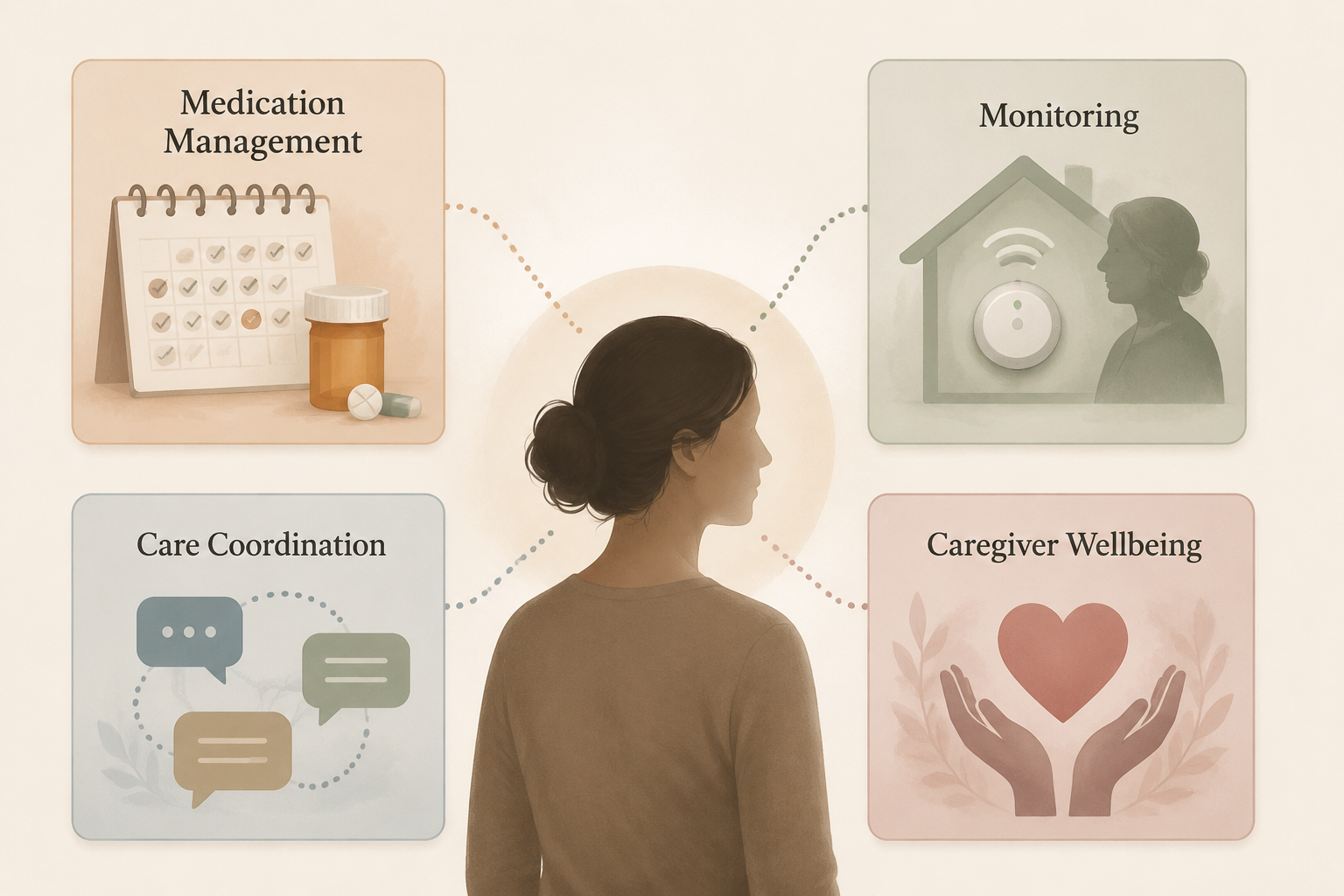
| Recurring burden | AI tool category that may help | What success looks like |
|---|---|---|
| Remembering medications, refills, and missed doses | Medication management | Fewer manual checks and faster notice when something is off |
| Wondering whether a parent is safe at home | Monitoring and safety tools | Useful alerts without constant camera watching or panic notifications |
| Repeating updates to siblings, aides, and clinicians | Care coordination and communication | One shared place for notes, tasks, summaries, and next steps |
| Not noticing your own burnout until it is severe | Caregiver support and risk screening | Earlier prompts to ask for respite, clinical support, or practical backup |
Medication Management: The Easiest Place To Start
Medication management deserves to come first because it is concrete. A medication either was taken or it was not. A refill is due or it is not. The caregiver either has to remember to check or the system can help surface the exception.
AI-supported medication tools may help by turning scattered reminders into a more active system: dose schedules, refill prompts, missed-dose alerts, and patterns that show whether nonadherence is becoming more frequent. Some tools connect to dispensers; others live in apps or caregiver dashboards. The useful question is not whether the tool uses impressive AI. It is whether it reduces the number of times you have to wonder, “Did she take the morning pills?”
This category is worth trying when medications are stable enough to enter into a system, the older adult can tolerate reminders or a dispenser, and the caregiver is already doing repeated checks. It is especially relevant when several people are involved and nobody is fully sure whether the last dose was confirmed.
It can backfire when the medication list changes often and nobody is clearly responsible for updating the tool. It can also create false reassurance if a device records that a compartment opened but cannot confirm what happened afterward. For medication safety, AI should sit beside a real medication review, not replace one. If falls are part of the worry, a manual review like a caregiver’s medication review for fall prevention still matters.
Monitoring Tools: Relief, Consent, and the Line Between Safety and Surveillance
Monitoring is where the promise of AI feels most emotionally loaded. The caregiver wants to sleep without wondering if Dad fell in the bathroom. The parent wants to live at home without feeling watched. Both needs are legitimate.
AI-enhanced monitoring tools may look for changes in movement, sleep, room use, door activity, appliance use, or emergency events such as possible falls. Some systems use cameras; others rely on passive sensors. For many families, the better starting point is not a camera but privacy-friendly elder monitoring that can flag patterns without turning the home into a live feed.
The most useful monitoring systems answer a narrow question: Has something changed enough that a person should check in? They should not make the caregiver responsible for watching another dashboard all day. If alerts are too frequent, too vague, or too easy to ignore, the system has not reduced vigilance; it has repackaged it.
NORC found that 57% of caregivers report barriers to using caregiving technology, including care recipient unwillingness at 23% and privacy concerns at 20%.[4] Those are not small objections. They are often the deciding factor between a tool that stays plugged in and one that ends up in a drawer.
The dementia evidence also calls for humility. A 2025 Springer scoping review of technology use among female caregivers found positive effects in areas such as emotional and social well-being, but it also reported that technology can worsen caregiver quality of life when devices are complex, unreliable, or burdensome. One included finding was especially stark: 81% of devices were abandoned as dementia progressed.[5]
That does not mean monitoring is a bad idea. It means timing and fit matter. A parent who is still able to participate in the decision can help choose what feels acceptable. A family that starts with simple smart home sensors for elderly living alone may have an easier path than a family trying to introduce a complicated system after a crisis. If falls are the main concern, a medical alert system with fall detection may be more appropriate than a broad home-monitoring setup.
Care Coordination: Fewer Repeated Updates, Fewer Dropped Details
Care coordination is where a lot of daughters lose hours without being able to point to a single dramatic task. It is the follow-up call after the appointment. The note to the home aide. The text to siblings. The question of whether the cardiologist’s instruction conflicts with what the primary care doctor said last month.
AI coordination tools can help when they summarize, sort, and share information that would otherwise live in one person’s head. A useful tool might turn appointment notes into a short family update, extract next steps from a visit summary, create a task list, or keep a shared timeline of changes in symptoms, medications, and services.
This is not the same as asking AI to make medical decisions. The safer use is administrative: capturing what was said, identifying what still needs follow-up, and making sure the person who promised to call the pharmacy can actually see that assignment. For families already struggling with appointments, insurance calls, and specialist handoffs, the goal is closer to coordinating a parent’s care without burning out than automating care itself.
A coordination tool is worth considering when the same information is being retyped into multiple texts, one person has become the default family dispatcher, or appointments generate action items that disappear into scraps of paper. If the family is not ready for an app, a shared document or even a printable system can still reduce the load. A free printable caregiver checklist binder may be the right bridge before adding AI.
Caregiver Support Tools Should Flag Risk, Not Pretend To Be a Sister
Caregiver wellbeing tools are easy to oversell. A chatbot cannot make a brother take a shift. It cannot make paid care affordable. It cannot undo the grief of watching a parent become less safe in a house they love.
But some tools can still be useful if they do a humbler job: check in on stress, flag burnout risk, suggest respite options, help prepare questions for a doctor or social worker, or make it easier to name what has changed. The value is not emotional replacement. It is earlier recognition.
Family Caregiver Alliance reports serious emotional and career consequences for women caregivers, including lost wages, reduced retirement security, and elevated depression risk in some caregiving situations.[3] If a tool helps a caregiver notice that she is no longer sleeping, missing work, or snapping at everyone by dinner, that information should lead toward human support: respite, clinical care, family redistribution, or a benefits review.
For some families, that next step might be learning whether respite support is available through programs such as Medicare’s GUIDE respite benefit. For a spouse caring alone, the warning signs may look different and may need more urgent attention, especially when the caregiver has no backup at home. That is a different situation than coordinating among siblings, and it deserves a different plan, as in solo spousal caregiving.
When AI Adds Work Instead of Removing It
The caregiving technology market likes the phrase “peace of mind.” Caregivers know peace of mind has setup instructions. It has passwords, consent conversations, subscription renewals, Bluetooth failures, app updates, and the parent who unplugs the device because the light bothers her.
The Springer scoping review’s caution is important here: technology can improve emotional and social well-being in some contexts, but when it is unreliable or complicated, it may worsen quality of life for caregivers.[5] That finding should sit beside every glossy promise about AI-enabled care.
AI is more likely to add burden when the caregiver cannot explain what task it owns, when the care recipient objects, when alerts are too frequent to trust, when nobody has time to maintain the information inside it, or when the tool arrives after everyone is already in crisis mode.
The federal government is paying attention to this space. The Administration for Community Living and HHS launched a $2 million Caregiver Artificial Intelligence Prize Challenge, signaling that caregiver AI has become a national policy priority.[6] That is encouraging, but policy attention does not answer the kitchen-table question of whether a particular tool will make Tuesday easier.
A Start-Small Framework That Respects the Caregiver’s Time
The safest way to adopt AI in caregiving is not to build a full digital command center. Start with the task that already wakes you up at night.
- Name the recurring burden in plain language: missed pills, fall worry, repeated family updates, appointment follow-up, or caregiver burnout.
- Choose one tool category that matches that burden. Do not shop across every AI feature at once.
- Ask whether the care recipient can accept the tool. Refusal is not a minor detail; it is one of the main adoption barriers in national data.
- Decide who maintains it. A medication tool with outdated prescriptions or a monitoring tool nobody checks becomes clutter.
- Test it for a short period against one outcome: fewer check-ins, fewer missed tasks, clearer updates, or earlier support.
If your parent is uneasy with technology, the first step may be the conversation, not the device. A guide to helping an aging parent with technology can prevent the common mistake of installing something “for safety” that the parent experiences as a loss of control.
If the family is already asking whether home is still safe, AI tools may help document patterns, but they should not carry the whole decision. Questions about supervision, nighttime risk, wandering, medication errors, and caregiver exhaustion belong in a broader conversation about when it may be time for assisted living.
AI can help female caregivers when it is chosen for one recurring task, introduced before crisis overload, accepted by the person receiving care, and simple enough to maintain. It becomes one more burden when it is adopted because it sounds advanced rather than because it removes a real job from someone’s head. The practical starting point is not the tool with the longest feature list; it is the job you are tired of carrying alone.
References
- Why are women so exhausted? Care work and the mental load. UN Women.
- 2026 Caregiver Statistics. A Place for Mom.
- Women and Caregiving: Facts and Figures. Family Caregiver Alliance.
- Caregiving in the Digital Age. NORC, February 2026.
- Female caregivers and technology: a scoping review. Springer, 2025.
- Caregiver Artificial Intelligence Prize Challenge. Administration for Community Living / HHS.
Questions to bring to a clinician or OT
This is not medical, legal, or a family's final decision — only a framework. Bring these questions to a clinician, occupational therapist, or your local Area Agency on Aging.
Find Local HelpRelated reading
Noticed something outdated or inaccurate on this page? Flag a correction. We review every report against CDC, NIA, and AARP HomeFit guidance before updating a page.