Get Your Free Printable Caregiver Checklist Binder
For: new caregiver12 minutes📄 PrintableReviewed: 2026-07-09
Get Your Free Printable Caregiver Checklist Binder
This article provides a free, downloadable packet of 7 printable caregiver checklists — covering daily care, medications, doctor visits, emergencies, and self-care — that you can assemble into a binder or share with your care team.
By Editorial Team
new caregiver
experienced caregiver
long-distance caregiving
spousal caregiver
working caregiver
daily routines
medication management
personal hygiene
care coordination
first steps
ADLs
IADLs
📄
A printable version of this guide is available. Use your browser's print function (Ctrl+P / ⌘P) to save or print.
If caregiving has suddenly become more than checking in, you probably do not need another pretty one-page chore list. You need a free printable caregiver checklist packet that can sit on the kitchen counter, go to appointments, and help the next person understand what already happened without asking you to explain it all again.
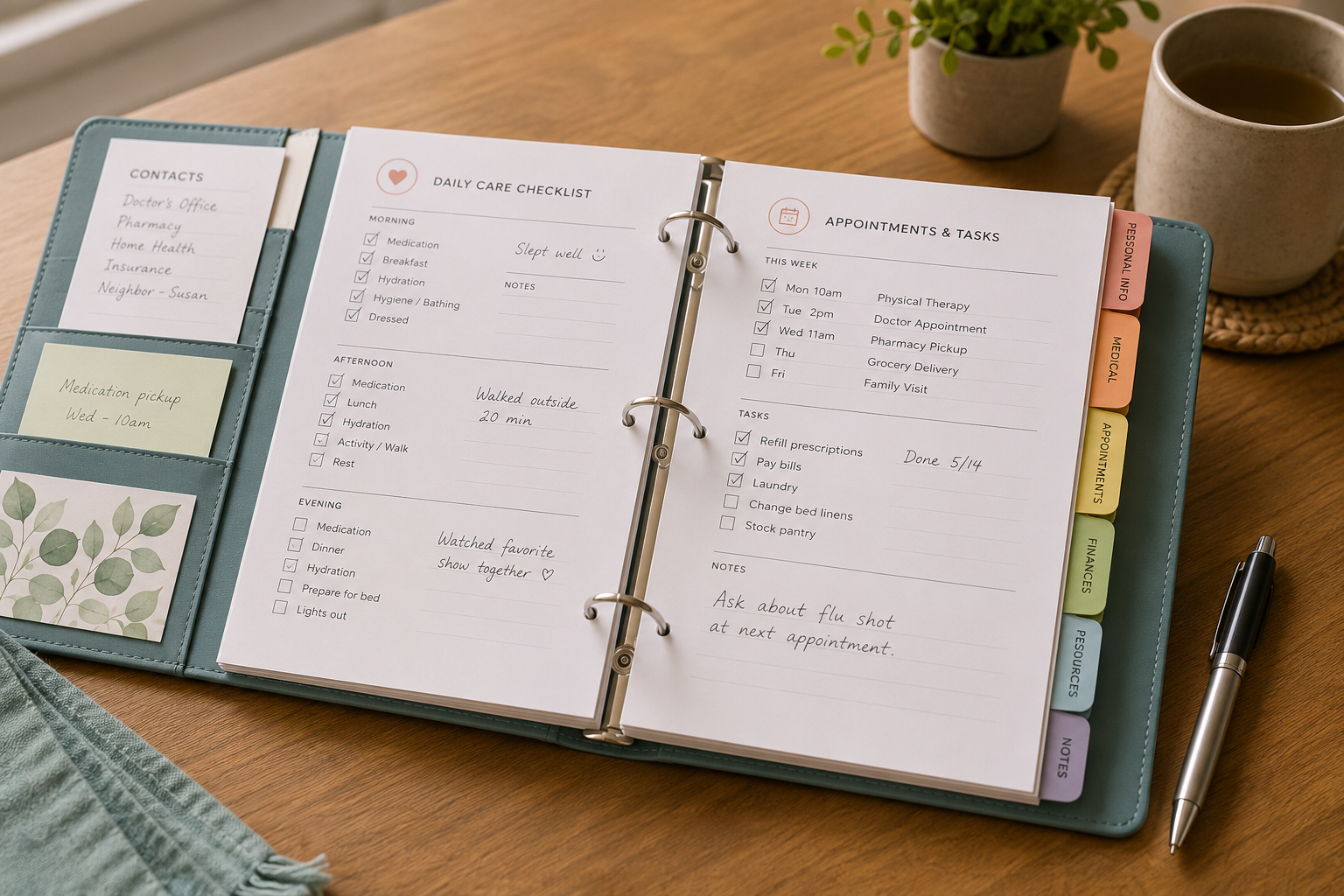
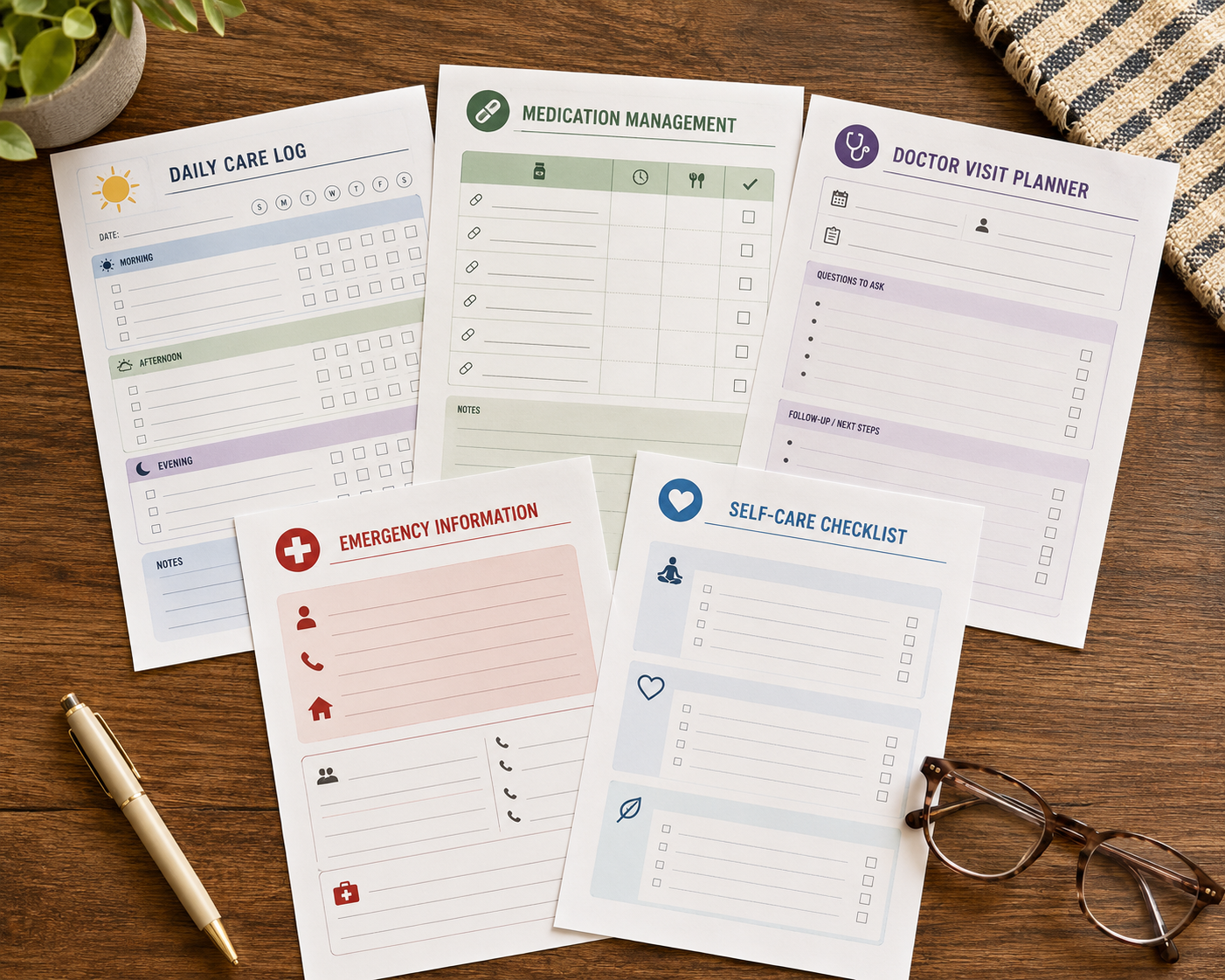
This binder packet is built around seven printable sheets: daily care, medications, appointments, emergency information, care-team contacts, home safety and supplies, and caregiver self-care. Print them, put them behind tabs, or save the same pages in a shared folder for siblings, aides, and anyone else who helps.
The reason a single checklist breaks down is simple: caregiving does not stay in one lane. The United States now has about 63 million family caregivers, a 45% increase over the past decade, but the more useful number for a tired household is the weekly load: caregivers average about 25 hours a week on care tasks. [1][2]
That time gets split across morning routines, prescription refills, transportation, doctor instructions, home safety concerns, bills, and calls from people who want to help but do not know where anything is. The average caregiving duration is about four years, and 15% of caregivers provide care for 10 years or more. [3] A system that only works for one good week is not enough.
If you are still in the first stretch of taking over, pair this packet with Your First 30 Days as a Caregiver for an Aging Parent. Use that guide for the week-by-week triage; use this binder as the ongoing handoff system.
What Is Included in the Free Printable Caregiver Checklist Packet
The packet is deliberately small. Comprehensive caregiver binders can run much longer; The Senior Alliance, for example, offers a caregiver binder with more than 40 pages. [4] That kind of reference can be useful once a household has the stamina to maintain it. For many new caregivers, the better starting point is a focused packet that catches the failures most likely to cause confusion.
Forgotten questions, lost instructions, no follow-up owner
Appointment tab or travel folder
Emergency Information Sheet
Searching for contacts, diagnoses, insurance, or hospital preferences during a crisis
First page of the binder and a copy near the phone
Care Team Contact List
One person becoming the only directory for everyone else
Contacts tab
Home Safety and Supplies Checklist
Running out of essentials or missing hazards between visits
Home tab
Caregiver Self-Care Check-In
Caregiver strain becoming invisible until something gives
Back section or weekly planning page
1. Daily Care Log
The daily care log belongs at the front because it answers the question everyone asks first: what happened today? It should be simple enough for someone to use at 7:15 a.m. before coffee, not a full nursing note.
A good daily sheet records the date, who is providing care, meals and fluids, bathing or dressing help, mobility notes, mood or confusion changes, bowel or bladder concerns if relevant, and anything that needs follow-up. The Alzheimer's Association recommends daily care planning around routine, personal care, activities, and changes in ability, which is a useful model for keeping the sheet practical rather than vague. [5]
This is the page an aide fills out before leaving, a sibling checks before calling you, and you review before deciding whether something is a one-off bad morning or a pattern worth mentioning to the doctor.
Update it daily, even if most boxes are blank.
Keep only the current week in the front pocket or front tab.
Move older sheets to the back or scan them if you need a longer record.
Circle anything that needs a call, refill, appointment, or family decision.
2. Medication Management Sheet
Medication tracking is where casual notes stop being enough. Caregiver Action Network points to medication errors as a serious safety issue and cites an estimate that medication errors are associated with 18 million emergency room visits per year. [2] That number does not mean every family caregiver is making mistakes; it does mean the medication page deserves more structure than a scribbled list on the refrigerator.
The medication sheet should include the drug name, dose, time taken, reason for taking it, prescribing clinician, pharmacy, refill date, known side effects, and whether the medication is taken with food. Caregiver Action Network's medication checklist emphasizes keeping an accurate medication list and bringing it to medical visits. [6]
One person should own the master medication page, even if several people give reminders. That person does not have to do all the care; they just need to be the one who updates the list after a hospital discharge, pharmacy change, specialist visit, or new side effect.
Write the date of the last medication review at the top. An undated medication list is dangerous because no one knows whether it reflects last year, last month, or yesterday's discharge instructions.
3. Doctor Visit Planner
The doctor visit planner is the sheet that keeps a 15-minute appointment from swallowing the rest of the week. It gives the person who attends the visit one place to write symptoms, questions, medication concerns, new instructions, tests ordered, referrals, and follow-up tasks.
Caregiver Action Network's doctor visit checklist encourages caregivers to prepare questions, bring medication information, take notes, and clarify next steps. [7] The printable planner should make those actions visible to the rest of the family, especially when the person who goes to the appointment is not the person who manages refills or transportation.
Before the visit: list the top three concerns, recent changes, and questions from family members.
During the visit: write down medication changes, tests, referrals, warning signs, and who to call with questions.
After the visit: assign each follow-up task to a specific person.
Before filing it: update the medication page, daily routine, and emergency sheet if anything changed.
For appointments after a hospitalization, also use the Hospital Discharge Checklist for Aging Parents. Discharge paperwork often changes the medication list, therapy schedule, warning signs, and follow-up appointments all at once.
The emergency sheet should not be buried behind twenty other pages. It belongs at the very front of the binder, and a copy should be somewhere obvious: near the phone, inside a kitchen cabinet door, or in the bag that goes to appointments.
Family Caregiver Alliance's emergency preparedness guidance for caregivers emphasizes planning for communication, medical needs, supplies, documents, and backup help before a crisis happens. [8] The point is not to predict every emergency. It is to keep the first 10 minutes from becoming a scavenger hunt.
Full legal name, date of birth, address, and preferred hospital
Primary diagnosis, major conditions, allergies, and implanted devices if any
Emergency contacts in call order
Primary care doctor, specialists, pharmacy, and insurance information
Medication list location and last updated date
Advance directive, power of attorney, or health care proxy location if applicable
The care team list is where you stop being the household switchboard. It should include family members, neighbors, aides, clinicians, pharmacy contacts, transportation options, preferred repair or maintenance contacts, and anyone who has a key or access code.
Use roles, not just names. Instead of writing only “Angela,” write “Angela — handles Tuesday groceries and pharmacy pickup.” Instead of “Mark,” write “Mark — backup ride for cardiology appointments, cannot do mornings.” The goal is for a sibling who wants to help to choose a real task without calling you first.
6. Home Safety and Supplies Checklist
This sheet catches the things that do not always feel medical until they become a problem: low incontinence supplies, a burned-out hallway bulb, loose rugs, expired food, a missing walker basket, a phone charger that keeps disappearing, or no backup batteries.
Use it weekly, not daily. A weekly pass through the home is enough for most households and keeps this page from turning into another chore list. If safety concerns are increasing, pair this checklist with 12 Warning Signs Your Parent Can No Longer Live Alone so the discussion is not based only on one bad afternoon.
7. Caregiver Self-Care Check-In
The self-care page is not here to add inspirational homework. It is here because caregiver strain changes the quality and reliability of care. Caregiver Action Network cites Guardian Life data showing that 41% of caregivers report low overall well-being, 32% more than non-caregivers. [2]
The printable check-in should be short: sleep, meals, movement, medical appointments of your own, backup coverage, work conflicts, and one sign that you are past your limit. Caregiver Action Network's self-care resources emphasize that caregivers need support for their own health, not only tools for managing someone else's needs. [9]
You do not need special supplies. A plain three-ring binder, a few dividers, a pen that stays with the binder, and a small folder pocket are enough. If paper works best in your household, print the packet. If your family is spread out, save the same sheets as a shared digital file and print the pages that need to travel.
Print one copy of the full seven-sheet packet.
Put the Emergency Information Sheet first, before any divider.
Create tabs for Daily Care, Medications, Appointments, Contacts, Home, and Self-Care.
Add extra copies of the Daily Care Log and Doctor Visit Planner because those pages get used most often.
Place a folder pocket in the back for discharge papers, visit summaries, insurance letters, and forms that have not been processed yet.
Write the binder location on the care team contact list so helpers know where to find it.
National Institute on Aging caregiver worksheets are another example of why printable tools remain useful: they give families a shared place to capture information that otherwise lives in one person's memory or phone. [10] The binder does not have to replace digital calendars, pharmacy apps, or patient portals. It only needs to make the current care picture visible when someone else steps in.
How to Keep the Packet Current Without Making It a Second Job
The packet stays useful only if everyone knows what gets updated and when. Do not ask every helper to maintain every page. That sounds fair, but it usually means no one knows which version is correct.
When something changes
Update this sheet
Best owner
New medication, stopped medication, dose change, side effect
Medication Management Sheet
Medication owner or appointment attendee
New symptom, appetite change, mobility change, confusion, fall concern
Daily Care Log
Person providing care that day
Appointment scheduled or completed
Doctor Visit Planner
Person handling the visit
New aide, new sibling role, changed phone number
Care Team Contact List
Primary coordinator
Hospitalization, new diagnosis, insurance change, new emergency contact
Emergency Information Sheet
Primary coordinator
Repeated missed sleep, skipped meals, work conflict, no backup coverage
Caregiver Self-Care Check-In
Caregiver filling it out
Set one review rhythm. For many families, Sunday evening or Monday morning works: toss old scratch notes, refill blank daily logs, check whether the medication sheet still matches the pill organizer, and move completed appointment pages into the back pocket.
For Siblings
Give siblings jobs that match a sheet. One person can own pharmacy refills. One can handle appointment transportation. One can review the home supplies list weekly. The binder makes those jobs visible, which reduces the familiar loop of “What do you need me to do?” followed by another explanation you do not have the energy to give.
For In-Home Aides
Keep the aide-facing pages near the front: daily care, emergency information, care team contacts, and any routine notes. Do not expect an aide to search through legal papers or old visit summaries to find breakfast instructions. If the binder includes private financial or legal documents, separate those from the working care pages.
For Appointments
Before a visit, pull the medication sheet, the current doctor visit planner, and any recent daily care logs that show a pattern. After the visit, update the binder before the paperwork disappears into a tote bag or car console. That handoff matters as much as the appointment itself.
What Not to Put in the Working Binder
A caregiver binder can become unusable if it turns into a filing cabinet. The working binder should hold the pages people need for daily care, appointments, emergencies, and near-term decisions. Store older records, tax paperwork, full insurance packets, and legal originals somewhere safer and more organized.
Do not keep the only copy of legal documents in a binder that travels.
Do not leave passwords visible if aides, visitors, or contractors may see the binder.
Do not save every old daily sheet in the front section.
Do not add forms no one has agreed to update.
Small enough to maintain beats complete enough to abandon. If the binder starts feeling heavy, remove anything that does not help the next handoff, appointment, refill, safety check, or emergency call.
The Checklist Is Really a Handoff System
The right free printable caregiver checklist is not one master to-do list. It is a small set of pages that answer different questions at the moment someone needs them: what happened today, what medicine is current, what should we ask the doctor, who do we call, what changes at home, and how is the caregiver holding up.
Print the packet, put the emergency sheet first, assign owners for the pages that change, and review it on a rhythm you can actually keep. The binder does not need to be perfect. It needs to reduce repeated decisions and make the next handoff less fragile.

Comments
Join the discussion with an anonymous comment.