Beyond the Pendant: How Passive Monitoring Systems Are Solving the Biggest Failure of Traditional Fall Detection
Most falls happen when a senior isn't wearing their medical alert pendant. This article explains how new passive radar and AI-based monitoring systems provide continuous, camera-free coverage — catching falls even at night in the bathroom — and why they are becoming the preferred choice for families and caregivers.
Features Covered in This Explainer
fall detection, long-lie prevention, false positive rate, detection range, cost
Medicare coverage: Discusses Medicaid RPM coverage as of December 2024 — Verify at Medicare.gov
By Editorial Team
fall detection
passive sensors
PERS
privacy and consent
automatic fall detection
The pendant on the nightstand at 2 AM
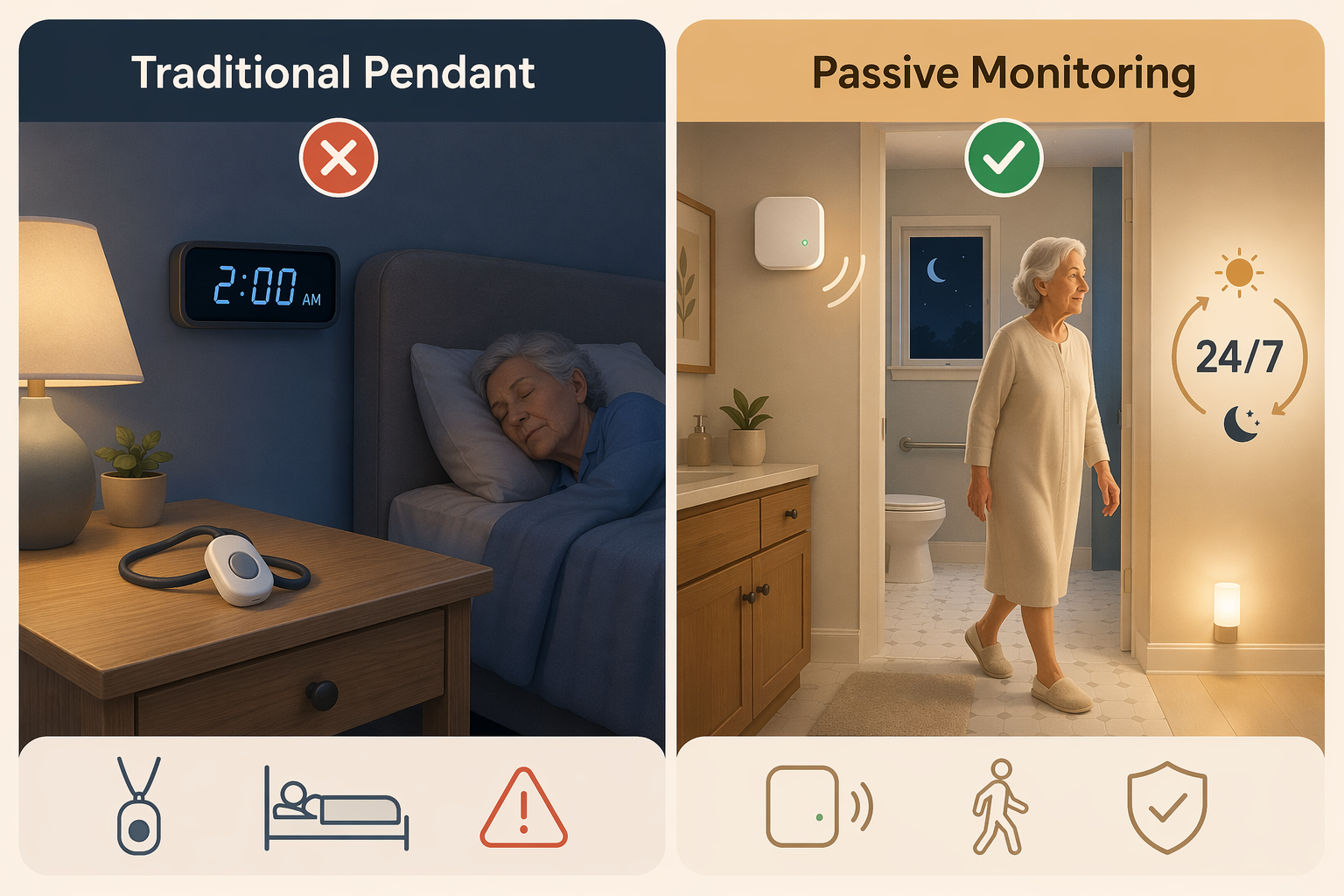
Your mother gets up to use the bathroom twice a night — sometimes three times. It is called nocturia, and it is so common in older adults that it has its own epidemiology: higher fall risk, sleep disruption, and a steady erosion of confidence. She keeps the medical alert pendant on the nightstand because it is uncomfortable to sleep in, or she forgets, or she simply does not think she will fall on the short walk to the toilet.
Then she falls. The pendant is still on the nightstand. It cannot call for help.
More than 230,000 older adults end up in the emergency room each year because of bathroom-related fall injuries. The average hospital visit for a fall costs over $3,500. But the bigger danger is the long lie — a person on the floor for an hour or more — which raises the risk of pressure injuries, dehydration, hypothermia, and muscle damage. The pendant was supposed to prevent that. It does not, because the moment it is not on the body, it is just a plastic box.
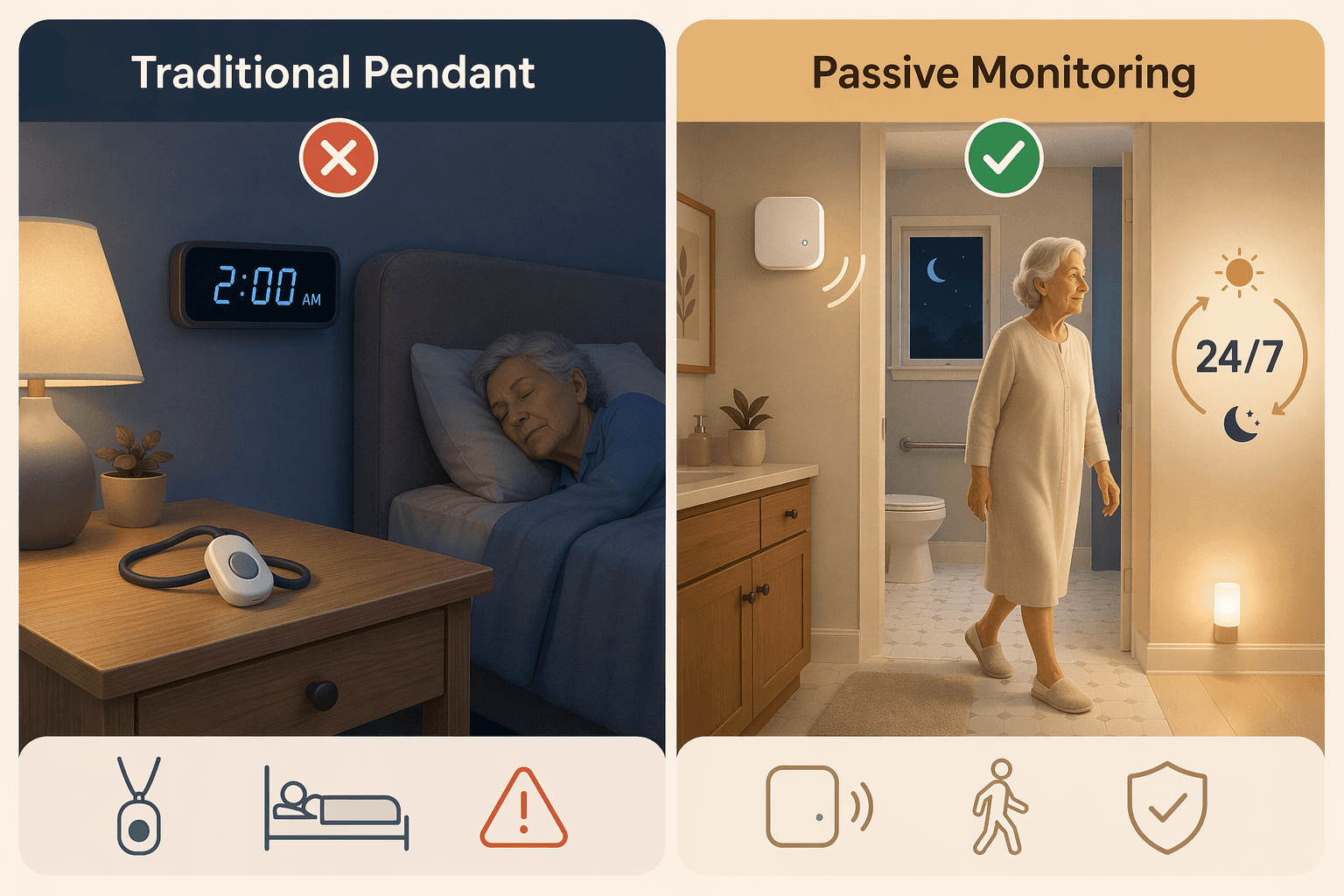
The traditional pendant (left) fails at the moment it is most needed. Passive radar-based monitoring (right) covers the bathroom around the clock.
Why the pendant stays on the nightstand
If the problem were just one person forgetting one night, a habit reminder might fix it. But it is not. The industry has long cited that up to 80% of falls happen when the wearable is not being worn. I want to be honest about that number: it is widely cited by commercial sources, but I have not found a single peer-reviewed study that pins it down with that precision. Still, every caregiver I have spoken with confirms the pattern. The reasons are predictable: the pendant is forgotten after a shower, left on the dresser during the night, taken off because it chafes, or never put back on after a bath. Some seniors with cognitive decline cannot remember its purpose. Others simply dislike the stigma.
The core failure is not the technology inside the pendant — it is that the pendant demands active participation from the person it is meant to protect. If a senior forgets to charge it, no software update fixes that. If they take it off at night, no algorithm can detect a fall. The system must require zero action from the senior. That is the design requirement that traditional pendants cannot meet.
What passive monitoring does — and its limits
Passive monitoring systems use millimeter-wave radar, infrared motion sensors, or acoustic sensors mounted on walls or ceilings. They detect motion, presence, and falls without any wearable device. The senior does not have to wear, charge, or remember anything. The system watches the room the way a motion light watches a driveway — silently, continuously, with no human action required.
The best-studied technology is radar-based. A 2022 scoping review in the Journal of Medical Internet Research found that a millimeter-wave radar system using a convolutional neural network achieved 98.74% accuracy for fall detection, and a WiFi-based system called DeFall reached 95% detection in both line-of-sight and non-line-of-sight conditions. Those are lab results. Real-world performance is likely a bit lower, but they show the technology works in principle. More important, leading radar systems like Vayyar Care can detect when a person is on the floor even if the fall itself was too slow to trigger the fall algorithm — that is called long-lie prevention, and it is exactly what the pendant cannot do when left on the nightstand.
Passive systems also generate far fewer false alarms than most people assume. Leading radar-based systems report false positive rates below one per week. That matters because every false alarm requires a caregiver to check in, disrupting both the senior's peace and the caregiver's day.
The trade-off: passive monitoring covers only indoors. If your parent gardens, walks the dog, or goes to the grocery store, those are blind spots. For a full picture of what other technology categories exist for aging in place, see our guide to technology categories that support aging in place.
Radar sensors: Detect motion and falls through walls; range up to 23 feet; no identifiable images.
Passive infrared sensors: Common in home security; trigger when heat signature moves; low cost but cannot distinguish a fall from sitting down hard.
Acoustic sensors: Listen for the sound of a fall or a call for help; need line of sight but work well in bathrooms.
No cameras, no microphones: the privacy argument that actually matters
The first concern I hear from families is always the same: "I don't want a camera in my parent's home." It is a valid concern. Passive radar systems solve it cleanly: they capture no images or sound. A device like the Pontosense Silver Shield, about the size of a soda can, monitors roughly 25 data points around a person — position, movement speed, trajectory — and sends an alert only when an abnormal event occurs. No video feed. No audio recording. No way to identify a face or overhear a conversation.
For the senior, this preserves dignity. For the caregiver, it removes the discomfort of constant surveillance. And for families where the older adult is already resistant to "being watched," the absence of a camera is often the difference between acceptance and outright refusal.
What CES 2026 tells us about where the market is going
The shift from wearables to passive systems is not hypothetical. At CES 2026, several products drew attention precisely because they address the compliance gap head-on. Pontosense unveiled Silver Shield, a radar system with no cameras or microphones. JoyCalls demonstrated an AI agent that makes phone calls for wellness checks without requiring an app or WiFi. And Avadin showed a stationary companion robot that uses cognitive quizzes to slow dementia progression while generating an autobiography from conversations over time.
These are early-stage announcements — check availability before planning a purchase. But they signal a clear market direction. The global elderly monitors market was valued at $4.66 billion in 2026 and is projected to reach $7.19 billion by 2030, growing at about 11% per year. Major players like Philips, ADT, and Bosch are already investing heavily.
For a broader look at the data behind these trends, our 2026 senior living reality check explores what families commonly get wrong about where and how seniors are monitored.
Passive vs. wearable: the only comparison that matters
For a family deciding between a traditional pendant and a passive system, the real choice is not about brand or price — it is about which design solves the compliance problem. The table below compares the two approaches on the dimensions that actually affect safety.
Passive systems win decisively on the most common failure mode: night-time bathroom falls. Wearables retain an advantage for outdoor mobility.
Dimension
Traditional Pendant
Passive Radar System
Compliance
Requires consistent wearing – fails when not on body
Zero action required – works 24/7 without any participation
Night coverage
Usually on nightstand – useless during bathroom trips
Covers bathroom, bedroom, hallway – detects all night falls
Bathroom detection
Cannot detect a fall if not worn
Radar sees through walls – covers the highest-risk room
Privacy
No camera, but requires physical wearing
No cameras or microphones – only data points
Cost (monthly)
$20–$40 (monitoring only)
$25–$50 (monitoring plus equipment amortized)
Equipment cost
$0–$50 (one pendant)
$150–$500 per sensor room
False positives
Very low (device not worn = no signal)
Below 1 per week (leading systems)
Outdoor coverage
Yes – pendant works anywhere with cellular
No – indoor only
Best for
Active seniors who consistently wear a device
Seniors who forget, refuse, or cannot manage a wearable
One sensor at a time: where to start (and why it is the bathroom)
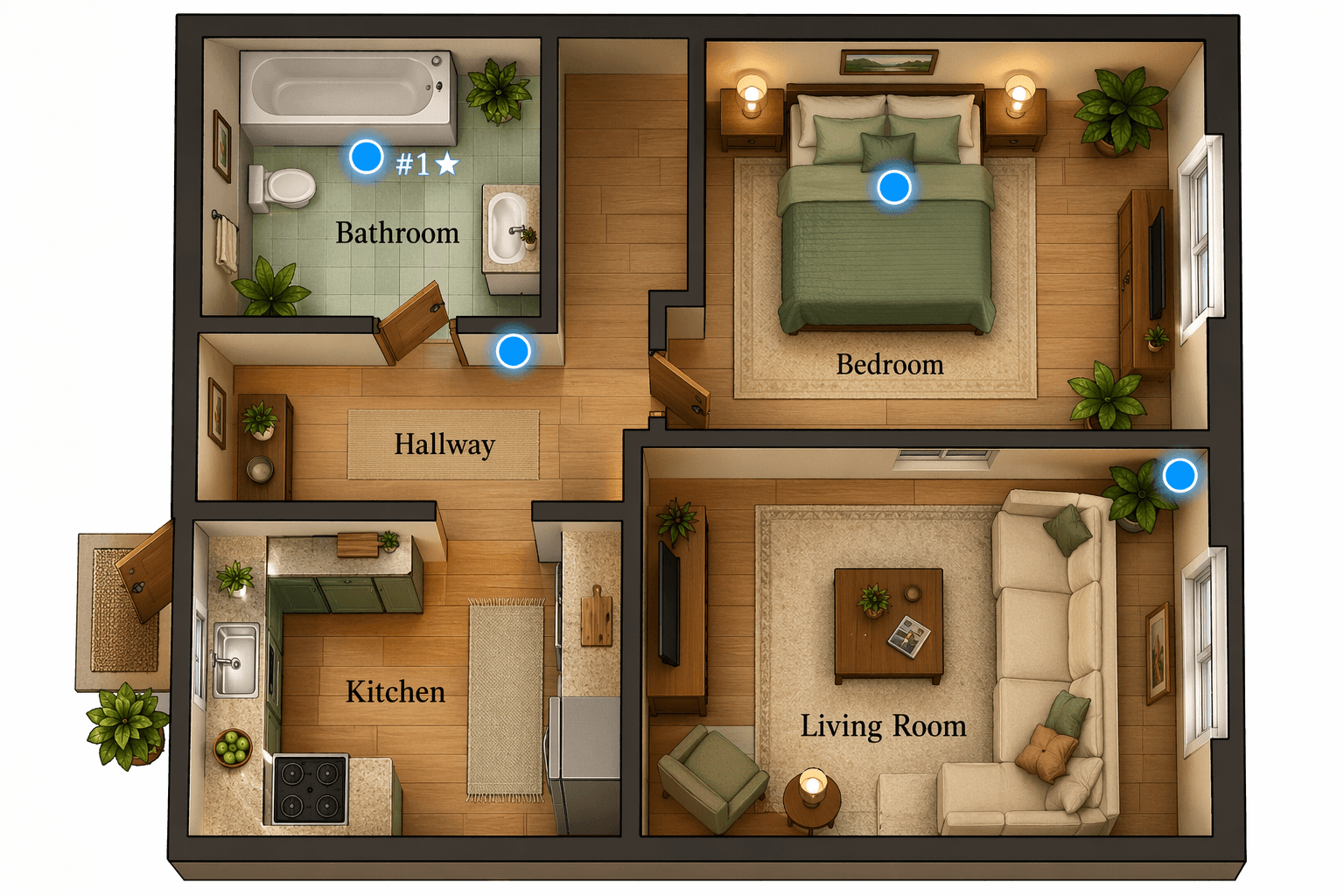
If you are reading this and thinking about buying a passive system, start with a single sensor in the bathroom. The reasons are specific and measurable: nocturia (two or more bathroom trips per night) directly increases fall risk, and over 230,000 seniors end up in the ER each year from bathroom falls. The pendant cannot help here because it is not worn at night. A radar sensor mounted high on the bathroom wall or ceiling covers the full space, detects a fall the instant it happens, and can alert a caregiver within seconds.
After the bathroom, add a sensor in the bedroom to cover the path from bed to bathroom. Then the living room or kitchen for daytime coverage. Most systems allow room-by-room expansion, so you do not have to equip the whole house at once.
Priority sensor placement: bathroom first (highest night-time fall risk), then bedroom and hallway, then living areas.
Why cognitive decline makes the pendant even worse
When memory loss is part of the picture, the pendant's compliance problem deepens. A person with dementia may not remember to put the pendant on, may not recognize its purpose, or may take it off and leave it in an odd place. Passive systems do not depend on the senior's memory at all. They work as long as the sensor is installed and powered.
A 12-week pilot study in the PMC scoping review found that smart home technology for nighttime wandering improved safety for people with dementia and significantly reduced caregiver depression and anxiety. That study used passive sensors (infrared and contact sensors), not a wearable. The benefits came precisely because the system ran in the background — no reminders, no switches to flip, no daily checklists.
But here is the boundary: passive systems cover indoors only. For a person with dementia who might wander outside, you still need a GPS tracker. Our guide to GPS trackers for seniors with dementia covers the options for outdoor safety.
The real price tag: $25 a month vs. a $3,500 ER visit
The cost of passive monitoring is real: $25 to $50 per month for the service, plus $150 to $500 per sensor room for the hardware. Some systems require professional installation. That adds up, and I would not pretend it is pocket change.
Now compare that to the cost of a single fall that requires emergency care. The average ER visit from a fall costs over $3,500. The total annual healthcare cost of non-fatal older adult falls is $80 billion nationally, according to the National Council on Aging. One fall avoided can cover years of monitoring.
And some of that cost can be offset. As of December 2024, 42 states have adopted Medicaid coverage for remote patient monitoring, though coverage varies. Some state Medicaid HCBS (Home and Community-Based Services) waivers explicitly cover non-wearable fall detection. It is worth checking whether your parent's plan includes RPM benefits.
When you still need a wearable: the case for layered coverage
I have spent this article arguing that pendants fail for the most common and most dangerous fall scenarios. But I do not want you to hear that you should throw away the pendant entirely.
Passive systems cover the inside of the home. If your parent spends time outdoors — gardening, walking, running errands — a wearable still offers protection, even if it is worn less consistently. The best strategy for many families is layered: a passive radar system as the always-on indoor safety net, especially for the bathroom and bedroom at night, and a pendant or smartwatch for outdoor activities. The passive layer handles the highest-risk, hardest-to-detect scenarios; the wearable handles everything else.
The pendant on the nightstand at 2 AM cannot call for help. A passive sensor on the bathroom wall can. That is the difference between hoping a technology works and knowing it does.
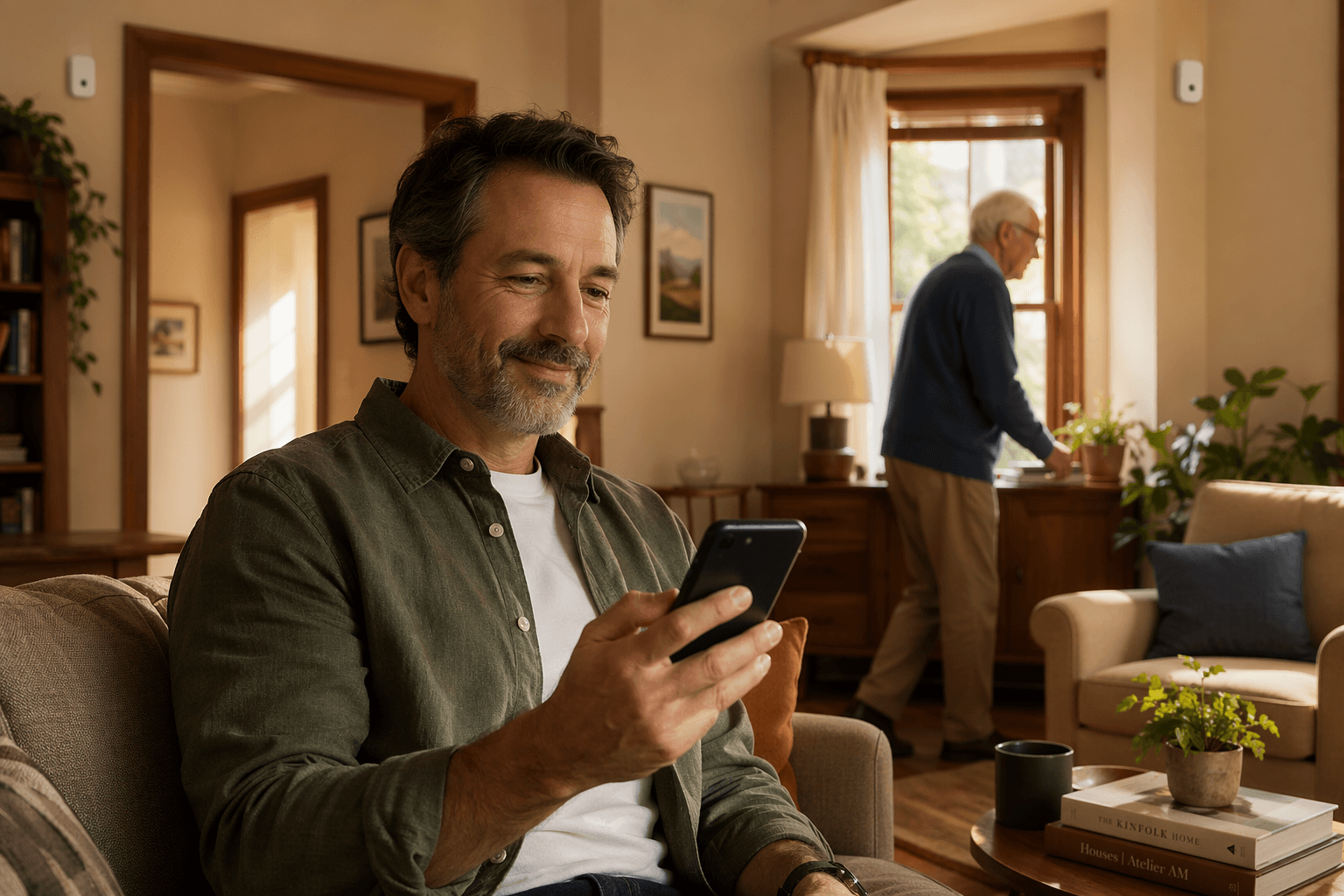
Passive monitoring works silently in the background, allowing families to feel connected without demanding anything from the senior.
For individualized recommendations:An occupational therapist or your primary care provider can assess your specific situation and recommend the monitoring category and feature set that best fits the person's functional level, living environment, and caregiver availability. This explainer provides educational context, not a personalized recommendation.

Comments
Join the discussion with an anonymous comment.