
Caregiver decision guide
Home Help for Elderly Adults: A Complete Guide to Services, Costs, and Technology for Aging in Place
This comprehensive guide maps the full spectrum of home help for older adults — from volunteer companionship and personal care to skilled nursing and passive monitoring technology. Written for adult children navigating care options for the first time, it covers service categories, 2026 costs, the difference between home care and home health care, technology options, provider evaluation, payment sources, and a decision framework to match needs to services.
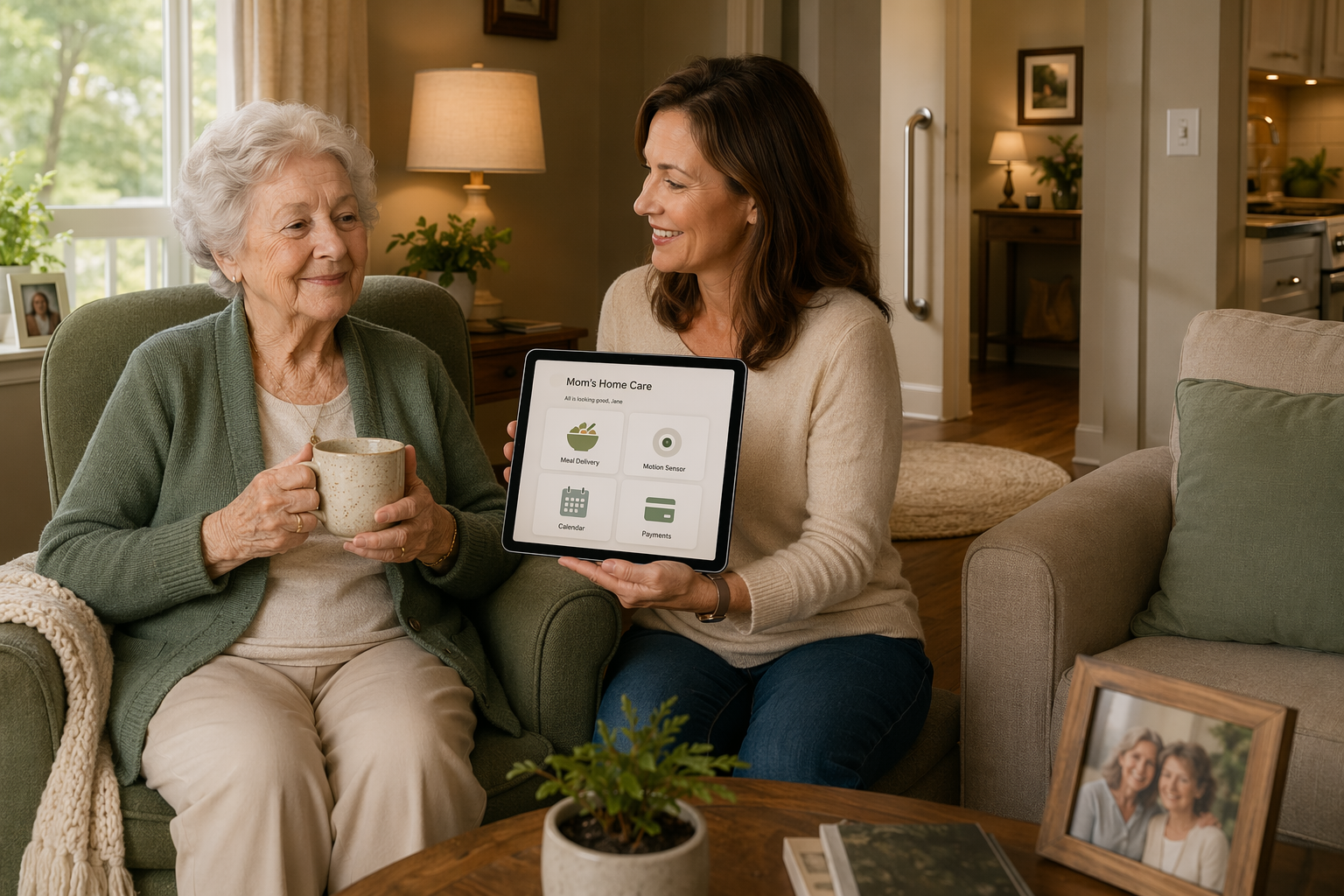
Why Home Help Matters: The Landscape of Aging in Place
The numbers are clear and consistent across every major survey: more than 9 in 10 older adults want to remain in their own homes as they age. Research from Choice Mutual puts the figure at over 90%, while a separate analysis from RubyHome, cited in 2026 home care statistics, finds that 82% of seniors specifically want to stay in their current home — not just any home, but the one they have lived in, often for decades.
Yet the gap between that desire and reality is wide. Only about 10% of homes are considered "aging ready" according to industry estimates. And while 8 in 10 older adults currently live independently, the moment a fall, a diagnosis, or a gradual functional decline occurs, families are thrust into a confusing landscape of service options, cost structures, and coverage rules — often with no clear starting point.
The core thesis of this guide is straightforward: home help is not a single service. It is a spectrum that runs from a volunteer stopping by for a weekly conversation, through paid assistance with bathing and meals, all the way to skilled nursing care and passive sensor systems that can detect a change in daily patterns before a crisis occurs. Family caregivers who understand this full landscape — who know what exists, what it costs, who pays for it, and how technology fits in — make better decisions, spend less money, and often extend their parent's independence longer than those who navigate by crisis.
This article is designed as a comprehensive starting point. Each section maps to a key decision families face, and each links to deeper resources on this site for the details that matter most at each stage.
The Full Spectrum of Home Help Services
One of the most common mistakes families make is assuming that "home help" means a full-time, paid caregiver. In reality, the National Institute on Aging (NIA) describes a wide range of services that can be mixed and matched to fit a person's actual needs, budget, and preferences. Understanding the full menu is the first step toward building a sustainable care plan.
Unpaid and Volunteer Services
Many families overlook the lowest-cost, lowest-barrier options. Volunteer services — friendly visitor programs, telephone reassurance lines, and meal delivery programs like Meals on Wheels — are often free and can provide meaningful social connection and nutritional support. The NIA notes that these services are typically offered through local Area Agencies on Aging (AAAs) and nonprofit organizations. Transportation services, money management assistance, and even some light home repair programs also fall into this category.
These services do not replace hands-on care, but they can fill gaps, reduce isolation, and give family caregivers a few hours of breathing room each week.
Personal Care and Homemaker Services
When an older adult needs help with activities of daily living (ADLs) — bathing, dressing, toileting, transferring, eating — or with instrumental activities of daily living (IADLs) like meal preparation, light housekeeping, laundry, and medication reminders, a paid home care aide is the typical solution. These are nonmedical services provided by trained caregivers, not nurses or therapists.
The NIA categorizes these as "help with everyday activities" and notes they are the most common form of paid home help. The scope can range from two hours a week for grocery shopping and companionship to 40+ hours a week for someone who needs constant supervision and physical assistance.
Skilled Home Health Care
Skilled home health care is a different category entirely. It is medical care delivered in the home — wound care, physical therapy, occupational therapy, speech therapy, medication administration, and monitoring of chronic conditions — provided by licensed nurses, therapists, and home health aides under a physician's plan of care. The NIA specifies that this type of care is typically short-term, focused on recovery or stabilization, and requires a doctor's order.
For a deeper look at what skilled nursing at home involves, what it costs, and how Medicare covers it, see our dedicated guide on in-home nursing care for the elderly.
Respite Care and Adult Day Care
Respite care provides temporary relief for family caregivers. It can be arranged for a few hours, a full day, or even a week, and it may be provided in the home, at an adult day center, or in a residential facility. The NIA notes that adult day care centers are generally less expensive than in-home care and provide structured activities, meals, and social engagement during daytime hours.
For quick definitions of all these care types and more, the Senior Care Options glossary is a useful reference to bookmark.
What Home Help Costs in 2026
Cost is the single most common question families ask, and the answer depends on where you live, what type of care you need, and how many hours per week. For 2026, two major data sources provide consistent national medians with slightly different methodologies.
A Place for Mom reports a 2026 national median of $34 per hour for nonmedical in-home care, based on its proprietary network data. SeniorLiving.org, using CareScout data, reports a 2026 national median of $35 per hour for a home health aide and $33.99 per hour for homemaker services. The small difference reflects different data collection methods and geographic weighting — both are reliable benchmarks.
The real variation, however, is geographic. State medians range from approximately $25 per hour in Mississippi to $44 per hour in South Dakota, according to A Place for Mom. SeniorLiving.org's data shows a similar spread, with Louisiana around $23 per hour and Washington state at $42 per hour. These differences are driven by local cost of living, state minimum wage laws, and the supply of home care workers.
| Hours per Week | Monthly Cost at $34/hr | Monthly Cost at $35/hr |
|---|---|---|
| 7 hours (1 hr/day) | $1,031 | $1,061 |
| 15 hours (2 hrs/day) | $2,208 | $2,273 |
| 30 hours (4 hrs/day) | $4,416 | $4,550 |
| 44 hours (6 hrs/day) | $6,478 | $6,672 |
Several factors influence the final rate beyond geography: whether you hire through an agency or independently, whether the aide is certified, the complexity of the care needed, and whether you require overnight or weekend coverage. Agency rates are typically higher because they include bonding, insurance, worker's compensation, and backup coverage.
Home Care vs. Home Health Care: Key Differences
These two terms are often used interchangeably, but they describe fundamentally different services with different costs, different eligibility requirements, and different insurance coverage. Understanding the distinction is essential for making the right choice — and for avoiding costly mistakes.
A Place for Mom provides a clear comparison that maps the key differences:
| Dimension | Home Care (Nonmedical) | Home Health Care (Skilled Medical) |
|---|---|---|
| What it provides | Companionship, bathing, dressing, meal prep, light housekeeping, transportation | Wound care, medication administration, physical/occupational/speech therapy, chronic disease monitoring |
| Who provides it | Home care aides, companions, homemakers (no medical license required) | Registered nurses (RNs), licensed practical nurses (LPNs), physical therapists, occupational therapists |
| Who is eligible | Any older adult who needs help with daily activities | Must be under a physician's plan of care and have a skilled medical need |
| Doctor's order required? | No | Yes |
| Typical duration | Can continue indefinitely as long as the need exists | Short-term, typically recertified every 60 days by Medicare |
| 2026 national median cost | $34–$35 per hour | Varies; often higher due to skilled staff; typically covered by insurance when eligible |
| Insurance coverage | Almost always paid out-of-pocket; some long-term care policies may cover | Medicare Part A/B covers if patient is homebound and needs skilled care; Medicaid covers in some states |
The most important takeaway: Medicare does not cover custodial home care. If your parent needs help with bathing and meals but does not need skilled nursing or therapy, Medicare will not pay for it. Home health care is covered by Medicare only when the patient is homebound, under a doctor's plan, and receiving skilled services. This distinction is the source of more confusion — and more financial surprises — than almost any other topic in senior care.
For a deeper dive into skilled nursing at home, including what services are covered and under what conditions, see our article on in-home nursing care for the elderly.
How Monitoring Technology Can Supplement Human Care
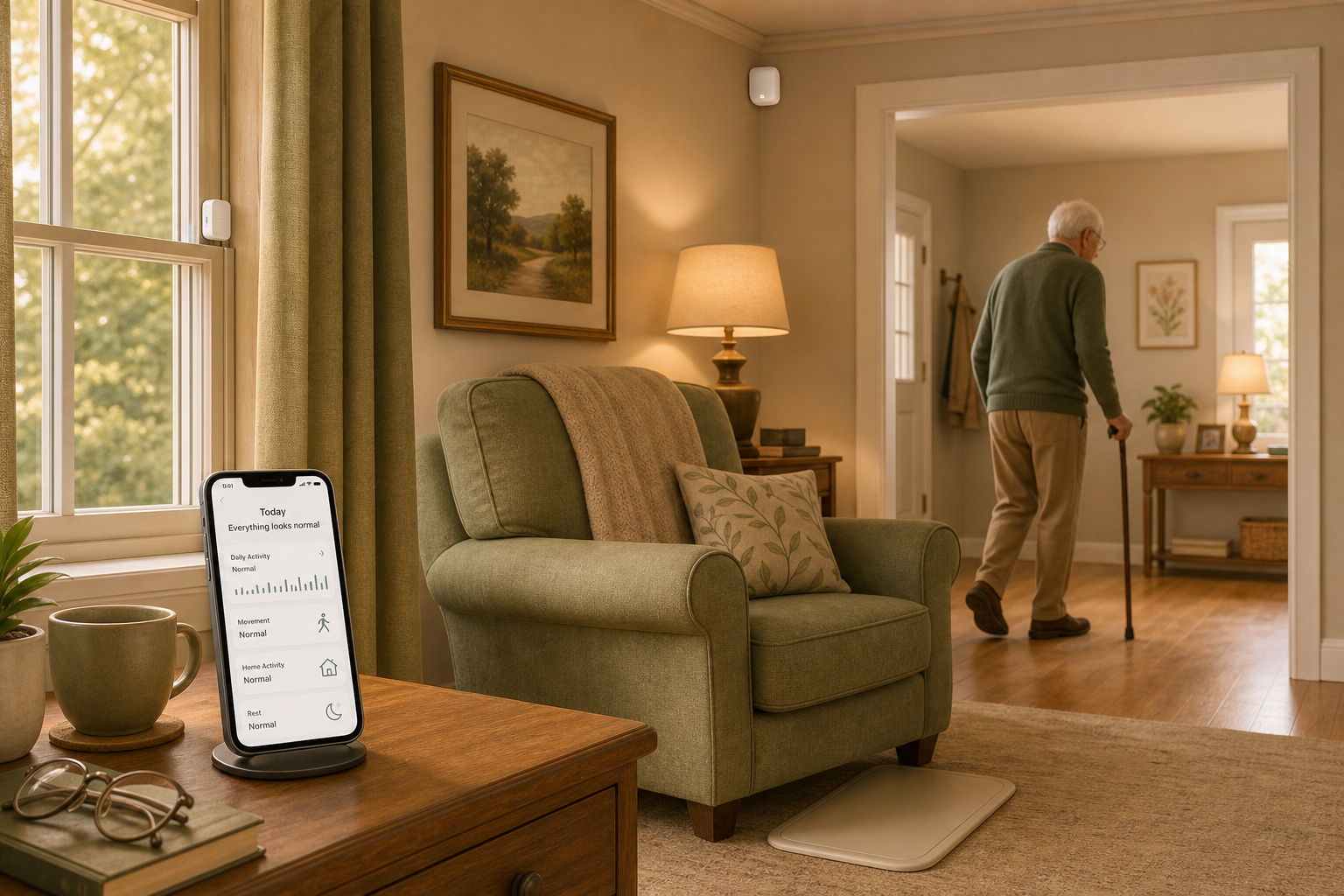
Technology is not a replacement for human care, but it can extend the time an older adult lives safely at home, reduce the burden on family caregivers, and — in some cases — detect health changes days or weeks before they become emergencies.
A 2022 scoping review published in the National Institutes of Health's PMC database identified 30 studies on in-home monitoring technology and catalogued 16 distinct types of sensors. The most common were passive infrared (PIR) motion sensors, found in 21 of the 30 studies, and contact sensors (used on doors, cabinets, and refrigerators), found in 19 studies. These sensors, combined with data analytics, can monitor six key functions: daily activities, abnormal behaviors, cognitive impairment indicators, falls, indoor positioning, and sleep quality.
The practical value for families is significant. A PIR sensor in the living room can detect that an older adult has not moved from their chair in an unusually long time. A contact sensor on the medication cabinet can confirm whether pills were taken. A pressure mat beside the bed can alert a family member if a parent has not gotten up by their usual time. These systems do not require cameras — they preserve privacy while providing actionable information.
The review also noted that non-wearable sensors (those installed in the home environment) are generally preferred over wearable devices by older adults with cognitive impairment, who may forget to wear them or find them uncomfortable. This is an important consideration for families exploring monitoring options for a parent with early-stage dementia.
- Personal Emergency Response Systems (PERS): Wearable or home-based buttons that connect to a call center. The most basic form of monitoring technology. Some now include automatic fall detection.
- Passive home sensors: PIR motion sensors, door/window contact sensors, pressure mats, and bed occupancy sensors. No action required from the older adult.
- Smart home devices: Smart speakers, video doorbells, smart locks, automated lighting, and water-leak sensors. These address safety and convenience.
- Clinical remote patient monitoring (RPM): Devices that transmit vital signs (blood pressure, glucose, weight, oxygen saturation) to a healthcare provider. Requires a physician order.
For a detailed, product-neutral look at how clinical remote patient monitoring works, what it costs, and how Medicare covers it, see our guide on remote patient monitoring for seniors. The broader Monitoring Technology section of this site covers each technology category in depth, including evaluation criteria, privacy considerations, and questions to ask before purchasing.
How to Find and Evaluate Home Help Providers
Once you know what type of help you need, the next challenge is finding a provider you can trust. Whether you are hiring an agency or an independent caregiver, a structured evaluation process reduces the risk of a bad match — and the disruption that comes with it.
Questions to Ask Every Agency
- Are you licensed, bonded, and insured? Requirements vary by state. Ask for proof of liability insurance and worker's compensation coverage.
- How do you screen and train your caregivers? Look for background checks, reference verification, and training that goes beyond basic orientation.
- Can you provide a written care plan? A professional agency should assess your parent's needs and document a plan before care begins.
- What happens if the regular caregiver is sick? Reliable agencies have backup staff and a process for ensuring continuity.
- How do you handle scheduling changes and communication? Clarify how you will be notified of schedule changes and how you can reach a supervisor.
- What is your policy on caregiver replacement if there is a personality mismatch? A good agency will accommodate reasonable requests for a different caregiver.
Red Flags to Watch For
- The agency cannot provide written documentation of licensing and insurance.
- The agency pressures you to sign a long-term contract or pay a large upfront fee.
- The agency refuses to let you meet the caregiver before services begin.
- The agency claims Medicare will cover nonmedical home care without a skilled need.
- The agency has multiple unresolved complaints with the state licensing board or Better Business Bureau.
For a detailed comparison of the pros and cons of hiring a family member versus a professional agency, see our guide on family caregiver vs. professional home care. It covers the financial, emotional, and practical trade-offs that many families face.
Paying for Home Help: Medicare, Medicaid, VA, and Other Options
The payment landscape for home help is fragmented, and the rules vary significantly by state, by program, and by the type of care needed. Below is a summary of the major payment sources. For a comprehensive treatment of each, see our dedicated guide on how to pay for senior home care services in 2026.
| Payment Source | What It Covers | Key Limitation |
|---|---|---|
| Private pay (out-of-pocket) | Any type of home care or home health care | Most common method; costs can exceed $6,000/month for full-time care |
| Medicare (Part A & B) | Skilled home health care only (nursing, therapy) for homebound patients under a physician's plan | Does NOT cover custodial/personal care (bathing, meals, companionship) |
| Medicaid (HCBS waivers) | Nonmedical home care, personal care, and some home modifications — varies by state | Income and asset limits apply; waitlists exist in many states |
| VA benefits (Aid and Attendance) | In-home care, adult day care, and assisted living for qualifying veterans and surviving spouses | Requires VA pension eligibility and a medical need for aid and attendance |
| Long-term care insurance | Varies by policy; may cover home care, home health care, and adult day care | Must have purchased policy before care was needed; elimination periods apply |
| Local/state programs | Varies; some offer subsidized homemaker services, meal delivery, or respite care | Often income-limited and may have waitlists |
Making the Right Choice: A Decision Framework for Families

With so many options, the risk of analysis paralysis is real. The following framework is designed to help you move from confusion to a concrete next step.
Step 1: Assess Functional Status
Start by identifying which activities of daily living (ADLs) and instrumental activities of daily living (IADLs) your parent needs help with. The most common needs, according to 2026 home care statistics, are bathing and showering — 83% of home care recipients need help with this single activity. If your parent can bathe safely, dress independently, and prepare their own meals, the level of help needed may be relatively low. If they need assistance with multiple ADLs, the care requirement is likely more intensive.
Step 2: Assess Safety Risks
One in four adults aged 65 and older falls each year, and falls are the leading cause of injury-related emergency department visits among older adults — approximately 3 million visits annually. If your parent has already fallen, has balance issues, or has a cluttered or poorly lit home, safety interventions (grab bars, improved lighting, non-slip flooring) and monitoring technology may be as important as personal care services.
Step 3: Assess Caregiver Availability and Capacity
A 2024 AARP report found that 70% of family caregivers struggle to balance career and caregiving responsibilities. Nationwide, approximately 20% of Americans are family caregivers, providing an estimated $873 billion worth of unpaid labor annually. Be honest about what you and other family members can sustainably provide. Burnout helps no one.
Step 4: Match Needs to Services
- Minimal help needed: Volunteer services (meal delivery, friendly visitor), a few hours of homemaker services per week, and a basic PERS button.
- Moderate help needed: Regular personal care aide (10–20 hours/week), passive home sensors for safety monitoring, and possibly adult day care 2–3 days per week.
- Intensive help needed: Full-time or near-full-time home care (30–40+ hours/week), skilled home health if recovering from hospitalization, and a comprehensive monitoring system.
- Post-hospitalization: Skilled home health care (nursing, physical therapy) is typically covered by Medicare for a limited period. Plan for the transition to nonmedical home care when skilled services end.
Step 5: Start Small and Reassess Regularly
As Vicki Demirozu, an expert cited by A Place for Mom, notes: "There's evidence that even small amounts of in-home care, such as helping someone with meals or light housekeeping, can extend their independence." You do not need to design the perfect care plan on day one. Start with the most pressing need — often bathing assistance or meal preparation — and add services as needs evolve. Reassess every 60 to 90 days, or after any significant health event.
For help deciding between relying on family and hiring professional care, see our guide on family caregiver vs. professional home care. And for recognizing the specific signs that it is time to begin this process, revisit our guide on when it is time for in-home help.
Questions to bring to a clinician or OT
This is not medical, legal, or a family's final decision — only a framework. Bring these questions to a clinician, occupational therapist, or your local Area Agency on Aging.
Find Local HelpRelated reading
- The Monitoring Conversation: How to Talk to an Aging Parent About Safety Technology Without Damaging Trust or Autonomy
- When Is 24/7 Care Actually Necessary? A Decision Framework for Using Monitoring Technology as a Safe Alternative
- A Decision Framework for Choosing an Elderly Monitoring System Based on Your Parent's Needs
Noticed something outdated or inaccurate on this page? Flag a correction. We review every report against CDC, NIA, and AARP HomeFit guidance before updating a page.