
Caregiver decision guide
The 7 Types of Senior Housing: A Guide to Options, Costs, and Choosing Wisely
This guide walks through the seven main types of senior housing — from independent living to skilled nursing facilities — with typical costs and care needs for each, so families can start their search with a clear picture of what fits their situation.
Searching for “homes for seniors” sounds simple until the results start mixing apartment listings, assisted living communities, memory care wings, nursing homes, and “care campuses” as if they were versions of the same thing. They are not. A useful search starts by separating at least seven different housing and care categories, because each one is built for a different level of daily help, supervision, medical need, and payment reality.
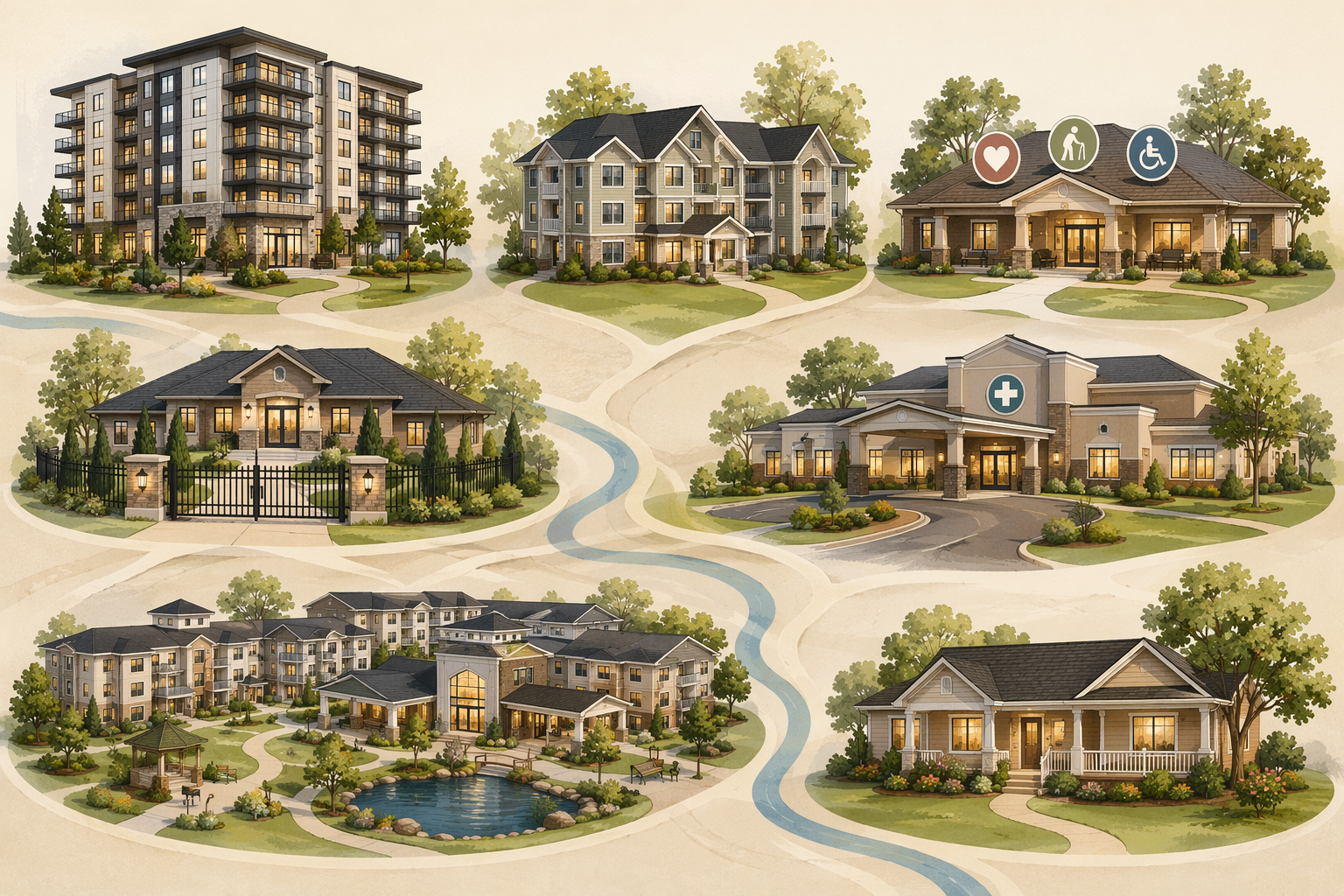
The National Institute on Aging groups long-term care settings by the kind of support they provide, from assisted living to nursing homes and continuing care retirement communities; that framing matters because a tour brochure may emphasize meals and activities while the real decision turns on bathing help, medication support, wandering risk, rehabilitation needs, and whether a parent can safely be alone for stretches of the day.[1]
| Type of senior housing | Typical fit | Broad cost signal | Watch this boundary |
|---|---|---|---|
| Independent living | Older adults who can manage personal care but want a maintenance-free setting, meals or dining options, activities, and easier social connection | Median around $3,065 per month in SeniorLiving.org’s 2026 cost survey[2] | Usually not designed for hands-on daily care; services may be limited or added through outside providers |
| Senior apartments | Age-restricted apartments for older adults, including market-rate and income-linked affordable housing pathways | Costs vary widely by market and subsidy; Section 202, Section 8, and subsidized senior apartments depend on local rules and availability[3] | Do not assume rent includes care; waitlists and income limits are local |
| Assisted living | People who need help with activities of daily living such as bathing, dressing, toileting, mobility, meals, or medication routines | Median around $5,419 per month in A Place for Mom’s 2026 cost report[4] | Often priced below nursing homes but above apartment-style housing; base rent may not include every care charge |
| Memory care | People with Alzheimer’s disease or other dementia who need structured routines, secured or monitored spaces, and dementia-trained supervision | Often priced above standard assisted living, but no single national median is cited here | The issue is not just “more help”; it is dementia-related safety, supervision, and behavior support |
| Nursing homes / skilled nursing facilities | People who need 24-hour nursing care, rehabilitation after hospitalization, or a higher medical-care setting | About $9,277–$10,646 per month in the CareScout 2025 survey cited by A Place for Mom[4] | This is a medical and skilled-care setting, not simply assisted living with more staff |
| Continuing care retirement communities, or CCRCs | Older adults who want a campus with more than one care level, often moving from independent living to assisted living or nursing care if needs increase | Average entrance fee around $402,000, with monthly costs often $3,000–$5,000+ in SeniorLiving.org’s housing guide[5] | Contracts and refund terms matter; this is not just a monthly-rent decision |
| Board-and-care homes | Small residential settings for people who need help with daily life in a more home-like environment | No reliable national cost figure cited here | Availability, licensing language, staffing, and quality vary by state and locality |
Those cost figures are orientation points, not interchangeable price quotes. They come from different sources and survey methods, including facility surveys, consumer move-in data, and housing guides. Use them to avoid comparing a senior apartment to a skilled nursing facility as if both were rent quotes for the same product.
Independent living and senior apartments: similar buildings, different promises
Independent living is usually for an older adult who does not need regular hands-on help with bathing, toileting, dressing, or eating. The appeal is convenience: fewer home-maintenance tasks, easier meals, social programming, transportation in some communities, and neighbors in the same stage of life. It can be the right move when the old house has become too much work but the person is still managing personal care.
The catch is in the word “independent.” If a parent is already missing medications, falling during transfers, leaving burners on, or needing help bathing several times a week, independent living may only solve the housing problem while leaving the care problem untouched. Some families combine independent living with outside home care, but then the real comparison becomes independent living plus paid care versus assisted living or another setting.
Senior apartments are a broader bucket. Some are market-rate age-restricted apartments. Others are affordable housing options tied to income rules, subsidies, or public programs. SeniorLiving.org identifies Section 202 Supportive Housing for the Elderly, Section 8 Housing Choice Vouchers, and subsidized senior apartments as affordable pathways, but eligibility and waitlist reality depend on the local Public Housing Agency and property-level rules.[3]
That distinction matters for families who are priced out of private-pay assisted living but whose parent does not yet need assisted living care. If affordability is the first wall you have hit, it is worth reading more about affordable alternatives when assisted living is too expensive and housing options for the overlooked middle. Those routes may take more paperwork and patience than a private tour, but they are real parts of the senior housing map.
Assisted living: the category families often reach for first
Assisted living is built around help with activities of daily living, often shortened to ADLs: bathing, dressing, toileting, eating, transferring, and moving around safely. It may also include meals, housekeeping, medication support, activities, transportation, and staff available around the clock. It is not a hospital, and it is not a nursing home, but it is more than an apartment with a dining room.
The resident profile is usually more care-intensive than families expect. A Place for Mom’s 2026 assisted living statistics page, citing National Center for Assisted Living data, reports that 53% of assisted living residents are age 85 or older and 62% need help with three or more ADLs.[6] That does not mean every 85-year-old belongs in assisted living. It does mean the typical community is serving people with substantial daily support needs, not just older adults who are lonely or tired of cooking.
A separate national measure helps explain why this category comes up so often: in 2024, 13.8% of adults age 75 and older needed personal care assistance, according to CDC data.[7] Personal care need is often the line that pushes a family from “Mom should move somewhere easier” to “Mom needs people who can help her get through the day safely.”
The expensive mistake is using assisted living as a catch-all. If a parent needs only accessible housing and transportation, assisted living may be overplacement. If a parent is wandering at night, becoming aggressive during care, or unable to recognize danger, standard assisted living may be underplacement unless the community has a memory care program that actually matches those risks. If a parent needs daily skilled nursing or complex medical management, assisted living may not have the license, staff, or clinical capacity to do the job.
Before touring assisted living, ask what the base monthly fee includes, how care levels are priced, how medication management is billed, what happens after falls or hospitalizations, and which conditions trigger a required move-out or transfer. The answer to that last question often reveals more than the lobby.
Memory care is a supervision decision, not a nicer name for assisted living
Memory care is usually for people with Alzheimer’s disease or another dementia whose safety depends on structure, staff training, and environmental design. Many memory care programs operate within assisted living communities, which is one reason the categories blur. The better question is not whether a parent needs “more help.” It is whether cognitive changes have created risks that ordinary assisted living cannot reliably manage.
Examples include leaving the building without understanding danger, waking at night and trying to exit, resisting care because the task feels frightening, misusing appliances, becoming lost in familiar places, or needing repeated cueing for basic routines. These are not character flaws or family failures. They are care-design problems. A setting that works for a person who can press a pendant and describe what is wrong may fail for a person who cannot explain pain, fear, or confusion.
Families comparing memory care should ask about staffing patterns, secured outdoor access, response to exit-seeking, dementia-specific training, behavior support, medication review, visiting policies, and how the program handles residents whose needs increase. A locked door by itself is not a care plan.
If dementia is the central concern, use a more focused next step: signs it may be time for a memory care transition, when to move from assisted living to memory care, and how to compare 24-hour dementia care at home versus memory care. If the situation is already in crisis, a staged first 30 days plan for adult child caregivers can keep the next calls from becoming random.
Nursing homes and skilled nursing facilities: higher care, higher scrutiny
Nursing homes and skilled nursing facilities serve people who need a medical or rehabilitation level of care. That may mean 24-hour nursing, therapy after a hospitalization, wound care, complex medication needs, or a level of physical assistance that cannot be safely handled in a lower-care residential setting. The National Institute on Aging describes nursing homes as providing a wide range of health and personal care services, with more medical care than most assisted living facilities.[1]
This category also has the highest cost signal in the materials here: A Place for Mom’s 2026 cost report cites CareScout’s 2025 survey at about $9,277 to $10,646 per month for nursing home care, depending on room type.[4] That number should not be used as a local quote, but it does make one thing clear: nursing home care belongs in a different financial conversation from independent living or senior apartments.
The NIA’s guidance on choosing a nursing home or other long-term care facility emphasizes matching the facility to the person’s needs, visiting, asking questions, and reviewing quality information rather than relying on a single impression.[8] For families, the practical trigger is often a hospital discharge planner, a rehabilitation recommendation, repeated unsafe transfers, or care needs that have outgrown what one family member or a lightly staffed residential setting can manage.
CCRCs trade a large upfront decision for continuity
Continuing care retirement communities, also called CCRCs or life plan communities, are campuses that typically offer more than one level of living: independent living first, with assisted living, memory care, or nursing care available if needs change. The value proposition is continuity. A person may move while still independent and avoid having to search from scratch after a health decline.
The financial model is the part families cannot gloss over. SeniorLiving.org’s housing guide lists an average CCRC entrance fee of about $402,000 and monthly costs often in the $3,000–$5,000+ range.[5] The entrance fee, refund structure, care contract, monthly fee increases, and what happens if assets run down are central questions, not fine print.
A CCRC may be a sensible option for a parent who can afford the contract, likes the campus, and wants to reduce future moves. It may be a poor fit for someone who already needs a high level of care, dislikes communal campus life, or cannot safely commit a large entrance fee. For a concrete look at how one faith-based senior living model can affect costs, the Presbyterian senior living cost case study is a more specific next read.
Board-and-care homes: smaller does not automatically mean simpler
Board-and-care homes are smaller residential settings, often serving a limited number of older adults in a house-like environment. In some states or markets, families may hear terms such as residential care home, adult family home, personal care home, or group home. The appeal is understandable: fewer residents, a more domestic setting, and potentially more familiarity in the day-to-day rhythm.
The caution is that smaller does not automatically mean better staffed, less expensive, or clinically appropriate. Licensing categories vary, and there is no reliable national median cost cited here. Families need local verification: who is awake overnight, what training staff have, whether dementia behaviors are accepted, how medications are handled, which conditions require transfer, and how the home is inspected.
Availability can feel tight, but local reality matters
If every desirable community seems to have a waitlist, that may not be your imagination, but the national shorthand still needs care. NIC reported Q1 2026 occupancy of 89.5% across 31 primary markets, in data covering roughly 85% of U.S. senior housing and care property inventory within those primary markets.[9] That is useful context for why some markets feel competitive. It is not a promise that your county, price range, or care category has the same availability.
Availability also differs by care level. A memory care opening does not solve an independent living need. A nursing home rehabilitation bed does not mean there is affordable long-term placement. A subsidized senior apartment waitlist may move on a completely different timeline from a private assisted living vacancy. Families save time when they ask about the exact unit type and care level, not just whether a “community” has openings.
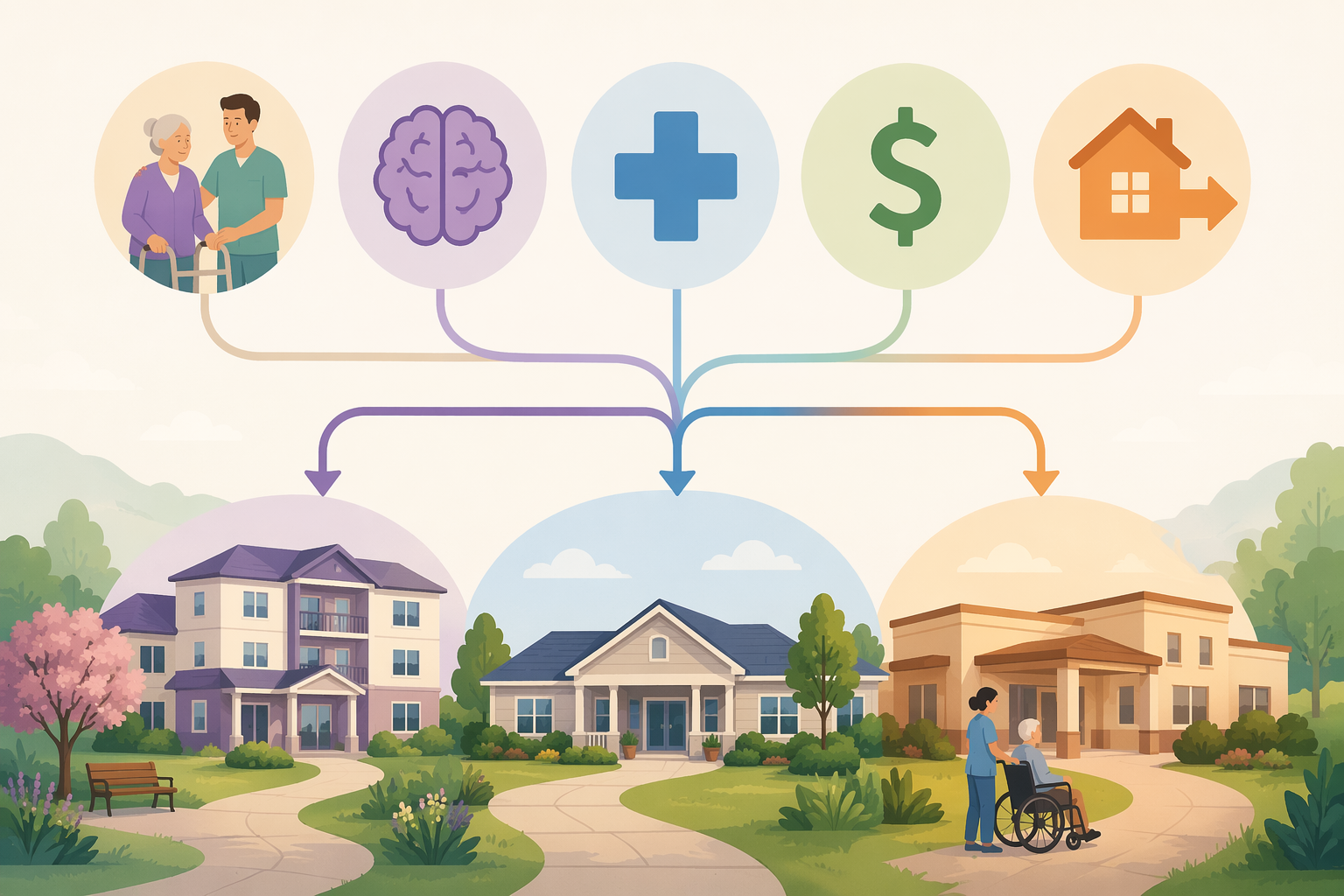
Sort the situation before booking tours
Tours are useful after the category is plausible. Before that, they can blur the decision. A polished dining room can make assisted living look like the answer even when the real need is affordable rent, dementia supervision, skilled nursing, or a plan to keep someone safely at home a little longer.
- ADL help: Write down exactly what help is needed with bathing, dressing, toileting, transferring, eating, walking, and medication routines. Note who currently provides that help and how often.
- Cognitive status: Separate forgetfulness from safety risk. Missed appointments and repeated stories are different from wandering, unsafe cooking, paranoia, or inability to call for help.
- Medical and skilled nursing needs: List recent hospitalizations, wounds, injections, rehabilitation needs, oxygen, complex medications, and fall patterns. These may point toward skilled nursing, home health, or a higher-care setting.
- Budget: Identify monthly income, savings that can realistically be used, long-term care insurance, home equity if relevant, and whether Medicaid or subsidized housing may need to be explored locally.
- Tolerance for moving again: Some families prefer the least restrictive setting now. Others want a campus or community that can absorb future care changes. Neither is automatically right.
- Local affordable pathways: If private-pay assisted living is out of reach, contact the local Public Housing Agency, Area Agency on Aging, and state Medicaid office before assuming there are no options.
At this stage, the goal is not to choose a final address. It is to cross off obvious mismatches. A parent who needs no personal care but cannot maintain a house belongs in a different search than a parent who needs help toileting at night. A parent with exit-seeking dementia belongs in a different search than a parent who wants more social meals. A parent recovering from a serious hospitalization may need skilled nursing or rehabilitation before anyone can judge the long-term housing fit.
Use cost after care level, not before it
Budget has to appear early, but it should not be the first and only filter. If you compare independent living at about $3,065 per month with assisted living at about $5,419 per month without naming the care difference, the cheaper option will look like a bargain even when it leaves the family buying outside help or responding to the next fall.[2][4]
A more useful comparison is total support. For example, if a parent can live in a senior apartment with a few hours of paid help each week, that may be very different from needing hands-on support several times a day. If the realistic alternative is staying home, compare facility costs with the cost of in-home help, family coverage, overnight supervision, home modifications, transportation, and the caregiver’s lost work time where applicable. The in-home senior care cost guide can help with that side-by-side exercise.
For payment planning beyond the first shortlist, use a broader guide to long-term senior care costs and payment pathways. The point is not to become a benefits expert overnight. It is to avoid signing a lease or contract before knowing whether the first year, the third year, and the next level of care are financially survivable.
A first shortlist should be narrow
After sorting care level and budget, most families should be able to narrow the field to two or three plausible categories. Not twenty buildings. Not every senior living option within driving distance. Categories first.
| If the main issue is... | Start with... | Probably not the first search |
|---|---|---|
| House maintenance, isolation, transportation, or easier meals, with no regular personal care | Independent living or senior apartments | Nursing homes or memory care |
| Low income or inability to afford private-pay senior living | Section 202, Section 8, subsidized senior apartments, local housing agencies, and affordable alternatives | Private-pay assisted living as the only path |
| Help with bathing, dressing, toileting, mobility, meals, or medication routines | Assisted living, or home care if staying home is still realistic | Independent living without a care plan |
| Dementia-related wandering, unsafe behavior, repeated confusion, or need for structured supervision | Memory care or dementia-capable home care | Standard senior apartments or ordinary assisted living without dementia support |
| Rehabilitation, 24-hour nursing, complex medical needs, or post-hospital skilled care | Skilled nursing facility or nursing home | Lifestyle-focused senior living |
| Desire for one campus that can support future care transitions | CCRC or life plan community, if finances and contract terms fit | A month-to-month apartment search only |
| Preference for a smaller home-like setting with daily support | Board-and-care homes, if licensed and appropriate locally | Assuming small settings can manage all dementia or medical needs |
Once the shortlist is this narrow, the next questions become practical: Who is licensed to provide the needed care? What is included in the monthly fee? What triggers extra charges? What happens after a fall, hospitalization, dementia progression, or depleted funds? Who is awake overnight? How long is the waitlist for the exact care level needed?
If the answer depends on Medicaid, subsidized housing, a hospital discharge, guardianship, unsafe dementia behaviors, or a possible nursing home placement, do not rely only on national averages or sales conversations. Call the local Area Agency on Aging, Public Housing Agency, state Medicaid office, hospital discharge planner, elder law attorney, geriatric care manager, or physician as appropriate. The right first win is modest: identify the two or three types of homes for seniors that actually match the person in front of you, and stop spending energy on the ones that do not.
References
- Long-Term Care Facilities: Assisted Living, Nursing Homes, and Other Residential Care, National Institute on Aging, https://www.nia.nih.gov/health/assisted-living-and-nursing-homes/long-term-care-facilities-assisted-living-nursing-homes
- Independent Living Cost, SeniorLiving.org, 2026, https://www.seniorliving.org/independent-living/costs/
- Affordable Senior Housing, SeniorLiving.org, https://www.seniorliving.org/care/cost/affordable/
- Senior Living Cost Guide, A Place for Mom, 2026, https://www.aplaceformom.com/senior-living/costs
- Senior Housing Guide, SeniorLiving.org, https://www.seniorliving.org/housing/
- Assisted Living Statistics, A Place for Mom, 2026, https://www.aplaceformom.com/assisted-living/statistics
- Older Adult Health and Well-being: 2024 National Health Interview Survey, CDC, 2024, https://www.cdc.gov/nchs/products/databriefs/db508.htm
- How to Choose a Nursing Home or Other Long-Term Care Facility, National Institute on Aging, https://www.nia.nih.gov/health/assisted-living-and-nursing-homes/how-choose-nursing-home-or-other-long-term-care-facility
- Senior Housing Occupancy Hits 89.5% in Q1 2026, NIC, March 2026, https://www.nic.org/news-press/senior-housing-occupancy-hits-89-5-in-q1-2026/
Questions to bring to a clinician or OT
This is not medical, legal, or a family's final decision — only a framework. Bring these questions to a clinician, occupational therapist, or your local Area Agency on Aging.
Find Local HelpRelated reading
Noticed something outdated or inaccurate on this page? Flag a correction. We review every report against CDC, NIA, and AARP HomeFit guidance before updating a page.