
Caregiver decision guide
Home Care vs. Assisted Living: The 40-Hour Break-Even Point
Deciding between home care and assisted living depends on how many hours of paid care a senior needs per week. This article provides a cost framework to help families calculate their own break-even point and make an informed financial decision.
Start with the weekly schedule, not the brochure. If your parent needs 20 paid hours of help a week, senior home living usually remains the cheaper arrangement. If that need is closer to 40 paid hours, home care and assisted living begin to meet in the middle. If the family is buying 60 hours a week, assisted living often becomes the stronger financial option before anyone has even counted the unpaid driving, phone calls, and missed work.
The quick calculation is this: hourly home care rate × paid hours per week × 4.3 weeks per month. Using a 2026 median home care rate of about $34–$35 per hour, and comparing it with an assisted living monthly range of about $5,419–$6,200, the break-even point lands near 40 hours of paid care per week.[1][2]

The 40-hour rule of thumb
Here is the math most families need on one page. It assumes the family is paying the full private-pay market rate for nonmedical home care and is comparing it with a standard assisted living monthly bill. Local prices may move the line, but the pattern is what matters.
| Paid care hours per week | Home care estimate at $35/hour | Assisted living monthly range | What the numbers suggest |
|---|---|---|---|
| 20 hours | $35 × 20 × 4.3 = $3,010/month | $5,419–$6,200/month | Home care usually costs less |
| 40 hours | $35 × 40 × 4.3 = $6,020/month | $5,419–$6,200/month | The options are roughly comparable |
| 60 hours | $35 × 60 × 4.3 = $9,030/month | $5,419–$6,200/month | Assisted living often costs less |
That table is not a law. It is a family meeting tool. It gives everyone the same starting number before the conversation turns into “Mom wants to stay home,” “Dad will hate a facility,” or “we can just add a few more shifts.” Twenty hours and 60 hours are not two versions of the same plan. They are different financial structures.
The assisted living number deserves a careful range, not a single tidy figure. A Place for Mom reports a 2026 median monthly assisted living cost of $5,419 based on more than 24,000 residents, while Genworth/CareScout’s 2025 survey, cited in a June 2026 U.S. News cost analysis, reports $6,200 per month.[1][2] The gap is not a rounding error. It reflects different data sources, samples, and market views, and local variation can be much wider than either national median.
A family in a lower-cost market may see assisted living quotes that make the break-even point arrive earlier. A family in a high-cost market may find that home care remains competitive longer, especially if the parent owns the home outright and needs limited support. The national figures are useful because they force the right calculation, not because they replace local quotes.
What counts as home care in this calculation
For this comparison, home care means paid, nonmedical support that helps an older adult remain at home: bathing, dressing, meal preparation, light housekeeping, medication reminders, transportation, companionship, and supervision. It does not mean Medicare-covered skilled nursing after a hospitalization, and it does not mean a family member dropping by after work for free.
Readers who need a service-by-service overview can use the senior home care guide. If the parent only needs a few hours of conversation, errands, or light household support each week, companion care may sit well below the cost level where assisted living becomes a serious financial comparison.
Assisted living, for this purpose, means a residential community that typically includes housing, meals, activities, some personal care, and staff availability. It is not the same as a nursing home. For a broader plain-language distinction among home care, assisted living, and nursing home care, see this FAQ on care settings or the guide to types of senior housing.
How to calculate your parent’s real break-even point
Use one monthly frame for both choices. Families often compare a weekly home care invoice with a monthly assisted living quote and then wonder why no one agrees. Put both on the same calendar.
- Write down the paid care hours used last week. Do not include hopeful estimates. Count the agency shifts, privately hired aides, overnight coverage, and recurring transportation help.
- Write down the paid care hours likely needed three to six months from now. A parent who now needs help bathing twice a week may soon need daily morning support after a fall or hospitalization.
- Multiply weekly hours by the local hourly rate, then by 4.3. The 4.3 converts a weekly schedule into an average month.
- Get at least one assisted living quote that includes rent, meals, base care, medication management if needed, and any known level-of-care charge.
- Add the costs that are being treated as invisible: home modifications, family caregiver lost wages, transportation, community fees, and expected care-level increases.
A clean example helps. Suppose a parent currently has an aide Monday through Friday from 9 a.m. to 1 p.m. That is 20 hours a week. At $35 an hour, the monthly cost is about $3,010. If the parent is safe alone the rest of the day and the home works well, assisted living at $5,419–$6,200 a month may not be the cheaper answer.
Now change one assumption. The parent starts needing help every morning and every evening, seven days a week. Even if each visit is only a few hours, the schedule can quickly reach 40 hours weekly. At that point, the monthly home care estimate rises to about $6,020. Assisted living is no longer the expensive option by default; it is sitting in the same financial neighborhood.
Change it again. The parent is unsafe alone for long stretches, cannot reliably prepare food, and needs evening supervision. Sixty paid hours a week costs about $9,030 a month at the same hourly rate. That is the point where many families discover they have not been choosing between “home” and “facility.” They have been choosing between a lightly supported home and a privately staffed home.
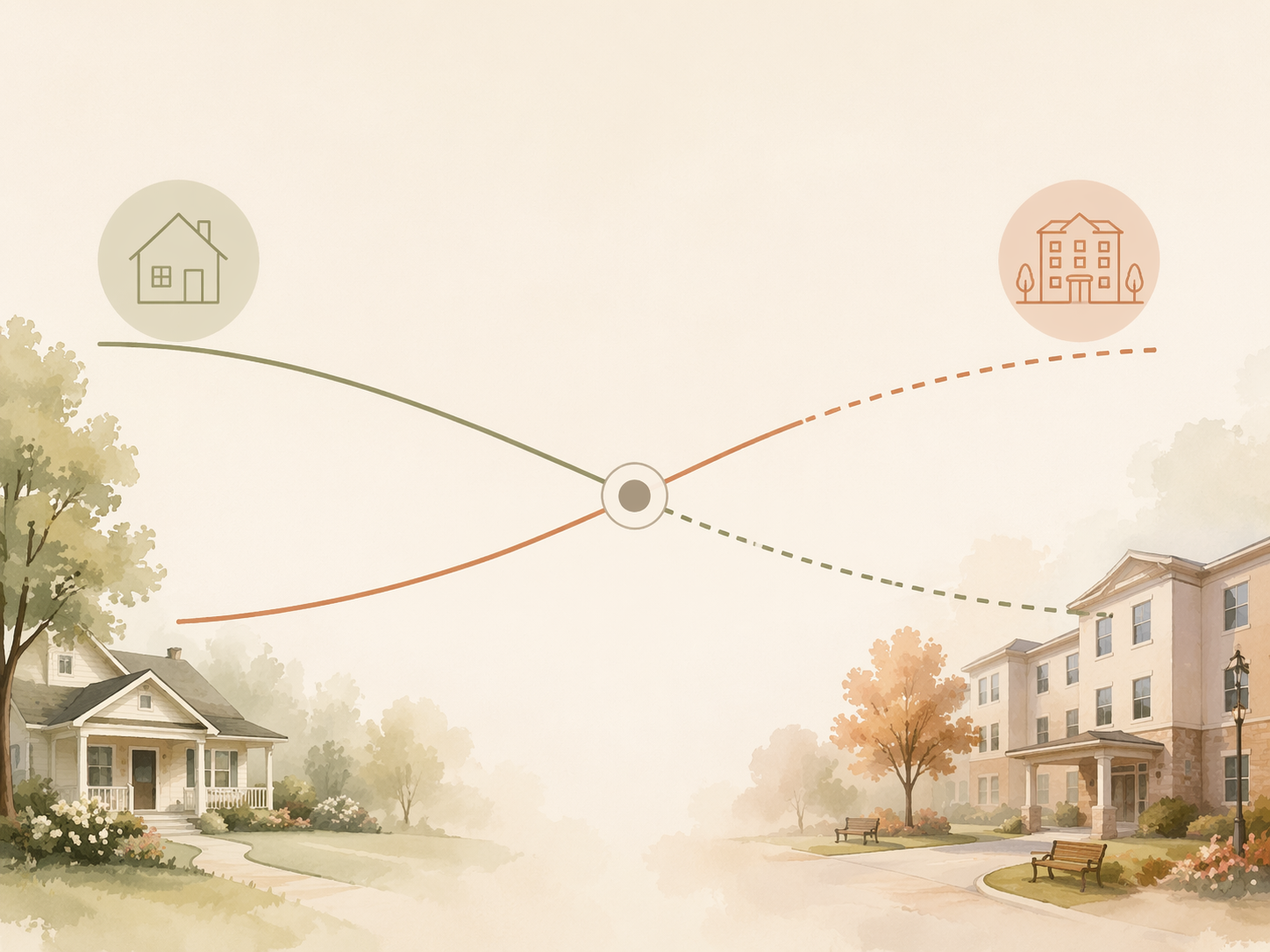
The 40-hour point moves when family care is filling the gaps
The spreadsheet may say 20 paid hours. The daughter who leaves work early twice a week, calls the pharmacy, handles the shower argument, and sleeps with her phone on may know the care plan is really 45 hours. The market is only billing part of it.
Unpaid care shifts the apparent break-even point upward because the family is absorbing work that would otherwise be purchased. That does not make home care wrong. It means the family should say plainly what is happening: “We are keeping monthly costs lower because one or more relatives are donating time, schedule flexibility, sleep, or income.”
AARP and the National Alliance for Caregiving reported in 2025 that family caregivers face an average annual income loss of $21,500.[3] That figure should not be casually dropped into every family’s budget as if it applies equally to everyone, but it belongs in the conversation when one adult child is turning down shifts, reducing hours, passing on promotions, or using vacation days for care coverage.
This is where sibling conversations often go sour. One person says, “Home is only costing $3,000 a month.” Another person is quietly contributing 15 unpaid hours and a career penalty. If the family wants a financial decision, count the donated labor at least as a visible line item, even if no one plans to reimburse it.
Preference matters, but it does not cancel the arithmetic
Most older adults who live at home want to age in place, according to Pew Research Center’s February 2026 reporting.[4] That preference deserves respect. The familiar kitchen, the neighbor who notices the curtains, the dog’s routine, the garden, the church route, the chair that fits exactly right — these are not sentimental extras to the person living there.
The National Institute on Aging describes aging in place as growing older at home with the services and supports needed to live safely and independently.[5] The important word is “safely.” A home plan that works at 10 hours a week may fail at 50 hours if the stairs, bathroom, medication routine, or nighttime wandering risk cannot be managed.
Cost comparisons should never be used to bully a parent out of the home. They should also not be used to reassure everyone falsely. “Home is cheaper” is a conclusion only after the family has priced the actual care schedule.
Hidden home costs that can erase the savings
A parent’s mortgage may be paid off. That does not mean staying home is free. The home may need a ramp, stair lift, bathroom changes, better lighting, grab bars, widened doorways, flooring changes, or a first-floor sleeping arrangement. Basic home modifications average about $3,000–$15,000, while full remodels can exceed $60,000, according to 2026 aging-in-place cost reporting from Choice Mutual.[6]
Those costs should be matched to the likely length of usefulness. A $6,000 bathroom project that helps a parent stay safely at home for several years is a different decision from a major remodel when the parent already needs near-constant supervision. The calculation is not simply “remodel versus move.” It is “how much safer does this purchase make the next stage of care?”
Families considering renovations can use a more detailed aging-in-place remodel cost comparison and, if the home plan still makes sense, look into home modification funding options.
Transportation is another quiet cost. If a parent stops driving, someone pays for rides in time, money, or both. Meal delivery, personal emergency response systems, lawn care, snow removal, housekeeping, and home maintenance can also become part of the care budget. None of those makes assisted living automatically better. They simply belong in the same column as the aide invoices.
Assisted living has hidden costs too
The assisted living quote needs the same skepticism. A monthly rent number may not include the community fee, care-level charges, medication management, incontinence support, escort help, or future increases. Community fees are often $1,000–$5,000 one time, and annual rate increases have historically run about 3%–6%.[1]
Ask what happens when needs increase. A parent may enter assisted living needing reminders and meals, then later need help with transfers, bathing, toileting, or medication administration. If the community uses levels of care, the monthly bill can rise as the care plan changes. If the community cannot support the next stage, the family may be facing another move.
A useful quote should answer these questions in writing:
- What is included in the base monthly rate?
- What one-time community or move-in fees apply?
- How are care levels assessed and priced?
- Is medication management included or separate?
- What services trigger additional charges?
- How often do rates typically increase?
- What needs would require transfer to memory care, skilled nursing, or another setting?
The assisted living side of the spreadsheet should therefore have two numbers: the move-in month and the ongoing month. The move-in month may look unusually high because of the community fee. The ongoing month may rise later if care needs increase.
When safety overrides the cheaper monthly line
Sometimes home care remains cheaper on paper and still does not solve the problem. If the parent is unsafe overnight, leaves the stove on, wanders, falls repeatedly, cannot transfer without help, or needs supervision that no one can reliably provide, the family is no longer comparing lifestyle preferences. It is comparing risk.
Twenty-four-hour care is its own category. Once a parent needs someone available all day and night, hourly home care can become far more expensive than the 40-hour example. Families in that situation should separately price 24-hour home care and ask whether assisted living, memory care, or another long-term care setting is actually the safer comparison.
Caregiver sustainability belongs in the same safety conversation. In a 2025 A Place for Mom survey of 1,029 caregivers, 78% reported burnout, and 54% said they wished they had started planning sooner.[7] Burnout is not a character flaw. It is a warning light that the care plan may be depending on a person rather than a system.
If the primary caregiver is missing sleep, losing income, becoming ill, or covering every agency cancellation, the current arrangement may be cheaper only because the bill has been moved from the parent’s checkbook to the caregiver’s body and calendar. A family weighing that reality can use a dedicated guide on caregiver burnout while caring for elderly parents alongside the cost comparison.
Benefits and insurance can change the answer
The 40-hour threshold assumes private-pay rates. Public benefits, veterans benefits, long-term care insurance, and state programs can change the math. They do not change the need to count hours; they change who pays for some of those hours.
Only 21% of adults age 65 and older have long-term care insurance, according to the research summarized in Choice Mutual’s 2026 aging-in-place report.[6] For those who do, the policy details matter: daily benefit amount, elimination period, covered settings, inflation protection, and whether home care and assisted living are both eligible.
Medicaid Home and Community-Based Services waivers may help some eligible older adults receive care at home or in community settings, but availability and rules vary by state. VA Aid & Attendance may help qualifying veterans or surviving spouses pay for care. State and local programs may also offset limited services, transportation, meals, or home modifications.
The practical move is to run two versions of the spreadsheet: one at full private-pay cost and one after any confirmed benefit. Do not build the family plan around a benefit that has not been approved, a waiver slot that is not available, or a policy interpretation no one has verified in writing.
For broader medical and long-term care cost boundaries, including where Medicare generally does and does not help, use a current senior health care cost guide.
A simple worksheet for the family meeting
Before the next sibling call, fill in these lines. The goal is not to settle every emotional question. It is to stop arguing from different sets of facts.
| Line item | Home care | Assisted living |
|---|---|---|
| Current paid care hours | _____ hours/week × $____ × 4.3 = $____/month | Not applicable |
| Likely near-term care hours | _____ hours/week × $____ × 4.3 = $____/month | Ask whether quoted rate covers this level of need |
| Unpaid family care | _____ hours/week, provided by _____ | May decrease, but family still provides visits and oversight |
| Housing and household costs | Mortgage/rent, taxes, utilities, maintenance, food, transportation | Base rent, meals, utilities included or excluded |
| One-time costs | Home modifications, equipment, moving furniture, safety devices | Community fee, move-in costs, furniture, deposits |
| Care increases | More shifts, longer shifts, overnight help, backup coverage | Level-of-care add-ons, medication management, transfer to higher care |
| Safety concerns | Falls, wandering, isolation, medication errors, emergency response | Staffing model, response times, fit for current and next-stage needs |
Then circle the number that matters most: paid hours per week. If it is under 40 and safety is manageable, home care may be the financially sensible plan. If it is around 40, gather better local quotes before assuming either side wins. If it is above 40, especially with unpaid family labor still propping up the schedule, assisted living deserves a serious look.
For families still trying to decide whether this is mainly a cost question, a safety question, or a long-term care question, a broader long-term care decision framework can sit next to this worksheet.
The better question
“Which option is cheaper?” is too blunt to be useful. The better question is: how many paid hours are we really buying, and what costs are we pretending are free?
Total the current weekly care hours. Estimate the likely near-term hours. Price local home care and assisted living in the same monthly frame. Add the hidden costs on both sides. Then talk about safety and caregiver sustainability with the numbers in front of everyone.
A parent’s wish to stay home matters. So does the daughter’s paycheck, the son’s sleep, the aide schedule, the bathroom doorway, the fall risk, and the monthly bill that will still be there after the family meeting ends.
References
- Home Care vs. Assisted Living: A Cost-Benefit Analysis and Price Guide (2026), US News Health, June 2026
- Assisted Living Costs by State: 2026 Pricing Guide, A Place for Mom, 2026
- Caregiving in the U.S., AARP/National Alliance for Caregiving, 2025
- Most older adults who live at home want to age in place, Pew Research Center, February 2026
- Aging in Place: Growing Older at Home, National Institute on Aging
- Aging in Place: Statistics + How to Prepare in 2026, Choice Mutual, 2026
- Caregiver burnout report, A Place for Mom, 2025
Questions to bring to a clinician or OT
This is not medical, legal, or a family's final decision — only a framework. Bring these questions to a clinician, occupational therapist, or your local Area Agency on Aging.
Find Local HelpRelated reading
Noticed something outdated or inaccurate on this page? Flag a correction. We review every report against CDC, NIA, and AARP HomeFit guidance before updating a page.