
What Is a Caregiver for the Elderly? Definition, Roles, and What Family Caregivers Should Know
clinicalA clear definition of what it means to be a caregiver for an elderly person, covering the spectrum from unpaid family caregivers to professional aides, and what new family caregivers need to understand about the role.
A caregiver for the elderly is someone who helps an older adult with daily needs, health-related tasks, safety, transportation, household responsibilities, or decision support. That person may be an unpaid daughter managing appointments after work, a spouse helping with bathing and meals, a home health aide coming in several mornings a week, or a hospice worker focused on comfort near the end of life. The word covers both informal family care and formal paid care, but most people searching for this term are probably closer to the first group than they realize: they are already doing the work, even if nobody has called it caregiving yet.[1][2]
If you are picking up groceries, organizing pill bottles, checking whether the bathroom is safe after a fall, driving to medical appointments, sorting insurance papers, or staying available because your parent can no longer reliably manage alone, you may already be a caregiver. The role often begins before the title arrives.

This is not a small or unusual family complication. More than 50 million Americans provide family care to adults age 50 and older, and nearly one in four U.S. adults is a family caregiver as of 2025.[3][4] The average time commitment is 22.8 hours per week, while 28% of family caregivers provide 31 or more hours weekly.[3] The estimated annual economic value of unpaid family caregiving is $873 billion.[3][4]
Those numbers are useful because they name the weight of the job without turning it into a performance of devotion. Caregiving can be loving, but it is also scheduling, lifting, remembering, driving, cleaning, watching, arguing with portals, and being the person who notices when something has changed.
The Two Main Meanings of Caregiver
The cleanest way to understand the term is to separate caregivers into two broad groups: informal or family caregivers, and formal or professional caregivers. The line matters because each group carries different obligations, training expectations, legal boundaries, and costs.
| Caregiver category | What it usually means | What a new family caregiver should notice |
|---|---|---|
| Informal or family caregiver | An unpaid relative, spouse, friend, or neighbor who helps because of a personal relationship. | No credential is required, but the work can still be complex, time-consuming, and emotionally heavy. |
| Formal or professional caregiver | A paid worker or care professional who provides help under an agency, program, facility, hospice provider, or private arrangement. | Training, certification, supervision, and allowed duties vary by role and by state. |
A family caregiver does not become less real because nobody is paying them. A professional caregiver does not become interchangeable with every other paid helper because they all enter the home. The mistake families often make is treating “getting help” as one category, when the actual question is what kind of help is needed and who is allowed to provide it.
Family Caregivers: The Role Most People Enter First
A family caregiver is usually an unpaid person who helps an older adult because of a relationship: an adult child, spouse, sibling, grandchild, friend, or neighbor. Some provide daily hands-on help. Others coordinate from across town or across the country, calling doctors, arranging transportation, monitoring bills, and checking whether a parent is still safe at home.
The work can look deceptively ordinary at first. One appointment becomes three. A weekly grocery run turns into meal planning because food is spoiling in the refrigerator. A medication reminder becomes a spreadsheet. A fall turns into a bathroom safety project, a physical therapy schedule, and a conversation about whether the stairs are still manageable.
Family caregivers often carry responsibility before they have authority. They may be expected to solve problems without being listed on medical forms, included in discharge instructions, or given access to financial information. That gap is one reason the role can feel confusing: the family sees the need before the systems around the older adult are ready to recognize the helper.
For a detailed view of what the work can look like over an ordinary week, see this day-to-day caregiving breakdown. If the caregiving role started after a fall, hospitalization, or sudden diagnosis, the more useful first stop may be a 72-hour crisis triage plan rather than a general definition.
What Caregivers Actually Do
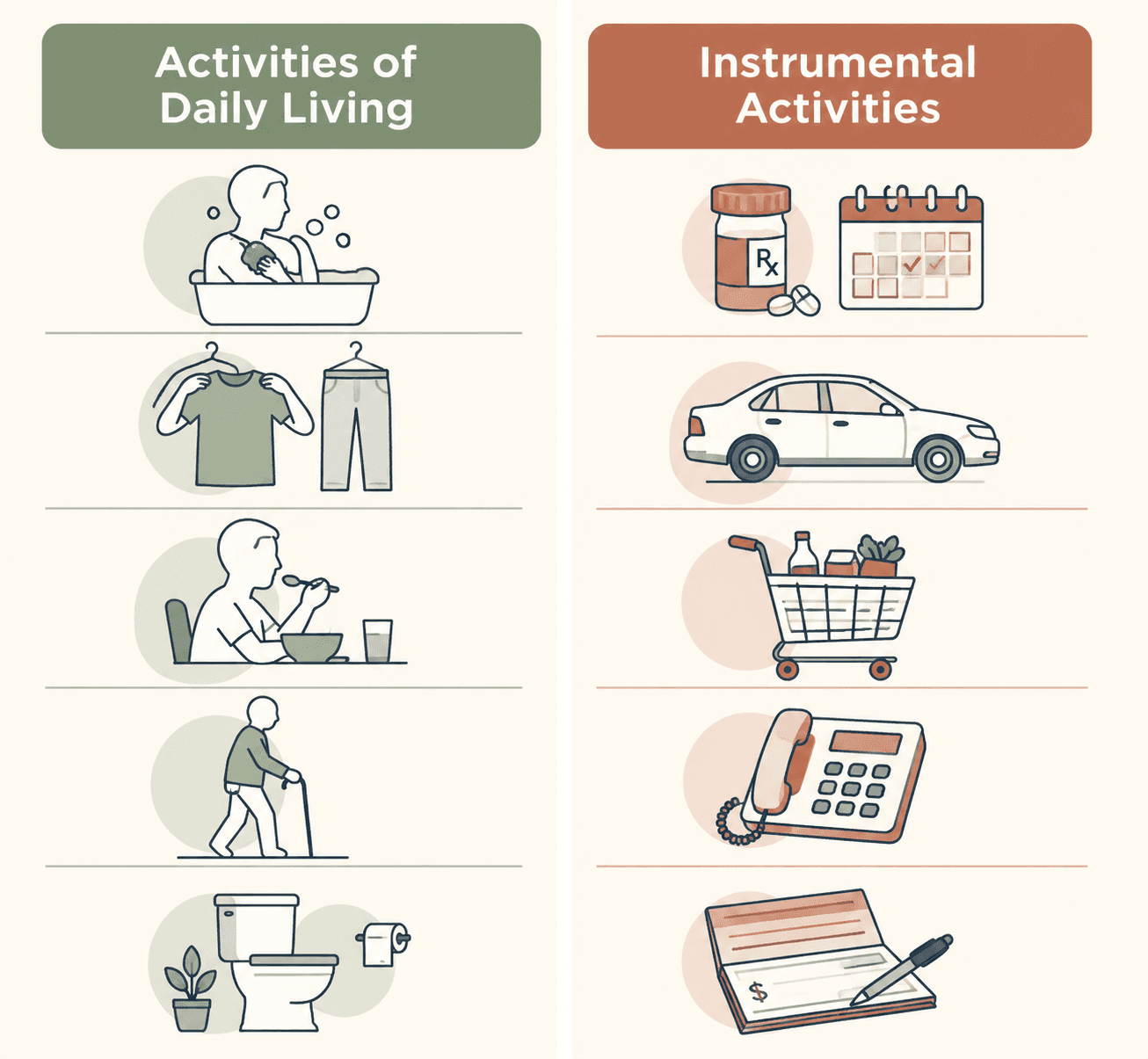
The most useful way to make caregiving visible is to look at two categories used often in care planning: Activities of Daily Living and Instrumental Activities of Daily Living. ADLs are basic self-care tasks. IADLs are the more complex activities that allow someone to live safely and function in a household and community.[5]
ADLs: Hands-On Daily Care
ADLs are the tasks people usually mean when they say an older adult “needs help at home.” They may include bathing, dressing, toileting, eating, transferring from bed to chair, walking, and other basic mobility needs.[5]
- Bathing and hygiene: setting up supplies, preventing slips, helping with showers, or arranging safer bathing routines.
- Dressing: choosing clothing, fastening buttons, managing compression socks, or helping after surgery or stroke.
- Eating: preparing food, cutting meals into manageable portions, monitoring appetite, or noticing swallowing concerns.
- Toileting and continence: helping with bathroom transfers, cleanup, supplies, laundry, and dignity-preserving routines.
- Mobility and transfers: assisting with walkers, stairs, chairs, beds, and the moments when a fall is most likely.
ADL help changes the feel of a relationship quickly. A daughter who was mainly handling errands may suddenly be helping her father shower. A spouse may become the person monitoring toileting overnight. These are not just “extra chores.” They are intimate, physically demanding tasks that can affect privacy, safety, and the caregiver’s own health.
IADLs: The Administrative Work of Aging
IADLs are often where family caregivers begin. They may not look like caregiving from the outside because nobody is helping someone bathe or dress. But these tasks are often what keep an older adult fed, housed, medicated, and connected to care.
- Medication coordination: filling pill organizers, watching for missed doses, calling pharmacies, and tracking changes after appointments.
- Transportation: driving to primary care, specialists, physical therapy, grocery stores, pharmacies, or social visits.
- Meals and shopping: planning food, checking what is being eaten, managing dietary restrictions, and noticing weight or appetite changes.
- Household management: laundry, cleaning, repairs, mail, trash, and safety changes such as lighting, grab bars, or trip-hazard removal.
- Money and paperwork: bills, benefits, insurance forms, medical portals, legal documents, and appointment notes.
- Communication: updating siblings, calling clinicians, explaining instructions, and deciding who needs to know what.
IADLs are also where missed work calls and late-night worry tend to appear. A parent may still say they are “fine,” while the adult child is spending hours each week coordinating refills, correcting billing mistakes, and trying to remember whether the cardiologist changed the dose or only discussed changing it.
This is why the national time-burden data matters. An average of 22.8 hours a week is not a favor squeezed between errands; for many families, it is a part-time job layered on top of paid work, parenting, marriage, health problems, and ordinary household life.[3]
Professional Caregiver Roles Are Not All the Same
Professional caregivers can be essential, but families need clear expectations. A person hired for companionship may not be trained or permitted to perform the same duties as a certified nursing assistant. A hospice aide is not the same as a live-in caregiver. A respite worker is there to cover time so the usual caregiver can step away, not to take over every medical decision.
| Role | Typical focus | Boundary to understand |
|---|---|---|
| Home health aide | Personal care and basic health-related support in the home. | HHAs are commonly described as certified after at least 75 hours of training, but requirements and supervision can vary by setting and state.[1] |
| Certified nursing assistant | Hands-on care such as bathing, dressing, transfers, vital signs, and assistance under nursing supervision. | CNAs complete state-approved training and an exam; they are not the same as nurses.[1][2] |
| Personal care attendant | Nonmedical help with personal care, homemaking, errands, and daily routines. | PCA requirements vary by state and program, so families should confirm what tasks are allowed.[1][2] |
| Hospice caregiver | Comfort-focused care for someone near the end of life. | Hospice care is organized around comfort, symptom support, and family support, not curing the underlying illness.[1][2] |
| Respite caregiver | Temporary coverage so the primary caregiver can rest, work, travel, or handle other responsibilities. | Respite can be brief or scheduled, but it works best when duties and emergency contacts are written down.[1][6] |
| Live-in caregiver | Extended in-home presence, often including personal care, household help, and supervision. | Live-in does not automatically mean awake and working 24 hours a day; schedules, sleep time, and duties need to be clarified.[6] |
The practical question is not “Do we need a caregiver?” but “Which tasks are we trying to cover?” Bathing help, dementia supervision, transportation, wound care, medication reminders, meal preparation, and overnight safety do not all point to the same solution. Some needs belong with family routines. Some can be handled by nonmedical home care. Some require clinical oversight. Some require a different living arrangement.
For a broader look at paid and unpaid care options, use this guide to caregivers for the elderly. If the immediate question is what kind of help can come into the home, start with home help for elderly adults.
Caregiver, Caretaker, Aide: A Short Terminology Note
Some authoritative sources use “caregiver” and “caretaker” interchangeably, while many caregiver advocacy organizations prefer “caregiver” because it emphasizes a person-centered, relational role rather than simply maintaining property or managing tasks.[2][7] In everyday family care, “caregiver” is usually the clearer and more respectful term.
“Aide,” “assistant,” and “attendant” usually point toward paid support roles, but they do not all mean the same thing. Before hiring anyone, families should ask what training the person has, who supervises them, what tasks they may perform, what they may not perform, and what happens if the older adult’s needs increase.
How to Tell Whether You Are Already a Caregiver
You do not have to live with your parent, provide hands-on bathing help, or quit your job to count as a caregiver. The role is usually defined by responsibility, not by a formal title. If the older adult’s daily life or safety now depends on your planning, presence, reminders, transportation, or judgment, the caregiving role has probably begun.
- You are the person who notices when medication, food, hygiene, bills, or appointments are slipping.
- You regularly adjust your workday, family schedule, or sleep because an older adult needs help.
- You coordinate with doctors, pharmacies, insurers, hospitals, agencies, or relatives.
- You are responsible for preventing foreseeable problems, such as falls, missed doses, unsafe driving, or unpaid bills.
- Other people assume you will know what is happening, even when no one has clearly handed you the role.
Naming the role does not mean you must do everything yourself. It means you can start sorting the work instead of absorbing it one emergency at a time.
What New Family Caregivers Should Do Next
The first useful step is to write down what is actually happening. Separate ADLs from IADLs. List who is doing each task now, how often it happens, what would go wrong if nobody did it, and which tasks are becoming unsafe, too frequent, or too emotionally costly for one person to carry.
| If this is your situation | Start here |
|---|---|
| A parent just fell, went to the hospital, received a serious diagnosis, or cannot safely be left alone tonight. | Use the 72-hour crisis triage plan. |
| You are newly responsible and need a practical first roadmap. | Use the first-90-days caregiving guide. |
| You need to understand the ordinary weekly work of caregiving. | Use the day-to-day caregiving breakdown. |
| You are deciding whether to bring paid help into the home. | Use the in-home help guide. |
| You are exhausted, resentful, numb, panicked, or losing your own health in the process. | Use the caregiver burnout guide. |
| You need help paying for care or understanding support programs. | Use the government benefit programs guide. |
For a staged starting point, see the first-90-days guide for new family caregivers. If the plan is to help an older adult remain at home, it may also help to clarify what aging in place actually requires, including the readiness gaps that can make “staying home” harder than it sounds.
If money is already shaping the decision, review available government benefit programs for seniors. State-specific paid-caregiver arrangements can change and should not be treated as nationally simple. Confirm current rules in the state where the older adult lives before making a financial plan.
And if the problem is no longer just logistics, pay attention to that too. Burnout can show up as anger, dread, sleep disruption, withdrawal, health problems, or a feeling that there is no version of the week where you catch up. The caregiver burnout guide is the better next page if the definition of caregiver feels less like clarity and more like recognition.
If you are helping an aging parent with daily needs, coordination, safety, transportation, paperwork, or decision support, you may already be a caregiver. The next move is not to prove that you are doing enough. It is to identify the work, decide what you can realistically provide, and bring in the right kind of support before improvisation becomes the whole care plan.
References
- Definitions. Family Caregiver Alliance.
- Caregiver Glossary. Pennsylvania Department of Aging.
- Caregiver Statistics. A Place for Mom.
- National Alliance for Caregiving: Caregiving in the U.S. 2025 Report. John A. Hartford Foundation.
- Being a Caregiver. Johns Hopkins Medicine.
- What Are the Different Types of Caregivers?. MeetCaregivers.
- Understanding Caretaker and Caregiver Roles. Caregiver Action Network.
See This Term in Context
- UnitedHealthcare 2026 Changes: What Seniors Losing Coverage or Facing Higher Costs Need to Know
UnitedHealthcare's 2026 Medicare Advantage changes — including service area reductions, benefit cuts, and a shift to HMO plans — mean that automatic reenrollment could lead to surprise costs or lost coverage. This guide explains the scale of the changes, who is affected, and the urgent steps seniors and their families should take during open enrollment.
- Navigating Senior Health Care: Key Terms Every Caregiver Should Know
A plain-language glossary of essential senior health care terms—from Medicare and Medicaid to ADLs and advance directives—designed to help new and spousal caregivers understand the system, advocate for their loved one, and avoid costly misunderstandings.
- How to Evaluate Elderly Care Companies: A Step-by-Step Guide for Family Decision-Makers
A practical, crisis-mode-optimized framework for adult children who need to compare and evaluate elderly care providers after a parent's fall or hospitalization. Covers needs assessment, licensing verification, cost analysis, caregiver training standards, and a structured tour and contract review checklist.
Also related: day-to-day caregiving breakdown, 72-hour crisis triage plan, first-90-days caregiving guide, in-home help guide, caregiver burnout guide, government benefit programs guide
Comments
Join the discussion with an anonymous comment.