
STEADI: Intervene
How long should seniors stay indoors during wildfire smoke?
No public health authority publishes a fixed number of days for keeping an older adult indoors during wildfire smoke; the stay ends when the Air Quality Index clears, which can be days. This guide explains that judgment and why a multi-day indoor stay creates its own fall risks — with an indoor mobility plan and a mobility-matched evacuation plan for seniors who use walkers or canes.
How long to keep seniors indoors during wildfire smoke? There is no safe universal number of days. Keep an older adult indoors while the outdoor air is unhealthy for them and while the indoor space can be kept cleaner than outside. That may be one day, several days, or longer if smoke returns with changing wind and weather. The CDC notes that wildfire smoke can remain in the air for days after a fire ends, and people with chronic heart or lung conditions need extra caution during smoke events.[1] AirNow’s fire-health guidance points caregivers back to the Air Quality Index, local instructions, symptoms, and cleaner indoor air rather than a calendar count.[2]
For an older adult, the daily decision starts earlier than it does for a healthy young adult. Public-health guidance treats adults 65 and older as a sensitive group; King County advises people 65 and older to take precautions when AQI is above 100, while Johns Hopkins describes AQI 101–150 as unhealthy for sensitive groups and AQI 151 and higher as unhealthy for everyone.[3][4] If you need the full color-by-color decision, use the site’s AQI wildfire smoke guide and air-quality precautions for elderly sensitive groups. The practical problem begins after the answer is “stay inside.”
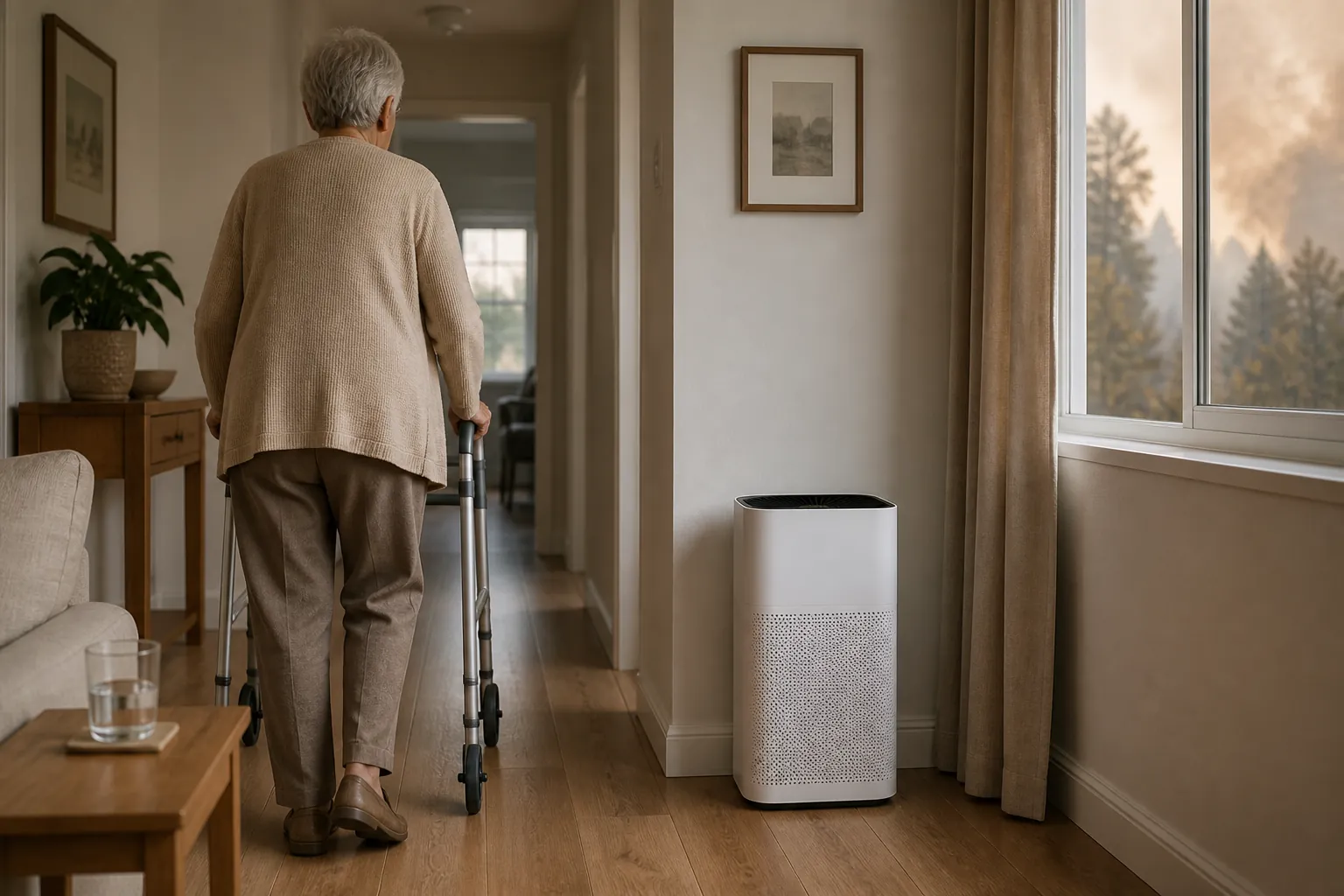
This is home-safety planning, not a substitute for medical care. If the older adult has COPD, asthma, heart disease, oxygen use, recent hospitalization, dementia, or a history of falls, call their clinician early in the smoke event and ask what symptoms or AQI levels should change the plan.
The indoor stay has to protect breathing and balance
“Stay indoors” sounds simple until the living room fills with an air purifier cord, a box fan, pet supplies, water bottles, medication bins, go-bags, a mask stash, and shoes by the door. For a steady adult, that is clutter. For someone who uses a walker, cane, oxygen tubing, or furniture for balance, it can turn every trip to the bathroom into a route test.
The fall risk during smoke is a practical synthesis, not a claim that one wildfire-smoke study proves a fall rate. Smoke guidance separately pushes at-risk people toward lower activity indoors, hot smoky days can bring dizziness or fainting, supplies and power-outage gear can narrow pathways, and evacuation may require a fast transfer by someone who cannot move fast safely. Michigan DHHS tells at-risk groups to keep activity levels low indoors during smoke.[5] Low activity may be necessary for breathing, but it should not accidentally become two or three days of sitting, dehydration, and rushed transfers.
Heat matters too. Smoke events often arrive with closed windows, less outdoor movement, and rooms that are harder to cool. LTC News warns that heat plus smoke can stress aging bodies, and that dizziness, fainting, and sudden confusion in older adults warrant immediate medical attention.[6] The CDC lists trouble breathing, nonstop coughing, chest pain, and new confusion among wildfire-smoke danger signs that need urgent help.[7]
Run the day from one clean-air base
Pick one cleaner indoor space and make it the working base for the day: usually a bedroom, den, or living room that can be closed off, cooled as safely as possible, and served by the best available filtration. The site’s clean-air room guide for seniors covers the setup in more detail. From a fall-prevention view, the clean-air room is not finished when the filter turns on. It is finished when the older adult can stand, turn, reach water, reach the walker, get to the bathroom, and leave the room without stepping over anything.
- Place the purifier, fan, and extension cords along a wall, not across the route between bed, chair, bathroom, and door.
- Keep a walker or cane on the side where the older adult normally stands up. Do not park the go-bag where the walker needs to turn.
- Put water, phone, glasses, hearing aids, medications, and tissues within easy reach so the person is not repeatedly leaning, twisting, or walking farther than planned.
- Leave a clear path to the bathroom before bedtime. A smoky night with closed windows is not the night to rely on memory and furniture-touching in the dark.
- If pets are in the room, move bowls, beds, and toys out of the walking line. A pet underfoot is still a trip hazard during an air-quality emergency.
Caregivers often load safety equipment into the same corner near the exit. That makes sense for speed, but it can steal the turning space a walker user needs most. A better pattern is “visible, reachable, out of the route”: supplies near the door, but not in the door swing, not on the floor path, and not where the walker has to pivot.
A smoke-day routine that keeps legs working
The goal is not exercise for fitness. The goal is to keep transfers familiar, legs awake, fluids steady, and dizziness visible before it becomes a fall. Activity should stay gentle during poor air, especially for anyone with heart or lung disease, but the day still needs planned movement inside the cleaner space.
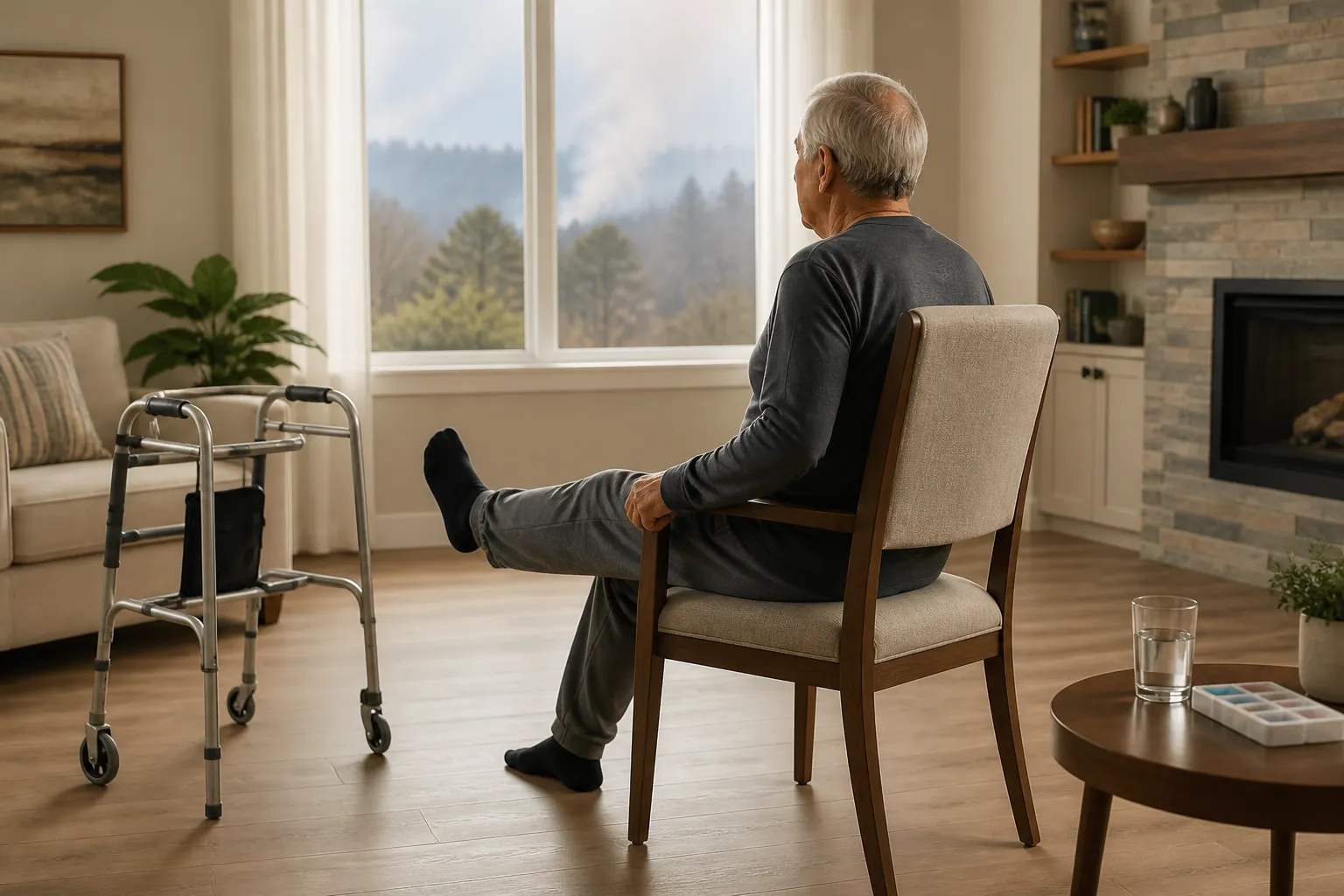
Start the morning with four checks before the first longer walk inside the home: the current AQI and forecast, symptoms, room temperature, and the route. If the older adult feels unusually short of breath, lightheaded, confused, weak, or unsteady, do not “walk it off.” Pause, sit, check hydration and heat, and call for medical advice or urgent help depending on severity.
Use short indoor walking circuits
Choose the smallest safe loop: bed to doorway and back, chair to hallway and back, or bedroom to bathroom and back. The loop should be wide enough for the walker, free of cords, and close enough that the older adult can stop without panic. If the home has only one safe route, use that route rather than inventing variety.
Several very short walks spread through the day are often more realistic than one ambitious walk. A caregiver can pair them with ordinary moments: after getting dressed, after lunch, before the evening medication check. The test is not distance. The test is whether the person can stand, walk, turn, sit, and recover without rushing or grabbing at furniture.
Add chair-based movement when walking is not wise
On worse smoke days, walking farther may be the wrong choice. A sturdy chair with arms can still support ankle pumps, gentle knee lifts, seated marching, shoulder rolls, and sit-to-stand practice if the clinician has allowed it. Keep the walker in front or to the side where it is normally used. Do not set it across the room as a “goal.” The walker is part of the safety setup, not a reward for reaching the other side.
Hydration is part of the fall plan
Closed windows, warm rooms, anxiety, and disrupted routines can all reduce drinking. Put water where the older adult already sits, not on a distant kitchen counter. If fluid intake is restricted because of heart failure, kidney disease, or another condition, follow the medical plan and ask the clinician what to do during heat and smoke. Otherwise, make drinking visible: a water glass beside the chair, a refill check with medications, and a caregiver note if the glass is untouched for hours.
Watch the first stand of the day
Many falls start at transitions: bed to standing, chair to walker, bathroom to hallway, hallway to car. During a smoke stay, slow those moments down. Sit at the edge of the bed before standing. Stand with both hands placed safely. Wait before stepping. If the person sways, looks pale, complains of dizziness, seems newly confused, or cannot coordinate the walker, the plan has changed from “keep moving indoors” to “sit, assess, and get help.”
Keep masks, supplies, and outage gear from blocking the route
Smoke readiness usually adds objects to the home. Multnomah County’s smoke-readiness guidance includes respirators such as N95 or P100 masks and supplies for staying prepared.[8] Those items are useful, but for a walker or cane user they have to be stored like mobility equipment: reachable, labeled, and off the floor.
- Put masks in a bin or drawer at hand height near the exit, not loose on a table where they slide to the floor.
- Keep medication lists, chargers, hearing-aid supplies, glasses, and oxygen-related items together so the caregiver is not searching while the older adult waits standing.
- Store bottled water and heavy supply boxes outside the walking path. A case of water beside the hallway wall can still narrow a walker route.
- Tape or reroute cords from air purifiers, fans, portable batteries, and phone chargers. A dark cord on a dim floor is not a small detail.
- Put flashlights where they are used: bedside, bathroom route, clean-air room, and exit. Do not rely on a phone light if the person needs both hands for a walker.
If the smoke event also brings a power outage, the fall plan tightens. Dark rooms, dead phone batteries, silent medical devices, and improvised extension cords can change a safe hallway by evening. Use the site’s power-outage fall-prevention guide for seniors before the outage, not after the first stumble.
Masks need special care for older adults with breathing limitations. A well-fitting N95 or P100 may be appropriate for brief necessary trips outside, but some people cannot tolerate one safely. If the older adult becomes more short of breath, panicky, lightheaded, or confused while masked, get them seated in cleaner air and call for medical advice.
When staying indoors may stop being the safer choice
For a mobility-limited older adult, evacuation timing is a fall-prevention decision. Alameda County advises older adults to consider evacuating during an evacuation warning instead of waiting for an evacuation order, because they may need extra travel time.[9] That advice is blunt and useful: a person who needs help standing, loading a walker, managing oxygen, finding medications, calming a pet, and stepping into a car does not gain safety by waiting until everyone is hurried.
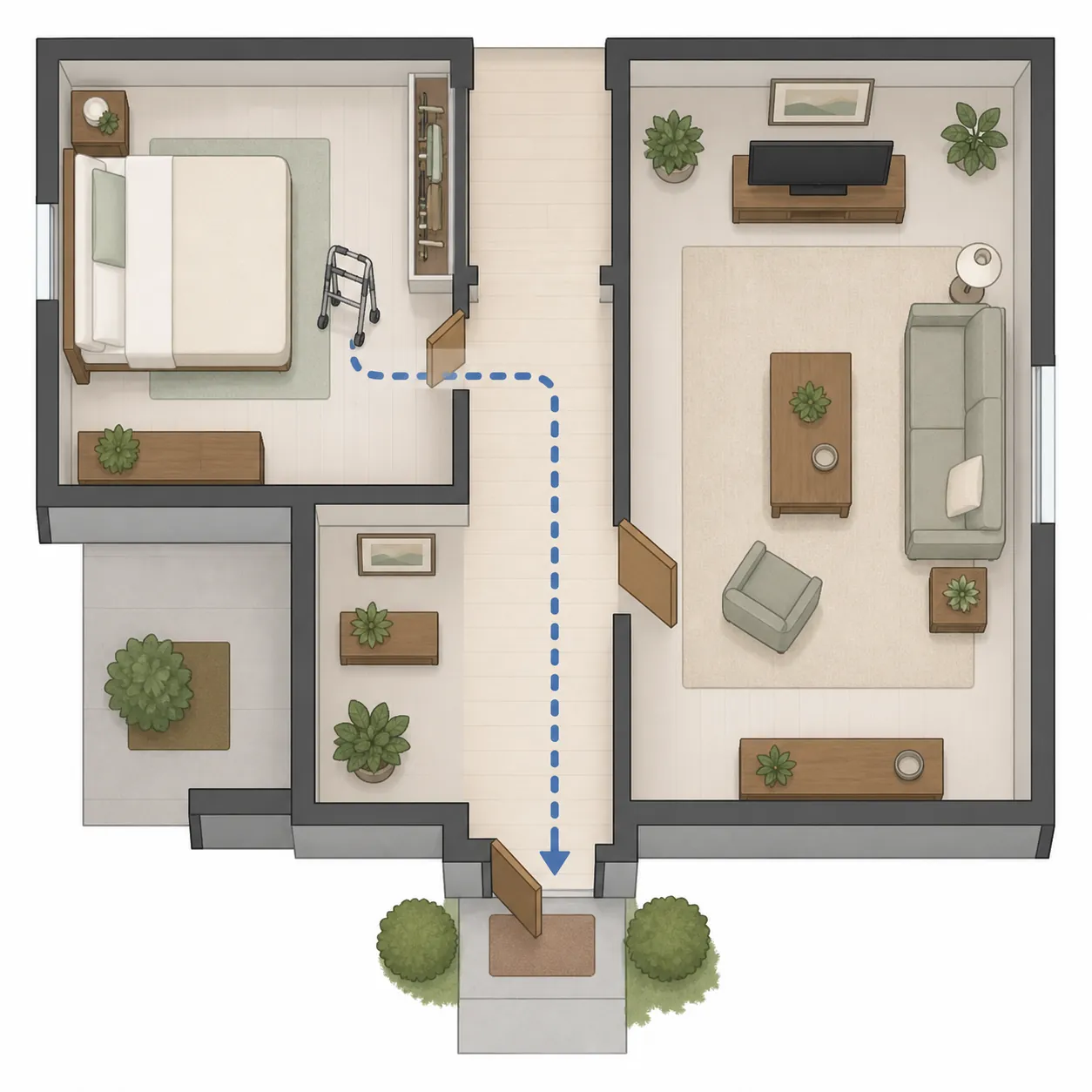
USFA/FEMA reports that adults 65 and older had 2.5 times the fire-death risk of the general population in 2020, and its older-adult fire-safety guidance tells walker and wheelchair users to verify that all exits are passable.[10] During wildfire smoke, that exit check should not wait for flames at the ridge or an official order on the phone. A smoke stay can be calm for two days and then become a rushed car transfer in a dark, crowded hallway.
Match the evacuation plan to the body that has to use it
A paper evacuation route is not enough for someone who uses a walker or cane. Walk the actual route on a calm day: bed to bathroom, chair to front door, front door to car, car to the place where the walker will be loaded. Notice thresholds, rugs, narrow doorways, shoe piles, porch steps, hoses, gravel, and the spot where the older adult has to turn. If the person normally needs a hand on the rail and a hand on the walker, decide who holds what before the warning comes.
- Choose the exit that works for the walker, not the exit that looks shortest on a floor plan.
- Keep shoes, cane, walker, glasses, hearing aids, phone, medication list, and mask in predictable places.
- Load heavy items before the older adult is standing at the door. Waiting in the doorway is tiring and unsafe.
- If oxygen, a wheelchair, or a transport chair is used, practice the car setup before smoke season.
- Plan for pets without letting leashes, carriers, or bowls block the older adult’s route.
The stay-in days are only one part of the plan. For evacuation itself, use the site’s brush-fire evacuation fall guide, senior wildfire evacuation kit checklist, and wildfire evacuation checklist for seniors. The important difference is timing: if an older adult cannot move quickly, the warning stage may be the safer window.
A caregiver’s daily smoke-and-fall routine
A multi-day smoke event is easier to manage when the day has a repeatable sequence. It does not need to be elaborate. It needs to catch the hazards that change while everyone is tired.
| When | What to check | Fall-prevention action |
|---|---|---|
| Morning | AQI, forecast, symptoms, room temperature | Decide whether the clean-air room is still workable; clear the walking circuit before the first transfer |
| Late morning or midday | Hydration, dizziness, breathing, fatigue | Use a short indoor walk or chair-based movement only if the person is steady and symptoms are quiet |
| Afternoon | Heat, power status, supply clutter | Move boxes, cords, pet items, and chargers away from the route before the home gets dim or crowded |
| Evacuation warning | Mobility, transportation, medications, pets, walker or cane | Consider leaving early if extra time is needed; do not wait until the older adult must hurry |
| Evening | Bathroom route, lighting, phone charge, water within reach | Set up the night path so no one is stepping around gear in the dark |
On hot smoky days, pull in the site’s senior heat-wave preparedness guide and heat and wildfire smoke safety checklist. Heat changes the decision because a closed-up home can become unsafe even when it is keeping some smoke out.
Symptoms that override the home plan
Do not manage serious symptoms with rearranged furniture or another glass of water. Call for emergency medical help if the older adult has trouble breathing, chest pain, a nonstop cough, fainting, severe dizziness, or new confusion. The CDC specifically flags trouble breathing, nonstop coughing, chest pain, and new confusion as danger signs during wildfires and wildfire smoke.[7] LTC News also warns that dizziness, fainting, and sudden confusion in older adults need immediate medical attention.[6]
Call the older adult’s doctor or care team sooner rather than later for worsening wheeze, increased rescue-inhaler use, unusual fatigue, swelling, poor intake, repeated near-falls, or any change that is worrying but not yet an emergency. A caregiver should not have to decide alone whether the smoke is still manageable at home.
The answer is still not a number of days
The indoor stay ends when outdoor air is safe enough for that older adult, indoor air is no longer doing better than outside, symptoms are stable, and local officials have not told the household to evacuate. For many families, that means checking AQI and symptoms every day of the smoke event, not counting down to a promised endpoint.
The caregiver’s safety job starts on day one indoors: cleaner air, gentle movement, hydration, clear walking routes, masks and supplies stored off the path, lights ready for outages, and an evacuation route that fits the person who has to walk it. Staying inside can protect lungs. It should not quietly take away the older adult’s balance, strength, or safe way out.
References
- Wildfire Smoke and People with Chronic Conditions. CDC.
- Fires and Your Health. AirNow.
- Three steps to stay safe from wildfire smoke. Public Health Insider. June 12, 2025.
- Air Quality and Health. Johns Hopkins Medicine.
- Your Health and Wildfire Smoke. Michigan DHHS.
- Wildfire Smoke Isn't Just an Outdoor Problem for Older Adults. LTC News.
- Safety Guidelines: Wildfires and Wildfire Smoke. CDC.
- Be Smoke Ready. Multnomah County.
- Older Adults – Emergency Preparedness. Alameda County.
- Fire Safety for Older Adults. USFA/FEMA.
Related reading
Noticed something outdated or inaccurate on this page? Flag a correction. We review every report against CDC, NIA, and AARP HomeFit guidance before updating a page.
Part of the Fall Prevention section.