
Caregiver decision guide
The Geriatric Syndromes That Threaten Your 80-Year-Old Parent
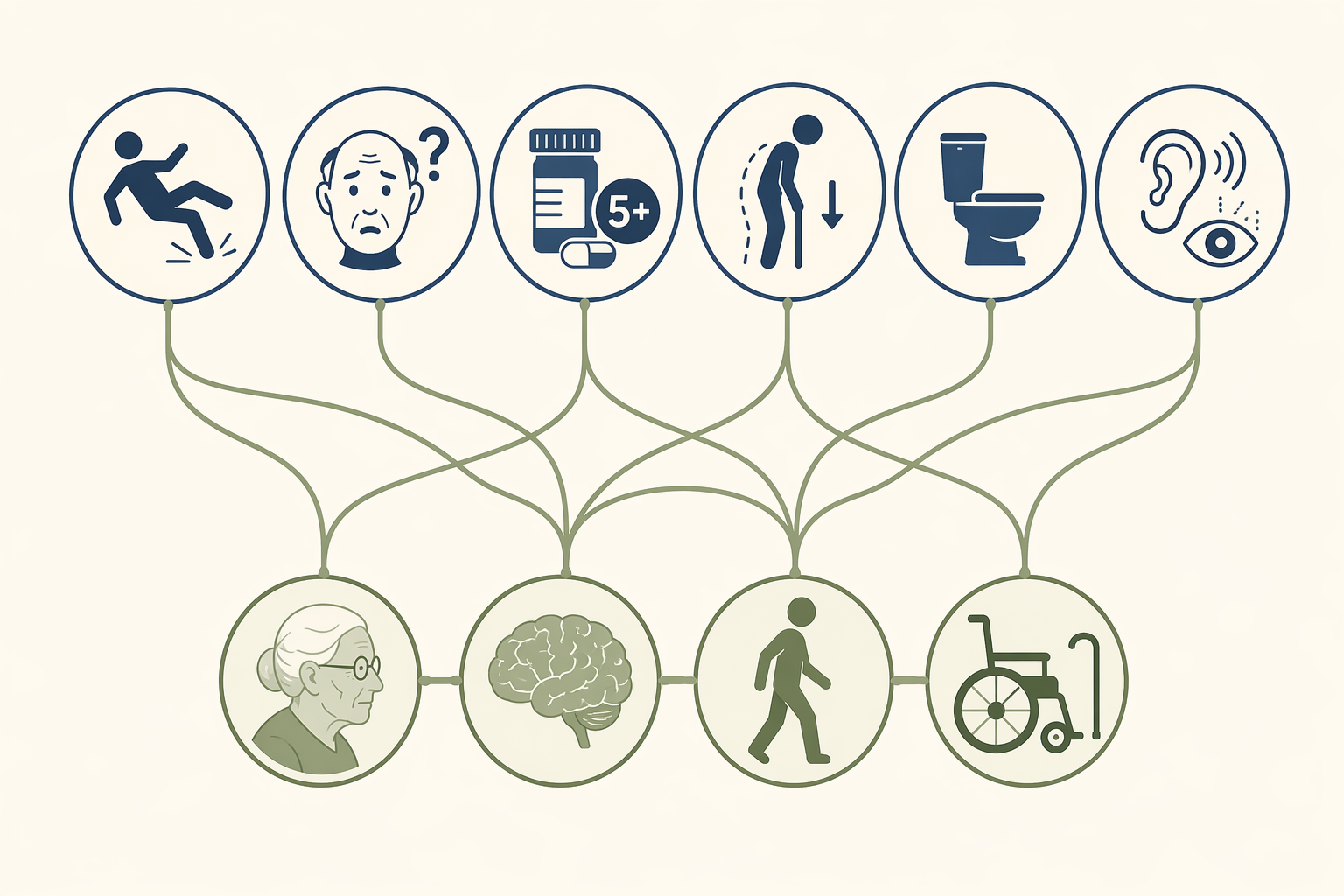
This article provides a caregiver-focused monitoring framework for the six most common geriatric syndromes in adults over 80—falls, cognitive decline, polypharmacy, frailty, incontinence, and sensory loss—with clear escalation thresholds to help you know when a change requires a doctor's call.
When a parent is in their 80s, the most useful question is often not “What disease is this?” It is “What changed from their usual?” A new fall, a week of unfinished meals, sudden confusion after a hospital visit, waking three times to rush to the bathroom, or missing morning pills twice may look like separate problems. In an older body, they often sit on the same fault lines: cognition, mobility, baseline function, and medication burden.
That is why geriatric syndromes are a better starting point than a disease checklist for many families. Inouye and colleagues described geriatric syndromes as conditions that do not fit neatly into one organ system and identified four shared risk factors underneath several of them: older age, cognitive impairment, functional impairment, and impaired mobility.[1] For a caregiver, that framework turns scattered household observations into usable evidence.

Chronic diseases still matter. Among U.S. adults age 85 and older, NCHS reported that 66.9% had hypertension, 55.9% had arthritis, 16.3% had diabetes, and 12.1% had diagnosed dementia in 2022–2023.[2] Those figures are for 85-plus, not the entire 80-plus population, so they should not be stretched into exact numbers for an 80-year-old. More broadly, NCOA reports that most adults 65 and older live with at least one chronic condition, and many live with more than one.[3]
But the day-to-day danger signal is usually functional. Can your mother still get out of the chair without pushing with both hands? Is your father still using the stove safely? Did the person who used to manage a pillbox start leaving tablets behind? Those observations do not diagnose anything. They do something more practical: they give the doctor a pattern to evaluate.
The six warning domains worth watching
The goal is not to turn a daughter, son, spouse, or neighbor into a clinician. The goal is to stop vague concern from disappearing in a rushed appointment. “She seems off” is easy to wave away. “She fell twice since March, stopped finishing dinner, and was suddenly confused the night after her medication changed” is harder to ignore.
| Syndrome | What you can observe at home | Why it matters |
|---|---|---|
| Falls | Any fall, near-fall, new furniture-walking, fear of walking, or bruises with unclear cause | Falls can repeat, cause injury, and expose mobility, vision, medication, or cognition problems |
| Cognitive change | Sudden confusion, new disorientation, missed bills or pills, trouble following familiar routines | Delirium can be an emergency; dementia changes care planning over time |
| Polypharmacy | New sleepiness, dizziness, confusion, poor balance, appetite change, or missed doses after medication changes | Medication burden can worsen falls, delirium, hospitalizations, and cognitive symptoms |
| Frailty | Unintentional weight loss, slower walking, exhaustion, weaker grip, more time in bed or chair | Frailty lowers reserve, so small stressors can cause large declines |
| Incontinence | Urgency, nighttime bathroom trips, accidents, avoiding outings, rushing to the toilet | It can increase fall risk and isolation, and it is often treatable |
| Sensory loss | Turning up the TV, missing conversation, avoiding phone calls, bumping into objects, medication-label trouble | Hearing and vision loss can look like withdrawal or confusion and can raise safety risk |
Falls: one event is enough to start the record
A fall is not just a fall in an 80-year-old parent. It is evidence. The CDC reports that about one in four older adults falls each year, and falls are the leading cause of injury deaths among older adults.[4] That does not mean every fall has the same cause or the same outcome. It does mean a fall should not be filed under “clumsy” without a closer look.
Write down the date, time, place, lighting, footwear, symptoms before the fall, whether they hit their head, whether they could get up, and any medication or illness change in the days before. A fall on the way to the bathroom at 2 a.m. points to a different prevention problem than a fall after standing up quickly from a chair.
Call the doctor after any fall, even if your parent says they are fine, especially if the fall is new, unexplained, involved dizziness, caused pain, or happened after a medication change. Seek urgent help after a head injury, new weakness, severe pain, inability to bear weight, loss of consciousness, chest pain, shortness of breath, or confusion. For the immediate aftermath, use a fall-specific protocol such as Your Parent Just Fell: A Caregiver's Guide to the First 72 Hours. If falls are recurring, the question shifts from one-time prevention to supervision and response time; When Falls Signal the Need for 24/7 Home Care is the more relevant decision point.
Cognitive change: sudden is different from gradual
Memory changes deserve attention, but the timing matters. A slow drift over months—missed appointments, repeated stories, trouble with finances, confusion about routes—belongs in a medical evaluation and may eventually require dementia care planning. A sudden change over hours or days is different. That pattern can be delirium, and HealthInAging.org tells families to treat delirium like chest pain: a sudden medical problem that needs immediate attention.[5]
The distinction is not academic at home. If your mother has been forgetful for a year but suddenly cannot recognize her own bedroom after starting an antibiotic, that is not simply “her dementia getting worse.” If your father is normally sharp in the morning but becomes disoriented, sleepy, agitated, or incoherent after a hospital stay, procedure, infection, dehydration, or medication change, that is a same-day call, and often an urgent evaluation.
Hospital settings deserve special vigilance. Harvard Health describes delirium in older hospitalized patients as common and dangerous, and emphasizes practical prevention supports such as family presence, glasses, hearing aids, familiar objects, orientation, sleep protection, hydration, and mobility when appropriate.[6] Families cannot prevent every episode, but they can notice when a parent is not at baseline and say so clearly.
For gradual cognitive decline, track the function, not just the label: missed bills, unsafe cooking, repeated medication errors, wandering, poor judgment with money, or inability to follow a familiar routine. If dementia is becoming part of the care picture, How Dementia Changes the Senior Care Equation can help separate medical planning, home safety, and supervision needs.
Medication burden: look hardest after something changes
Polypharmacy is often defined as taking five or more medications, but the exact count is less useful than the pattern after a change. A new prescription, a stopped medication, a dose increase, an over-the-counter sleep aid, a pain medicine, or a duplicate drug from a specialist can all show up at home as dizziness, sleepiness, confusion, constipation, poor appetite, unsteadiness, or missed doses.
Do not deprescribe on your own. Do make the medication list impossible to ignore. Bring every prescription, over-the-counter medicine, supplement, eye drop, cream, inhaler, and “only as needed” pill to the next appointment or pharmacy review. Ask one plain question: “Could any of these be contributing to the falls, confusion, appetite change, or sleepiness we are seeing?”
Escalate quickly if a medication change is followed by sudden confusion, a fall, fainting, severe dizziness, trouble breathing, swelling of the face or throat, black stools, uncontrolled bleeding, or extreme sleepiness. For less urgent but still concerning changes, document the start date, the dose, the symptom, and whether the symptom improves or worsens at a particular time of day.
Frailty: shrinking life radius is a warning
Frailty is easy to miss because it often looks like a parent doing less. Less walking. Less cooking. Less laundry. Fewer outings. Smaller meals. More sitting. The change may be gradual enough that nobody can name the week it began.
Unintentional weight loss deserves particular attention. Mayo Clinic lists weight loss among warning signs adult children should notice in aging parents, and HealthInAging.org notes that weight loss can signal problems such as malnutrition, dementia, depression, or cancer.[7][5] The important household detail is whether clothing is looser, meals are unfinished, groceries are spoiling, dentures hurt, swallowing has changed, or your parent is too tired to prepare food.
A simple frailty check does not need a device. Watch for fatigue, difficulty climbing stairs, trouble walking a short distance, multiple illnesses, and weight loss—the kinds of domains reflected in the caregiver-accessible FRAIL scale. If the life radius is getting smaller, the doctor needs specifics: “She no longer walks to the mailbox,” “He stopped showering unless someone is present,” or “She used to cook twice a week and now eats toast for dinner.”
Call the doctor for unexplained weight loss, new weakness, loss of appetite lasting more than a few days, repeated dehydration, inability to manage basic self-care, or a sharp drop after illness or hospitalization. If you are trying to notice changes from a distance without turning the home into a surveillance project, Monitoring Elderly Parents Without Cameras may fit better than constant check-in calls. If frailty is making response time the real problem, compare monitoring with hands-on supervision in When Is 24/7 Care Actually Necessary?.
Incontinence: the fall risk may start before the bathroom
Incontinence is often hidden because people are embarrassed or assume nothing can be done. For caregivers, the first clue may be laundry, odor, fewer outings, new pads in the trash, or a parent refusing a car ride that used to be routine. It matters medically because urinary urgency can send an older adult rushing across a dark hallway at night, half-awake and off balance.
Track the pattern without interrogating. Daytime urgency is different from nighttime frequency. Leakage with coughing is different from not reaching the toilet in time. Burning, fever, lower abdominal pain, blood in urine, new confusion, or sudden worsening should prompt a medical call because infection, medication effects, constipation, mobility problems, and other treatable causes may be involved.
Nighttime is where incontinence becomes a safety problem. Note how often your parent gets up, whether they use a walker, whether the path is lit, whether they are dizzy on standing, and whether accidents happen because they cannot move quickly enough. If bathroom trips are driving nighttime fall risk, use an Overnight Care Decision Framework or the red flags in Is It Time for Overnight Care? rather than waiting for a second fall.
Sensory loss: silence is not proof everything is fine
Hearing and vision changes are easy to misread. A parent who stops joining conversation may look depressed, stubborn, or confused. A parent who mismanages medication may be making a vision error, not a memory error. AARP, citing aging and geriatric sources, reports that about one-third of older adults have hearing loss and that hearing loss is associated with increased risk of depression, dementia, social isolation, and falls.[8]
The useful observations are ordinary: TV volume creeping up, missed doorbells, answers that do not match the question, avoiding restaurants, trouble reading labels, bumping into furniture, difficulty seeing steps, or giving up hobbies that require vision. Patients often do not raise these changes themselves, so bring them up directly at primary care, audiology, optometry, or ophthalmology appointments.
Escalate urgently for sudden vision loss, sudden hearing loss, new one-sided weakness, facial droop, severe headache, eye pain, or acute confusion. For gradual changes, schedule evaluation and connect the symptom to function: “He stopped answering the phone because he cannot hear it,” or “She cannot read the pill bottle even with her glasses.”
Use one baseline, not six separate notebooks
The shared-risk-factor framework matters because these syndromes do not politely stay in their lanes. A medication change can worsen balance and cognition. Poor hearing can look like confusion and increase isolation. Incontinence can create nighttime falls. Frailty can make a minor infection look like a major decline. The same four areas—cognition, function, mobility, and medication burden—keep showing up underneath the visible problem.[1]
A workable monitoring rhythm is simple enough to survive a busy week:
- Once a month, write down baseline function: walking, stairs, bathing, dressing, meals, medications, bills, sleep, bathroom trips, hearing, vision, and social activity.
- After any illness, hospital visit, fall, or medication change, watch more closely for several days because that is when “not at baseline” often becomes visible.
- Before appointments, bring dates and examples instead of impressions: what changed, when it started, how often it happens, and what your parent can no longer do.
- Keep one current medication list and one short timeline of falls, confusion episodes, weight changes, hospital visits, and major care changes.
- If you are new to this role, use a structured first-month plan or a printable binder so the system does not live only in one tired person’s head.
For a staged setup, The Adult Child Caregiver's First 30 Days gives the early sequence. For appointment prep and records, a Free Printable Caregiver Checklist Binder can keep the observations in one place.
When to call, when to go now
Home monitoring is not a substitute for medical evaluation. It is a way to know what to say when you ask for one. The safer rule is to escalate based on suddenness, severity, repetition, and loss of function.
| Change | Response |
|---|---|
| Sudden confusion, hallucinations, extreme sleepiness, or not recognizing familiar people or places | Seek same-day urgent medical advice or emergency evaluation, especially after illness, hospitalization, dehydration, or medication change |
| Any fall with head injury, loss of consciousness, severe pain, inability to stand, new weakness, chest pain, shortness of breath, or confusion | Seek urgent or emergency care |
| Any fall without obvious injury | Call the doctor and document the circumstances; do not wait for the next fall |
| Repeated falls, near-falls, or new fear of walking | Request a fall-risk review and reassess supervision, home setup, mobility aids, vision, and medications |
| Unexplained weight loss, persistent poor appetite, dehydration, or shrinking ability to manage meals | Schedule prompt medical evaluation |
| New dizziness, confusion, sleepiness, appetite change, or unsteadiness after a medication change | Call the prescribing clinician or pharmacist promptly; seek urgent help for severe symptoms |
| New nighttime bathroom rushing, accidents, or falls on the way to the toilet | Call the doctor and reassess overnight safety |
| Sudden vision loss, sudden hearing loss, facial droop, one-sided weakness, or severe headache | Seek emergency evaluation |
The most helpful thing a family member can bring to a doctor is not a suspected diagnosis. It is a clear baseline and a clear change: what your parent could do last month, what they cannot do now, when it started, and what else changed around the same time. Track that, bring it forward, and treat sudden confusion, repeated falls, unexplained weight loss, and medication-linked decline as reasons to escalate rather than wait.
References
- Geriatric Syndromes: Clinical, Research and Policy Implications, Journal of the American Geriatrics Society
- Chronic Conditions in Adults Age 85 and Older: United States, 2022−2023, NCHS, June 2025
- The Top 10 Most Common Chronic Diseases for Older Adults, NCOA
- Facts About Falls, CDC
- Tip Sheet: A Guide to Geriatric Syndromes, HealthInAging.org
- The dangers of hospital delirium in older people, Harvard Health, 2011
- Aging parents: 8 warning signs of health problems, Mayo Clinic
- The Most Common Chronic Health Conditions Among Older Adults, AARP, July 2025
Questions to bring to a clinician or OT
This is not medical, legal, or a family's final decision — only a framework. Bring these questions to a clinician, occupational therapist, or your local Area Agency on Aging.
Find Local HelpRelated reading
Noticed something outdated or inaccurate on this page? Flag a correction. We review every report against CDC, NIA, and AARP HomeFit guidance before updating a page.