How Monitoring Technology Addresses the Top 5 Health Risks for Seniors Aging at Home
A risk-first guide for adult children and family caregivers. Learn how specific monitoring technology categories — from fall detection to social isolation sensors — can mitigate the five most significant health risks for a parent living at home, and how to prioritize based on their unique health profile.
Features Covered in This Explainer
fall detection, battery life, range, response time, privacy implications
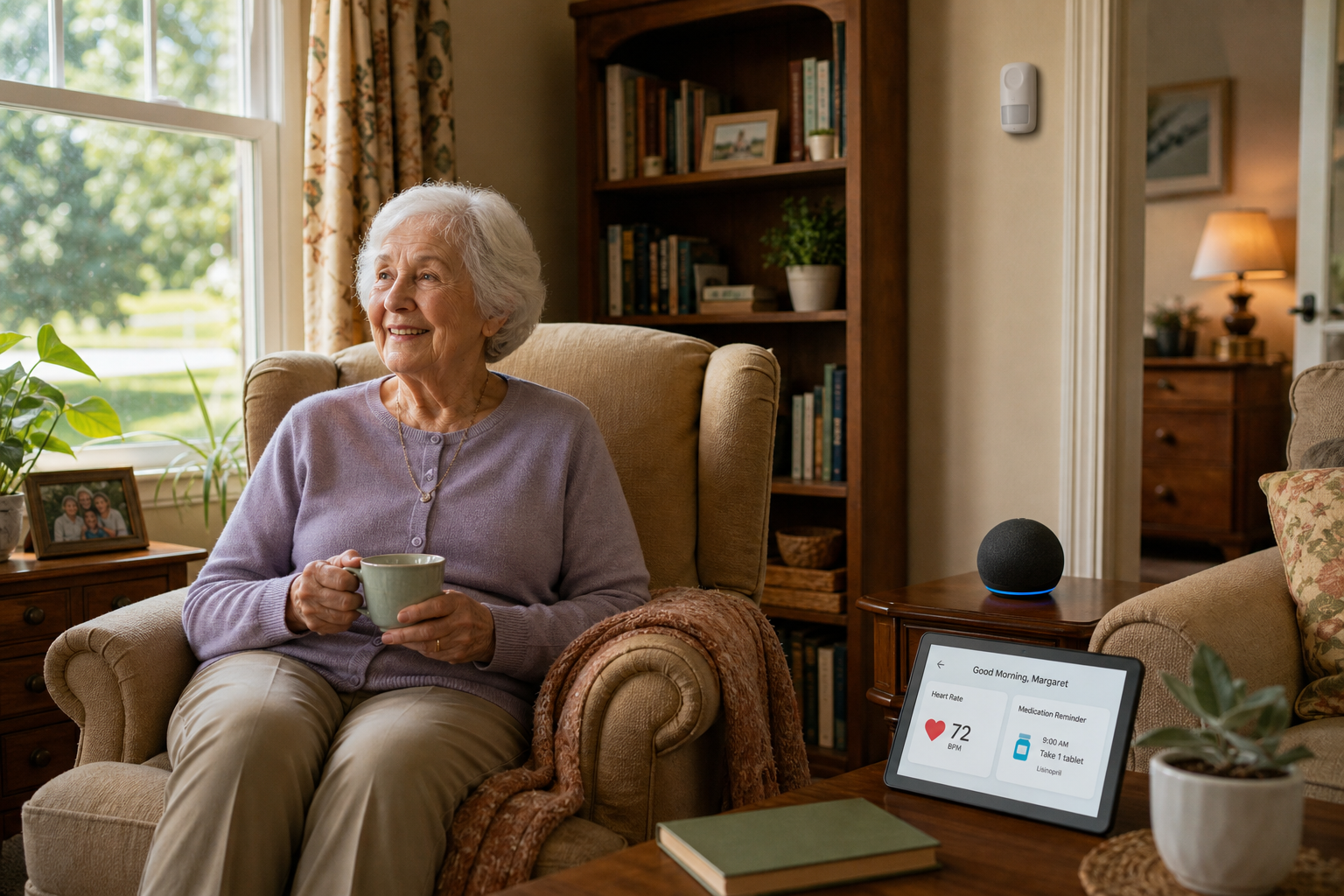
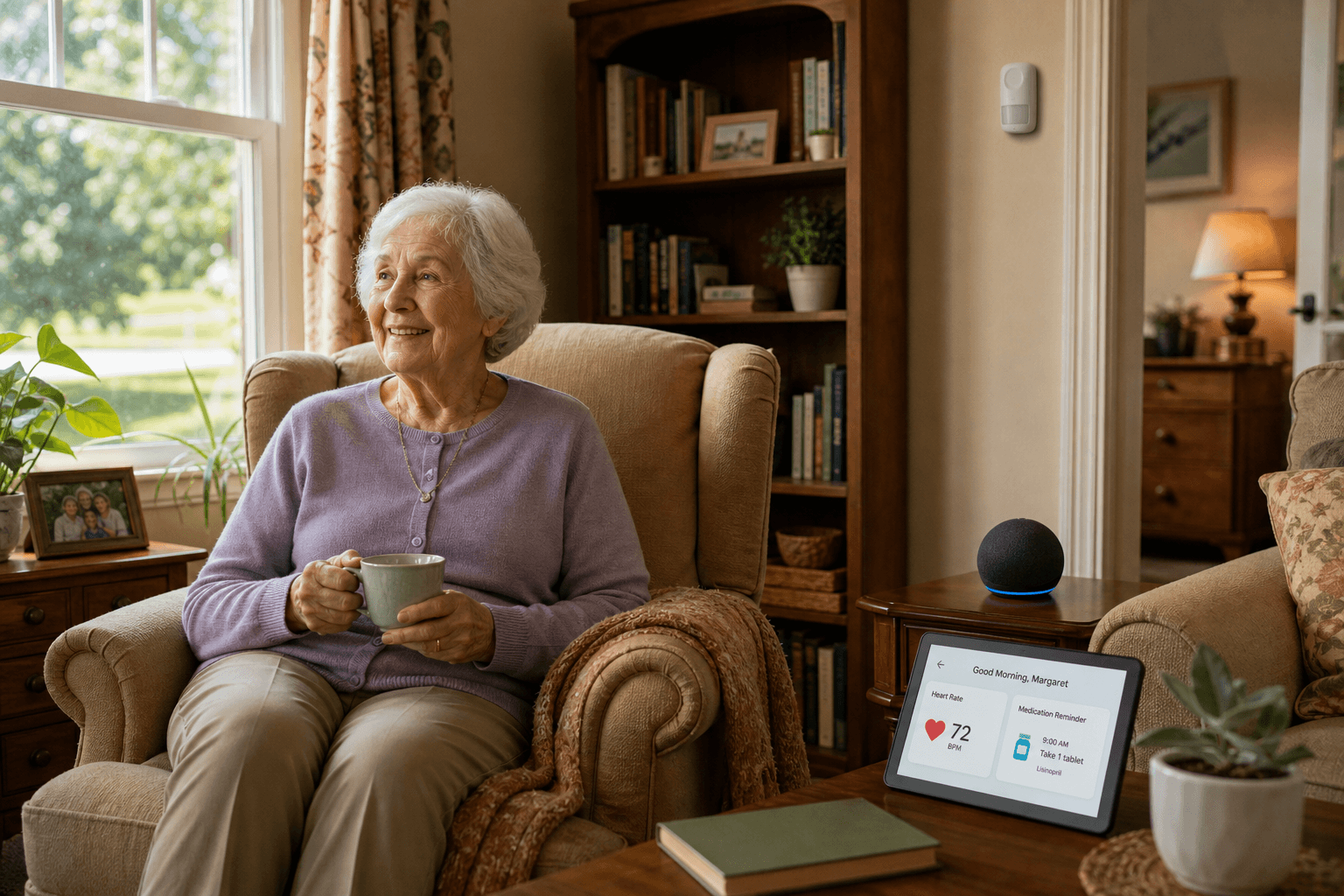
Modern monitoring technology can be integrated into the home environment in a way that feels ambient and dignified, not intrusive.
Why Monitoring Technology Is Becoming a Standard Layer of Senior Health Care
The decision to help a parent age at home is rarely a single moment. It is a series of realizations — a bruise from a stumble that went unwitnessed, a pile of unopened pill bottles, a phone call that goes unanswered for hours. Each event raises the same question: how do you stay aware of what is happening when you cannot be there?
Monitoring technology has moved past the era of a single medical alert pendant. The category now spans passive motion sensors, radar-based fall detectors, smart medication dispensers, and remote patient monitoring (RPM) devices that transmit vital signs directly to clinicians. The common thread is that these tools are designed to detect a specific health risk before it escalates into an emergency. The challenge for a family caregiver is not finding a device — it is knowing which risk to address first.
More than 75% of adults older than 50 plan to age in place, according to AARP data cited by UCLA Health. Yet the health profile of the average older adult is complex: 93% have at least one chronic condition, and 78.8% have two or more, per a 2023 CDC BRFSS study. The five most common and consequential risks for this population — falls, medication errors, undetected chronic condition changes, cognitive decline, and social isolation — each have specific technology categories designed to mitigate them. The difference between a helpful system and an unused gadget is whether the technology matches the actual risk profile of the person it is meant to protect.
Risk #1: Falls — From Wearables to Ambient Detection
Falls are the most prevalent and costly acute risk for older adults living at home. According to the CDC, 1 in 4 older adults reports falling every year, and falls are the leading cause of fatal and nonfatal injuries among people aged 65 and older. The age-adjusted fall death rate rose from 64.7 per 100,000 older adults in 2018 to 78.4 per 100,000 in 2024 — a 21% increase. The financial toll is equally stark: the nation spends $50 billion annually treating fall-related injuries, with 75% of that cost covered by Medicare and Medicaid.
Monitoring technology addresses this risk through two primary approaches: wearable devices and ambient sensors.
Wearable PERS with automatic fall detection: These are the most widely recognized category. A pendant or wristband contains accelerometers and gyroscopes that detect the impact and motion pattern of a fall and automatically place a call for help. The critical evaluation dimension is the accuracy of the fall-detection algorithm — false alarms erode trust, while missed falls defeat the purpose.
Radar-based sensors: An NIH scoping review of 30 studies found that radar-based fall detection systems achieved 98.74% accuracy. These devices mount on a wall or ceiling and use radio waves to detect a person's position and sudden changes in posture. They require no action from the user, which makes them a strong option for someone who refuses to wear a pendant.
WiFi-based systems: The same NIH review documented the "DeFall" system, which uses WiFi signal disruptions to detect falls with a 95% detection rate. This category is less mature but promising because it requires no additional hardware beyond a standard home WiFi router.
Risk #2: Medication Errors — Smart Dispensers and AI-Assisted Reminders
Nearly 35% of adults ages 60 to 79 take five or more prescription drugs, according to the CDC. Managing that many medications — different dosages, different times of day, different refill schedules — is a cognitively demanding task that becomes harder with age. Medication nonadherence affects roughly 50% of older adults, and the consequences range from uncontrolled chronic conditions to dangerous drug interactions to emergency hospitalizations.
The technology response to this risk falls into two tiers:
Smart pill dispensers: These devices pre-load doses into individual compartments and release them at programmed times. They can hold up to 90 days' worth of medication across multiple prescriptions and send smartphone alerts to both the user and a designated caregiver if a dose is missed. The key feature to evaluate is the capacity (number of medications and days) and the reliability of the alert system.
AI-assisted reminder systems: These range from smartphone apps with escalating reminders to voice-activated smart speakers that announce medication times. Some systems integrate with the smart dispenser to confirm that the dose was actually taken, not just dispensed.
The economic case for this category is unusually strong. The McKinsey Health Institute found that at-home medication reminder devices demonstrated a 7.6× return on investment, with an average annual cost of $15.50 per year. Across 18 healthy aging interventions studied, the median ROI was 3.0×. For a family caregiver, this means that a modest upfront investment in a smart dispenser can prevent a single medication-related hospitalization that would cost thousands of dollars and cause significant stress.
Chronic conditions are the baseline reality for the vast majority of older adults. In 2023, 93% of adults aged 65 and older reported at least one chronic condition, and 78.8% reported two or more, according to the CDC's Behavioral Risk Factor Surveillance System. The most common conditions — hypertension (61.4%), high cholesterol (55.1%), and arthritis (51.3%) — are manageable when stable, but dangerous when they shift without warning.
Remote patient monitoring (RPM) addresses this risk by transmitting clinical data — blood pressure, blood glucose, oxygen saturation, weight — from the home to a healthcare provider on a regular schedule. The goal is to detect a deteriorating trend before it becomes a crisis that requires an emergency room visit or hospitalization.
The evidence for RPM's impact is strongest in cardiac care. One study found that RPM led to a 50% reduction in 30-day hospital readmissions for heart patients. The Sutter Health VPACC program, which used RPM to guide medication management for heart failure patients, increased the proportion of patients receiving all four guideline-directed drug classes from 12% to 39% within six months and was associated with a 74% reduction in cardiac hospitalizations.
For a family caregiver, the key question is whether a parent's existing conditions are being monitored at a frequency that matches their risk level. A parent with well-controlled hypertension who sees a doctor every three months may not need daily RPM. A parent with heart failure who has been hospitalized in the past year likely does. For a deeper look at how to build a cohesive RPM system, especially when managing care from a distance, see our guide on building a remote monitoring tech stack for long-distance caregiving.
Risk #4: Cognitive Decline and Wandering — Passive Sensors and Pattern Monitoring
Cognitive decline introduces a set of risks that are harder to detect than a fall or a missed medication dose. Wandering, changes in sleep patterns, and a decline in the ability to complete daily routines are often gradual. A caregiver who visits once a week may not notice the pattern until it becomes a crisis.
Passive sensor networks are the most studied technology category for this risk. The NIH scoping review found that passive infrared (PIR) motion sensors were used in 21 of 30 studies, and contact sensors (placed on doors, cabinets, refrigerators, and medication boxes) were used in 19 of 30. These sensors do not require the user to wear, charge, or interact with anything. They simply record when a room is entered, when a door is opened, or when a cabinet is accessed.
The value comes from the pattern, not the individual data point. Over days and weeks, the system learns what "normal" looks like for that person — when they typically get out of bed, how often they visit the kitchen, whether they open the front door during the night. When the pattern deviates significantly — no motion detected by 10 a.m., or unusual nighttime activity — the system sends an alert.
This category is especially useful in early-stage dementia, when the person may not yet accept a wearable device. The sensors are invisible in daily life, and the monitoring is focused on functional changes rather than location tracking. For caregivers dealing with a parent who resists any form of monitoring, the passive approach often represents the lowest-friction entry point.
Risk #5: Social Isolation — Sensors That Detect Loneliness Before It Becomes a Crisis
Social isolation is the risk that connects all the others. It is linked to higher rates of depression, faster cognitive decline, poorer management of chronic conditions, and increased mortality. Yet it is also the risk that is hardest for a family caregiver to monitor directly — you cannot ask a parent to report on their own loneliness.
Sensor data offers a proxy. The NIH scoping review found that machine-learning models could detect depression with up to 96% accuracy by analyzing daily activity patterns captured by in-home sensors. Loneliness could be estimated from data points including out-of-home hours, phone call frequency, computer use, walking speed, and mobility patterns. A person who used to leave the house three times a week and now stays inside for ten consecutive days is showing a behavioral change that may signal isolation, even if they say they are "fine."
This is not a standalone solution. A sensor alert that detects reduced activity should trigger a human response — a phone call, a visit, or a connection to a video calling platform. The technology identifies the signal; the caregiver or community provides the intervention. Framed this way, social isolation monitoring becomes part of a broader system that includes the other four risks, not a separate category with its own device.
Risk-to-Technology Comparison Table
The following table maps each of the five risks to the matching technology category, the key feature to evaluate when choosing a device, and the primary privacy consideration for that category. Use it as a quick-reference tool when comparing options across risks.
Risk-to-technology mapping with evaluation criteria and privacy considerations.
Radar and WiFi systems do not capture video or audio, but they do collect continuous movement data. Ensure data is encrypted and not shared with third parties.
Medication errors
Smart pill dispensers, AI-assisted reminder systems
Capacity (number of medications and days); reliability of missed-dose alerts; confirmation that dose was taken
Dispensers track when medication is accessed. This is time-of-use data, not health data, but it should still be protected. Confirm the device does not share data with advertisers.
Cellular vs. Bluetooth connectivity (cellular is better for tech-averse users); integration with the provider's EHR system
RPM devices transmit protected health information (PHI). Verify that the device and platform are HIPAA-compliant and that data is transmitted over an encrypted connection.
Alert threshold customization (how much deviation from normal pattern triggers an alert); battery life; range
Passive sensors do not record video or audio, but they do create a detailed picture of daily routines. Discuss with the older adult what data is being collected and who will receive alerts.
Social isolation
Activity pattern analysis (via PIR sensors, computer use, phone use); video calling platforms
Machine-learning capability to detect behavioral changes; integration with caregiver alert system
This category involves the most sensitive data — inferences about mental health and social behavior. Transparency about what is being measured and why is essential. Obtain explicit consent.
How to Prioritize: A Decision Framework Based on Your Parent's Health Profile
The five risks do not carry equal weight for every older adult. A parent with well-controlled blood pressure who lives alone and has never fallen faces a different risk profile than a parent with heart failure, mild cognitive impairment, and a recent history of medication errors. The technology you choose should reflect the actual risks, not the most heavily marketed device category.
Start with these four questions:
Has your parent fallen in the past year, or do they have a known balance or gait problem? If yes, fall detection should be your first priority. Choose between wearable and ambient based on their willingness to wear a device.
Do they manage their own medications, and do they take five or more prescriptions? If yes, a smart pill dispenser is the highest-ROI investment you can make. It addresses a concrete, daily risk with a proven economic return.
Have they been diagnosed with a chronic condition that requires regular monitoring (heart failure, diabetes, COPD)? If yes, discuss RPM with their primary care provider. The device is often prescribed and may be covered by Medicare. Do not purchase an RPM device without clinical buy-in.
Have you noticed changes in their daily routines — sleeping more, eating less, staying inside, missing appointments? If yes, a passive sensor network can help you distinguish between a temporary slump and a pattern that requires intervention.
Finally, remember that your own wellbeing is part of the equation. A monitoring system that reduces your worry without adding a new source of stress is the right one for your family. If you are experiencing caregiver burnout, our guide on monitoring systems that reduce caregiver burnout can help you match your choices to your own worry profile.
For individualized recommendations:An occupational therapist or your primary care provider can assess your specific situation and recommend the monitoring category and feature set that best fits the person's functional level, living environment, and caregiver availability. This explainer provides educational context, not a personalized recommendation.

Comments
Join the discussion with an anonymous comment.