
STEADI: Intervene
Wildfire evacuation for parents with walkers or dementia
Wildfire evacuation is rarely a 'grab the bag and go' moment when a parent uses a walker or wheelchair or lives with dementia. This two-track plan covers the decisions to settle before the fire — who moves and drives, whether each exit fits the mobility device, and how to prevent wandering during and after evacuation.
A senior wildfire evacuation checklist for elderly parents has to answer a different question when a parent uses a walker, wheelchair, or lives with dementia. The question is not only what goes in the bag. It is who gets the person through the door, into the vehicle, and under supervision once every familiar cue has been disrupted.
That distinction matters most for the two parents most likely to be treated too casually by generic evacuation advice: the parent who can “usually” walk but cannot safely hurry through smoke, darkness, fear, or uneven ground; and the parent with dementia who may become mobile, frightened, or separated at exactly the wrong time. The Alzheimer’s Association estimates that 60% of people with dementia wander at some point, and warns that up to half of those not found within 24 hours suffer serious injury or death.[1]
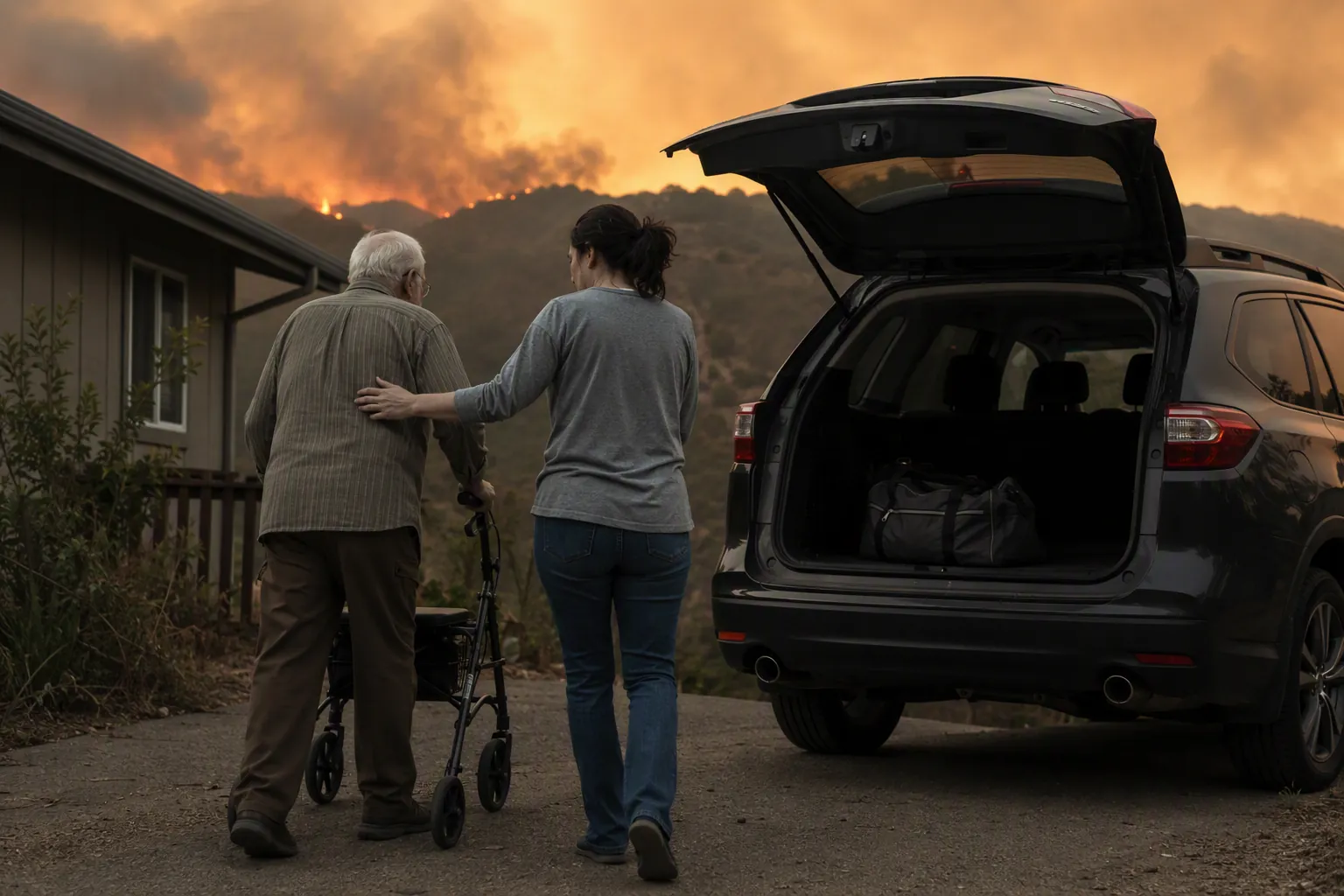
Start with the two jobs, not the bag
The evacuation bag still matters. It just should not be allowed to crowd out the harder plan. Medications, documents, chargers, device supplies, vehicle staging, and home-prep items belong in the companion wildfire evacuation checklist for seniors. This plan stays on the part that fails when everyone assumes a frail or cognitively impaired person can be moved like luggage.
| Track | What must be settled before the fire | Failure point it prevents |
|---|---|---|
| Mobility and transfer | Who helps the parent stand, transfer, exit, and load the walker or wheelchair; which exit is usable; which vehicle actually works | A parent stuck at a narrow doorway, on a step, beside a bed, or next to a vehicle that the caregiver cannot safely load |
| Dementia supervision | Who stays within sight and reach during the move and afterward; who tells shelter, hotel, facility, or relatives about the diagnosis; what happens if the person is missing | A parent left alone in a car, lobby, shelter, hallway, or unfamiliar room and then reported missing too late |
If one adult child is expected to do both jobs, the plan has to admit that. Driving, lifting, loading, answering evacuation alerts, managing pets, and keeping eyes on a parent with dementia are not the same task. A plan that assigns them all to one person may still be the best available plan, but it should be written that way so the weak point is visible before the smoke is.
Track one: get the parent from the room they are in to the vehicle they can use
Start in the room where your parent is most likely to be when an evacuation order comes: bed, recliner, bathroom, kitchen table, or a back bedroom. Then walk the route from that exact spot to the exact vehicle. Not the route you imagine. The real route, with the walker, wheelchair, cane, oxygen tubing, portable ramp, threshold, hallway furniture, throw rug, pet gate, and porch step included.
The U.S. Fire Administration gives a plain instruction that belongs near the top of this plan: walker and wheelchair users should check all exits to make sure they can fit through the doorways.[2] That is not a design detail. It decides whether the caregiver is moving a parent out of the home or improvising a lift at the worst possible moment.
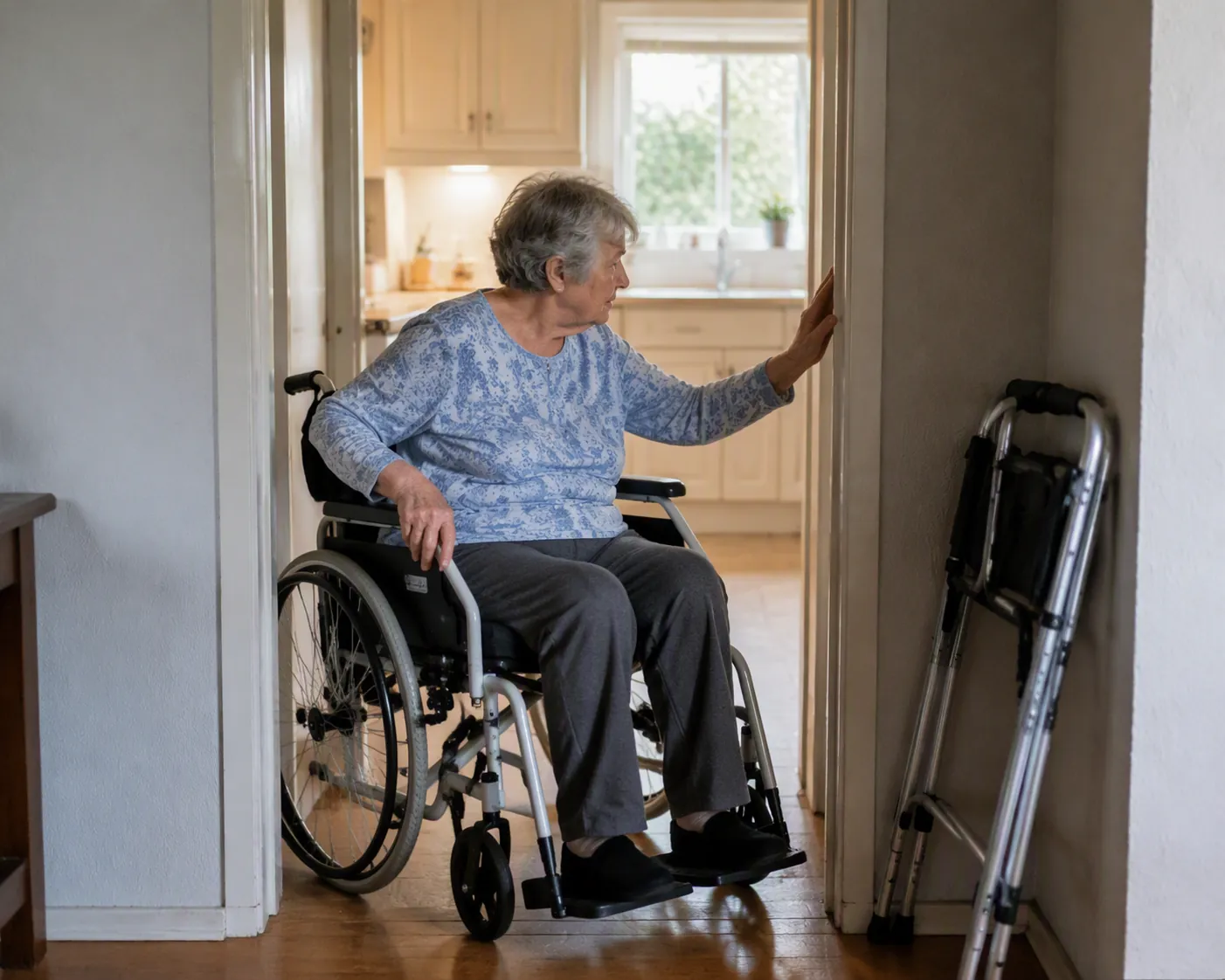
Test the exit with the device, not without it
A doorway that looks passable when a person is walking may not work for a wheelchair. A hallway that works in daylight may become a trip route when the power is out and the caregiver is rushing. A front door may be the widest exit but useless if there are steps and no ramp. A garage exit may look convenient until the walker has to be folded, lifted, and re-opened while the parent is standing unsupported.
Do the test slowly before fire season, then write down the usable exit. If there is only one realistic exit, treat it as critical equipment. Keep that path clear. Do not let boxes, laundry baskets, plant stands, pet supplies, or spare chairs migrate into it. If the best exit requires a portable ramp, the ramp needs a named person who knows where it is and how to place it.
The California Department of Aging recommends keeping walking aids close at all times and placing extra walking aids in different rooms.[3] That advice is especially practical for wildfire evacuation because the “right” walker is often parked in the wrong room. If your parent naps in the bedroom but spends evenings in the living room, a single walker by the front door is not enough. The aid has to be reachable from the place where evacuation begins.
Write the transfer plan as a physical handoff
“Mom can walk” is not a transfer plan. “Dad uses a walker” is not a transfer plan. The plan should say who helps the parent stand, who steadies the walker or wheelchair, who opens doors, who carries or folds the device, and who drives. If the driver is also the only person strong enough to assist with standing, then the driver cannot be warming up the car while the parent is still trying to get out of a chair.
Be honest about the difference between ordinary mobility and evacuation mobility. A parent may manage ten careful steps from bed to bathroom on a normal morning and still be unsafe crossing a sloped driveway while frightened, coughing, or disoriented. A spouse may be devoted and present but too frail to break a fall or lift a wheelchair into the back of an SUV. An adult daughter may be able to drive but not safely raise her father from the floor if he goes down at the threshold.
The vehicle deserves the same test as the doorway. Can the parent get into the seat without being lifted? If the parent uses a wheelchair, does the chair fold or load into the vehicle with the available helper? If the parent cannot step up into an SUV, is there a lower vehicle available? If the caregiver must choose between loading the walker and keeping one hand on a parent who is unsteady, the plan needs another person or a different sequence.
- Name the primary mover: the person who physically assists the parent from bed, chair, bathroom, or doorway.
- Name the driver: the person responsible for the route, fuel, keys, and vehicle positioning.
- Name the device handler: the person who folds, carries, loads, or retrieves the walker, wheelchair, cane, ramp, or transfer aid.
- Name the backup helper: the person called before conditions deteriorate if the primary helper cannot lift, steady, or drive.
- Name the no-go condition: the moment the caregiver stops trying to do it alone and calls emergency services or a prearranged neighbor, relative, or facility contact.
This article is not medical advice. If transfers, lifting, oxygen use, medication timing, or medical equipment create safety concerns, involve the parent’s clinician, home-health team, durable medical equipment provider, or local emergency planning contacts before fire season.
Leave while help is still easy to use
Early evacuation is not a moral performance. For a parent who needs physical assistance, it is a logistics tool. CAL FIRE’s Ready for Wildfire guidance advises leaving before a mandatory evacuation order when possible.[4] The California Department of Aging also tells older adults and people with medical or physical limitations to evacuate immediately when advised.[3]
Waiting removes options. The neighbor who could help lift may have left. The road that allowed a calm turn into the driveway may be crowded. The parent who could walk carefully at noon may be exhausted by evening. The adult child who could manage one slow transfer may now be doing it under an evacuation warning, with ash in the air and a phone that will not stop ringing.
The age pattern in recent wildfire tragedy is a blunt reminder of who pays when evacuation becomes difficult. AARP reported that only six of the 85 people killed in the 2018 Camp Fire were younger than 50.[5] That does not mean every older adult is unable to evacuate, and it does not mean age alone predicts an outcome. It does mean that a plan for an older parent with mobility limits deserves more than “we’ll go when they tell us.”
If your family already uses severe-weather planning tools, keep wildfire in the same practical category: movement under bad conditions. The same fall-risk thinking that applies in a tornado preparedness checklist for seniors or an earthquake evacuation checklist for elderly parents applies here too: the emergency changes the walking surface, the lighting, the timing, and the caregiver’s attention.
Track two: dementia evacuation requires continuous supervision
A parent with dementia should not be treated as “loaded” once they are in the car, checked in at a shelter, or settled in a relative’s spare room. Wildfire evacuation breaks routine. It adds noise, strangers, changed sleep, unfamiliar bathrooms, long waits, and anxious relatives. Those are exactly the conditions in which a person who seemed quiet can stand up and leave.
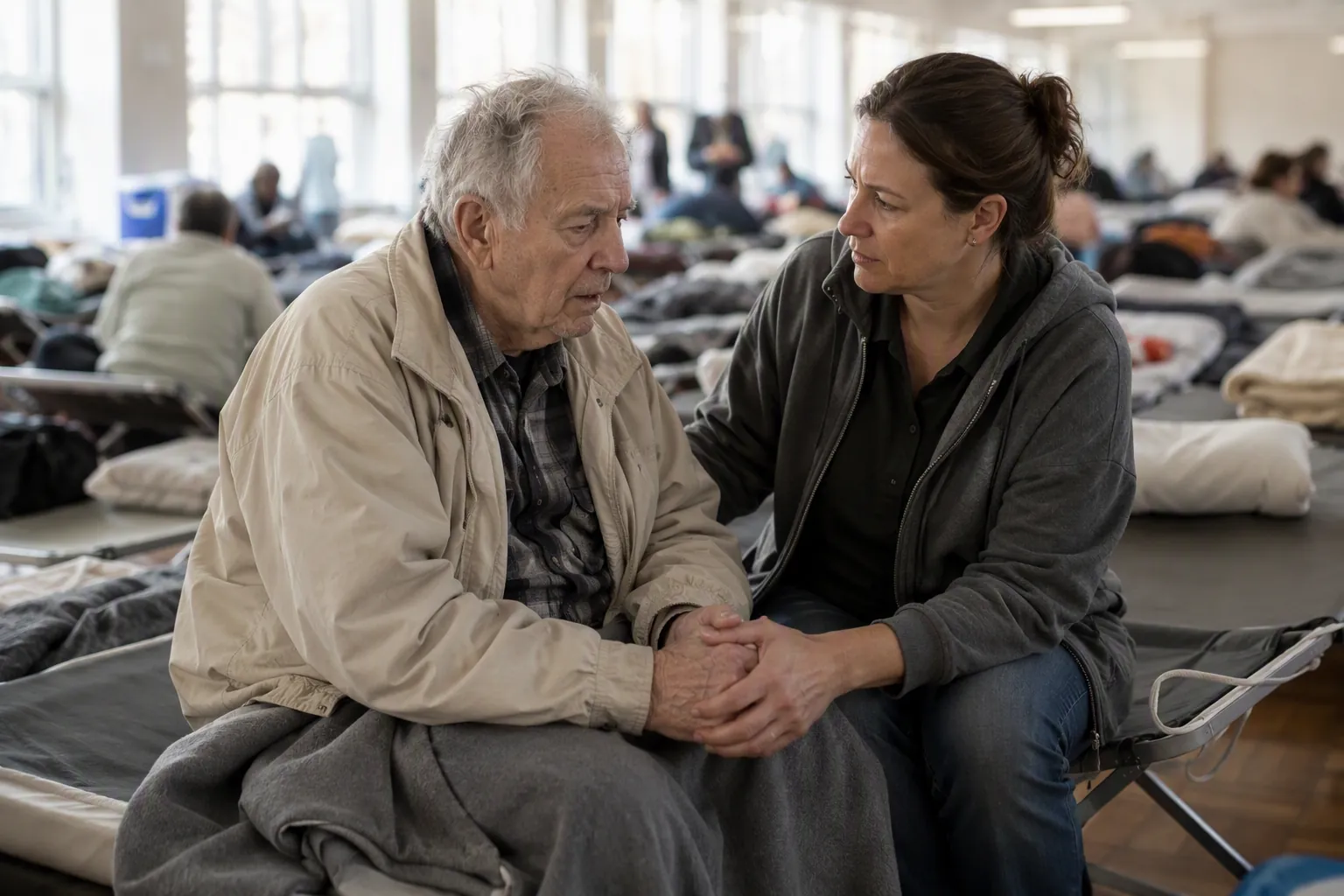
The first dementia evacuation rule is not complicated: the person is accompanied during the move and after the move. Do not leave them alone in the car while you check on a pet, register at a shelter, unload bags, talk to staff, use a restroom, or step into a hotel lobby. If one caregiver has to leave, another named person takes over before the first person walks away.
That handoff should be explicit enough to sound almost awkward: “You are watching Dad until I come back.” In a hotel room, shelter, or relative’s home, “watching” means within sight or close enough to intervene before the person reaches a door, hallway, parking lot, elevator, or crowd. A chair beside the exit is not supervision. A sleeping caregiver in the same room may not be supervision if the parent is prone to nighttime wandering.
Tell the unfamiliar people what they need to know
Shelter staff, hotel staff, neighbors, relatives, transportation volunteers, and facility workers cannot protect against a risk they do not know exists. The diagnosis does not have to be announced to everyone in the building, but the people controlling doors, rooms, transport, and check-in should know that the parent has dementia and may wander if left alone.
Use direct language. “She has Alzheimer’s and cannot be left by herself.” “He may try to leave if he thinks he is going home.” “Please do not give him directions to the parking lot; get me first.” That is more useful than “she gets confused sometimes,” which often sounds mild to people who have not seen what stress does to cognition.
For a fuller home wandering plan, caregiver liability questions, and technology options, use the site’s broader guides on what to do when an elderly family member is missing and on dementia wandering and legal liability. In a wildfire evacuation, keep the focus narrower: disruption, relocation, and handoffs create the risk.
Pre-commit to the missing-person response before anyone is missing
Families often lose time because everyone searches quietly at first. They check the bathroom, the hallway, the car, the front desk, the snack table, the next room, and then the same places again. In ordinary circumstances that delay is understandable. During an evacuation, it can be dangerous.
The Alzheimer’s Association’s disaster guidance is specific: search for 15 minutes, then call 911 if the person is not found. It also advises telling authorities that the person has Alzheimer’s disease and is a vulnerable adult, and notes that many states use Silver Alerts or similar public notification systems.[1]
- Search the immediate area briefly: bathroom, exit doors, parking area, lobby, nearby hallway, and last known location.
- At 15 minutes, call 911 if the person is not found.[1]
- Say the person has Alzheimer’s or dementia and is a vulnerable adult.[1]
- Tell staff or hosts immediately so doors, exits, cameras, sign-in desks, and transportation areas can be checked.
- Ask about the state’s Silver Alert or similar alert process; activation rules vary by state.
State alert systems are not identical. Some states use Silver Alerts, Florida uses a Purple Alert for certain missing adults, and eligibility rules differ. For the state-by-state distinction, see the site’s Purple Alert vs. Silver Alert explainer. The wildfire plan does not need to master every statute; it needs the family to call quickly and use the right vulnerability language.
If your parent lives in assisted living or a nursing home
Facility residence does not remove the adult child from the plan. It changes the questions. AARP’s emergency-planning guidance for assisted living and nursing home residents points caregivers toward the operational issues that matter: who evacuates the resident, how residents who cannot walk are moved, whether generators are available, how medications are administered, what staffing looks like, and how families are contacted.[5]
- Who is assigned to evacuate my parent if they cannot walk out?
- How are wheelchair users, bedbound residents, or residents needing transfer help moved to transportation?
- What happens if the facility loses power, and what generator capacity supports medical or safety needs?
- Who administers medications during transport and after relocation?
- What staff-to-resident coverage is planned during evacuation?
- How and when will the family be told where the resident has been taken?
- If my parent has dementia, who is responsible for supervision during loading, transport, arrival, and temporary housing?
Ask these questions before fire season and again after any change in mobility, cognition, staffing, or facility ownership. A glossy binder at the front desk is not the same as knowing which staff member notices that your parent cannot self-transfer, cannot follow shouted directions, or will walk away if left in a hallway.
Rehearse the part everyone hopes will be obvious
A rehearsal does not need to be theatrical. It can be one calm afternoon when the caregiver asks the parent to move from the usual chair to the vehicle using the planned route. Time is less important than friction. Where does the walker catch? Which door swings the wrong way? Can the parent step off the porch? Does the wheelchair fit through the side door but not the front door? Does the caregiver need both hands for the parent and a third hand for the device?
For a parent with dementia, rehearse the supervision handoff among caregivers even if the parent is not asked to practice. Who sits beside them in the car? Who stays with them at check-in? Who watches them while the driver unloads? Who sleeps closest to the door at a relative’s house? Who has permission to tell staff, “He has dementia and cannot be left alone”?
If your parent lives alone, add the movement details to an emergency evacuation checklist for seniors living alone. If declining strength or balance is the deeper issue, work from the broader guide to helping aging parents maintain mobility and independence. Wildfire planning exposes mobility problems that were already there; it does not politely wait for them to be solved.
The plan is ready when a named person can move your parent through a verified exit into a workable vehicle, with the needed mobility aid traveling too. For a parent with dementia, it is ready only when another named protocol keeps that parent supervised through the evacuation, the drive, the shelter or hotel arrival, and the unfamiliar days that may follow.
References
- In a Disaster — Alzheimer’s Association
- Older Adults — U.S. Fire Administration
- Disaster Tip Sheets — California Department of Aging
- Go! Evacuation Guide — Ready for Wildfire
- Preparing for an Emergency — AARP
Related reading
Noticed something outdated or inaccurate on this page? Flag a correction. We review every report against CDC, NIA, and AARP HomeFit guidance before updating a page.
Part of the Fall Prevention section.