
Caregiver decision guide
Dementia Care Options: A Stage-Based Guide to Choosing the Right Level of Support
This guide helps family caregivers of a parent or spouse recently diagnosed with Alzheimer's or dementia understand how care needs evolve across disease stages. It maps the Alzheimer's Association's care options framework — from in-home companion care and adult day programs to memory care, skilled nursing, and hospice — to the early, middle, and late stages of dementia, providing cost data, quality signals, and a proactive planning framework.
Dementia Changes Everything — and It Keeps Changing
A dementia diagnosis reshapes a family in an instant. But the hardest part for most caregivers is what comes next: the slow, relentless evolution of the disease. What works today — a few hours of companion care, a weekly adult day program — will be inadequate in six months. The care arrangement that feels stable in the early stage will unravel as middle-stage symptoms emerge. This is not a failure of planning. It is the nature of the disease.
The single most important shift a family caregiver can make is to stop thinking of dementia care as a one-time decision and start thinking of it as an evolving sequence. Each stage of Alzheimer's disease and related dementias brings distinct care needs, distinct safety concerns, and distinct financial implications. Planning proactively — rather than reacting to a crisis — is the difference between choosing a care setting on your terms and accepting whatever bed is available after a hospitalization or a wandering incident.
This guide uses the Alzheimer's Association's three-stage model — early, middle, and late — as its organizing framework. For each stage, we map the appropriate care options from the full spectrum recognized by the Association: in-home care, adult day centers, assisted living, memory care, skilled nursing, respite care, and hospice. The goal is not to prescribe a single path but to give you a roadmap so you can see what is coming and make informed decisions before urgency forces your hand.
The Alzheimer's Association Care Options Framework
Before mapping options to stages, it helps to understand the full landscape. The Alzheimer's Association organizes dementia care into five broad categories, each serving a different purpose along the disease trajectory:
- In-Home Care: Companion care (non-medical assistance with daily activities), personal care (bathing, dressing, toileting), and skilled home health care (nursing or therapy services). Allows the person to remain in a familiar environment.
- Adult Day Centers: Structured programs offering socialization, meals, and activities in a supervised setting during daytime hours. Provides essential respite for family caregivers.
- Long-Term Care: A spectrum that includes assisted living (help with daily tasks but not intensive medical care), memory care (specialized secured units for dementia), and skilled nursing facilities (24-hour nursing care for complex medical needs).
- Respite Care: Short-term relief for primary caregivers, ranging from a few hours of in-home help to short stays in a residential facility. Critical for preventing caregiver burnout.
- Hospice Care: Comfort-focused end-of-life care that prioritizes quality of life and symptom management over curative treatment. Available in-home or in a facility.
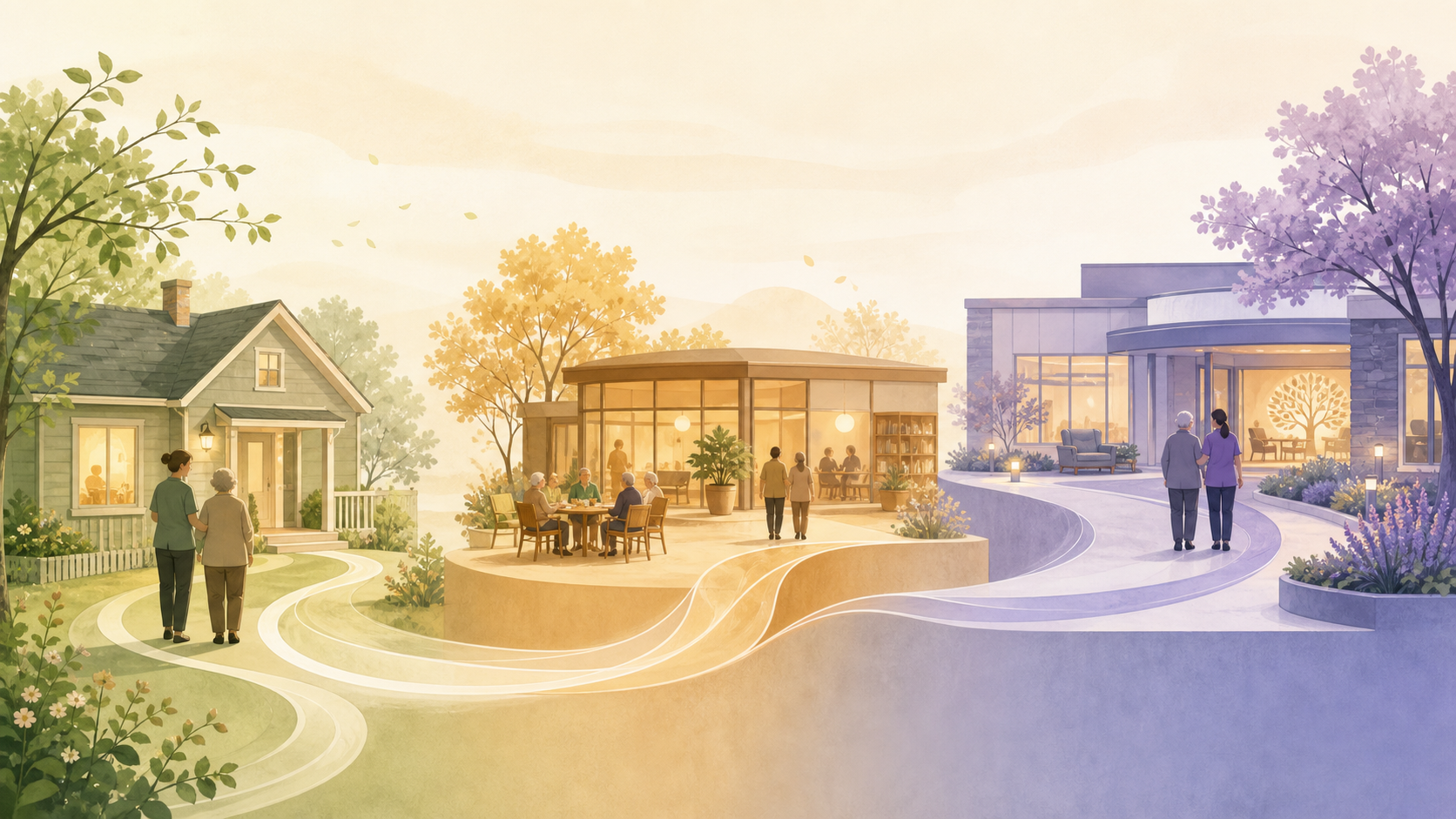
The Alzheimer's Association recommends a progressive approach: start with the least restrictive setting that meets current needs — typically in-home care — and transition to more structured environments as the disease advances. The following sections apply this framework to each stage.
Early-Stage Dementia: In-Home Care, Adult Day Programs, and Geriatric Care Management
In the early stage, the person with dementia can still perform most activities of daily living independently or with minimal cues. Memory lapses are noticeable but do not yet prevent safe functioning at home. This is the window for proactive planning — not crisis management.
In-Home Companion and Personal Care
For most families, the first formal care intervention is a few hours of in-home companion care per week. A companion can provide meal preparation, light housekeeping, medication reminders, and companionship — tasks that reduce the caregiver's load while allowing the person with dementia to remain in their own home. As needs increase, personal care aides can assist with bathing, dressing, and grooming.
The national median cost of non-medical home care in 2026 is $34 per hour according to A Place for Mom's analysis of actual costs paid by more than 24,000 residents in their network, and $35 per hour per CareScout's 2025 Cost of Care survey. At 15 hours per week — a common starting point — that translates to roughly $2,208 per month. At 30 hours per week, it rises to approximately $4,416 per month.
For a detailed breakdown of companion care versus personal care versus skilled home health — and how to choose the right type for a parent with dementia — see our guide on choosing home care for a parent with dementia.
Adult Day Centers
Adult day centers provide structured socialization, meals, and activities in a safe, supervised environment during daytime hours. For early-stage dementia, they serve two purposes: they keep the person cognitively engaged and socially connected, and they give the family caregiver a predictable block of time each day or week to work, rest, or attend to other responsibilities.
The national average cost for adult day services is approximately $95 per eight-hour day (U.S. News, 2026). For a family using adult day two days per week, that is roughly $760 per month — significantly less than the cost of in-home care for the same hours, and a fraction of the cost of residential care.
For a full decision framework on when adult day makes sense and how to evaluate centers, see Adult Day Care as a Middle-Ground Solution.
Geriatric Care Management
A geriatric care manager — typically a social worker, nurse, or gerontologist — can assess the person's current needs, coordinate services, and help the family navigate the care system. This is especially valuable for long-distance caregivers who cannot be on-site to evaluate providers or monitor care quality. The Alzheimer's Association includes geriatric care management as a resource within its care options framework, particularly for families in the early stage who are building their care team for the first time.
| Care Option | Typical Monthly Cost (2026) | Best For |
|---|---|---|
| In-home companion care (15 hrs/wk) | ~$2,208 | Families starting with minimal support |
| In-home personal care (30 hrs/wk) | ~$4,416 | Increasing assistance with ADLs |
| Adult day center (2 days/wk) | ~$760 | Social engagement + caregiver respite |
| Geriatric care manager | Varies ($100–$200/hr) | Care coordination and planning |
Middle-Stage Dementia: Assisted Living, Memory Care, and Respite for Caregivers
The middle stage is where dementia care becomes truly demanding. Cognitive decline is more pronounced: the person may need help with multiple activities of daily living, may wander, may experience sundowning or agitation, and may no longer be safe at home alone for extended periods. This is the stage where most families begin considering residential care.
Assisted Living vs. Memory Care
Standard assisted living communities provide help with daily tasks, meals, housekeeping, and social activities — but they are not designed for the specific needs of someone with moderate to advanced dementia. Memory care units, by contrast, are secured environments with staff trained in dementia care, structured daily routines, and activities designed to reduce confusion and engage remaining cognitive function.
The cost difference is substantial. The national median for assisted living in 2026 is $5,419 per month (A Place for Mom) to $6,200 per month (CareScout). Memory care adds a 20–30% premium, bringing the national median to $6,690 per month (A Place for Mom) or $7,645 per month (U.S. News).
For families considering whether 24/7 home care or memory care is the better option, the cost comparison is instructive. At $34–$35 per hour, 24/7 in-home care (168 hours per week) costs approximately $5,544 per week — or more than $22,000 per month. Memory care at $6,690–$7,645 per month is dramatically less expensive for round-the-clock support. Our 24-hour home care vs. memory care decision guide walks through this comparison in detail.
Respite Care as a Bridge
The middle stage is also when caregiver burnout becomes a serious risk. Respite care — whether a few hours of in-home help per week or a short-term stay in a residential facility — is not optional; it is essential for sustaining the caregiver's ability to provide care. The Alzheimer's Association includes respite care as a standard component of its care options framework, and for good reason: caregivers who do not take breaks are far more likely to experience health problems of their own, which ultimately leads to earlier and more crisis-driven placement.
| Care Option | Typical Monthly Cost (2026) | Key Differentiator |
|---|---|---|
| Assisted living | $5,419–$6,200 | Help with ADLs, but not dementia-specialized |
| Memory care | $6,690–$7,645 | Secured environment, specialized staff training |
| 24/7 in-home care | $22,000+ | One-on-one care at home, highest cost |
| Respite care (in-home) | $34–$35/hr | Short-term relief for family caregivers |
For guidance on recognizing the signs that it is time to transition to memory care, see 10 Signs It's Time for Memory Care.
What to Look for in a Memory Care Community
Not all memory care communities are created equal. When evaluating facilities, focus on the factors that directly affect quality of life and safety for someone with dementia — not on amenities like granite countertops or a swimming pool.
The Critical Quality Differentiators
- Staff training in dementia care: This is the single most important factor. Staff should have ongoing training in communication techniques for dementia, non-pharmacological behavior management, and recognizing changes in condition. Ask what specific dementia training staff receive and how often it is updated.
- Staff-to-resident ratios: Lower ratios mean more individualized attention. For memory care, a ratio of 1:5 or better during daytime hours is a reasonable benchmark. Ask about night-time ratios as well — sundowning and sleep disturbances are common in middle-to-late stage dementia.
- Secured environments: Wandering is one of the most dangerous dementia behaviors. The community should have secured exits, alarmed doors, and a layout that allows safe wandering without risk of leaving the building. For more on wandering prevention, see our guide on understanding wandering in dementia.
- Structured daily routines: Predictable schedules reduce anxiety and confusion for people with dementia. Look for communities that offer structured programming throughout the day — not just activities but also consistent mealtimes, rest periods, and engagement opportunities.
- Sensory and cognition-focused activities: The best memory care programs offer activities designed to engage remaining cognitive abilities — music therapy, art programs, reminiscence therapy, gentle exercise, and sensory stimulation. These are not optional extras; they are core components of quality dementia care.
The Joint Commission Memory Care Certification
The Alzheimer's Association recommends looking for communities that have earned The Joint Commission Memory Care Certification. This certification indicates that the facility has undergone a rigorous evaluation of its dementia care practices, including staff training, resident assessment, care planning, and safety protocols. While certification does not guarantee perfect care, it is a strong signal that the community takes dementia care seriously enough to submit to external review.
For families dealing with specific middle-stage behaviors like sundowning, agitation, or sleep disturbances, our guide to sundowning and overnight dementia care provides practical strategies for managing these challenges at home or in a residential setting.
Late-Stage Dementia: Memory Care with Specialized Security, Skilled Nursing, and Hospice
In late-stage dementia, the person requires extensive assistance with all activities of daily living. They may be bed-bound or chair-bound, unable to communicate verbally, and at high risk for infections, pressure ulcers, and aspiration. Safety concerns — particularly wandering and fall risk — are acute.
Memory Care with Specialized Security
For many families, the late stage means remaining in a memory care community that can provide an even higher level of supervision and personal care. The secured environment that was important in the middle stage becomes essential now: wandering remains a risk even in late-stage dementia, and the person may not recognize danger. Memory care communities with specialized security features — alarmed exits, enclosed outdoor areas, and continuous monitoring — are the standard of care at this stage.
For families facing a crisis situation where home is no longer safe, the Crisis-to-Plan Transition Guide for Dementia Caregivers provides step-by-step guidance on making an emergency move to a safer setting.
Skilled Nursing Facilities
When the person with dementia develops complex medical needs — such as difficulty swallowing, recurrent infections, or significant weight loss — a skilled nursing facility (nursing home) may become necessary. These facilities provide 24-hour nursing care, three meals a day, assistance with all daily activities, and rehabilitation services.
The cost is substantial. The national median for a semi-private nursing home room in 2026 is $9,581 per month, while a private room averages $10,798 per month (U.S. News, citing CareScout data). Only about 5% of older Americans live in nursing homes at any given time, but dementia is the leading reason for skilled nursing placement among those who do.
Hospice Care
When the disease has progressed to the point where curative treatment is no longer appropriate, hospice care focuses on comfort, dignity, and quality of life. Hospice can be provided in the person's home, in a memory care community, or in a skilled nursing facility. The Alzheimer's Association includes hospice as a standard care option in its framework, and Medicare's hospice benefit covers the full cost for eligible individuals.
| Care Option | Typical Monthly Cost (2026) | When to Consider |
|---|---|---|
| Memory care (late-stage) | $6,690–$7,645 | Advanced dementia with high supervision needs |
| Skilled nursing (semi-private) | $9,581 | Complex medical needs requiring 24/7 nursing |
| Skilled nursing (private) | $10,798 | Complex medical needs + preference for private room |
| Hospice care | Covered by Medicare | End-of-life comfort care, no curative treatment |
Paying for Dementia Care: Medicare, Medicaid, and VA Benefits
Financing dementia care is one of the most complex and stressful parts of the caregiving journey. The following overview covers the major payment sources, but it is essential to verify your specific situation with a professional — rules vary by state and by individual circumstances.
Medicare
Medicare covers only short-term skilled nursing care following a qualifying hospital stay (up to 100 days) and limited home health visits. It does not cover long-term custodial care, assisted living, memory care, or 24/7 in-home care. This is the single most important financial fact for dementia caregivers to understand: the care that most people with dementia need — help with bathing, dressing, eating, and supervision — is not covered by Medicare.
Medicaid
Medicaid is the single largest payer of long-term care in the United States. It covers nursing home care for individuals who meet strict income and asset limits. Some states also offer Home and Community-Based Services (HCBS) waivers that can help pay for in-home care, adult day services, or memory care — but availability and eligibility vary significantly by state.
VA Aid & Attendance Benefits
For veterans and surviving spouses who qualify, the VA Aid & Attendance pension benefit can provide significant financial assistance for dementia care. In 2026, eligible single veterans can receive up to $2,424 per month; married veterans up to $2,874 per month; and surviving spouses up to $1,558 per month. These funds can be used to offset the cost of in-home care, assisted living, or memory care.
| Payment Source | Covers Dementia Custodial Care? | Key Limitation |
|---|---|---|
| Medicare | No | Only short-term skilled nursing and limited home health |
| Medicaid | Yes (nursing home); varies (HCBS waivers) | Strict asset limits; 5-year look-back; state-specific |
| VA Aid & Attendance | Yes (up to $2,424–$2,874/mo) | Requires qualifying military service; application process |
| Private pay / LTC insurance | Yes | Requires personal assets or qualifying policy |
Behavior Management and Communication Across Stages
The care setting you choose must be capable of supporting the behavioral and communication challenges that emerge at each stage. This is not a secondary consideration — it is often the deciding factor in whether a placement succeeds or fails.
- Early stage: The person can still participate in conversations and decisions. Care settings should support cognitive engagement and social connection. In-home caregivers and adult day staff should be trained in validation techniques — acknowledging the person's reality rather than correcting or arguing.
- Middle stage: This is where challenging behaviors emerge — wandering, sundowning, agitation, repetitive questioning, and sleep disturbances. The care setting must have staff trained in non-pharmacological behavior management and a physical environment that supports safety without over-restriction. Memory care communities are designed for this stage. For detailed strategies, see our guides on wandering and sundowning.
- Late stage: Verbal communication may be minimal or absent. Care focuses on comfort, dignity, and non-verbal communication — touch, tone of voice, music, and familiar routines. Staff in skilled nursing and hospice settings should be trained in pain assessment for non-verbal individuals and in providing comfort care.
The choice of care setting at each stage should be guided not only by cost and location but by whether the setting can meet the behavioral and communication needs that are present — and those that are coming. A memory care community with strong dementia-trained staff and a low staff-to-resident ratio will serve a family far better than one with nicer amenities but less expertise.
Questions to bring to a clinician or OT
This is not medical, legal, or a family's final decision — only a framework. Bring these questions to a clinician, occupational therapist, or your local Area Agency on Aging.
Find Local HelpRelated reading
- Choosing Home Care for a Parent with Dementia: Companion, Personal, Adult Day, or Skilled Care
- Senior Health Care Services: A Family Guide to the Full Continuum of Care
- ACASA Senior Care vs. Visiting Angels vs. Comfort Keepers vs. Home Instead: How to Choose Between National Franchise Home Care Providers
Noticed something outdated or inaccurate on this page? Flag a correction. We review every report against CDC, NIA, and AARP HomeFit guidance before updating a page.